
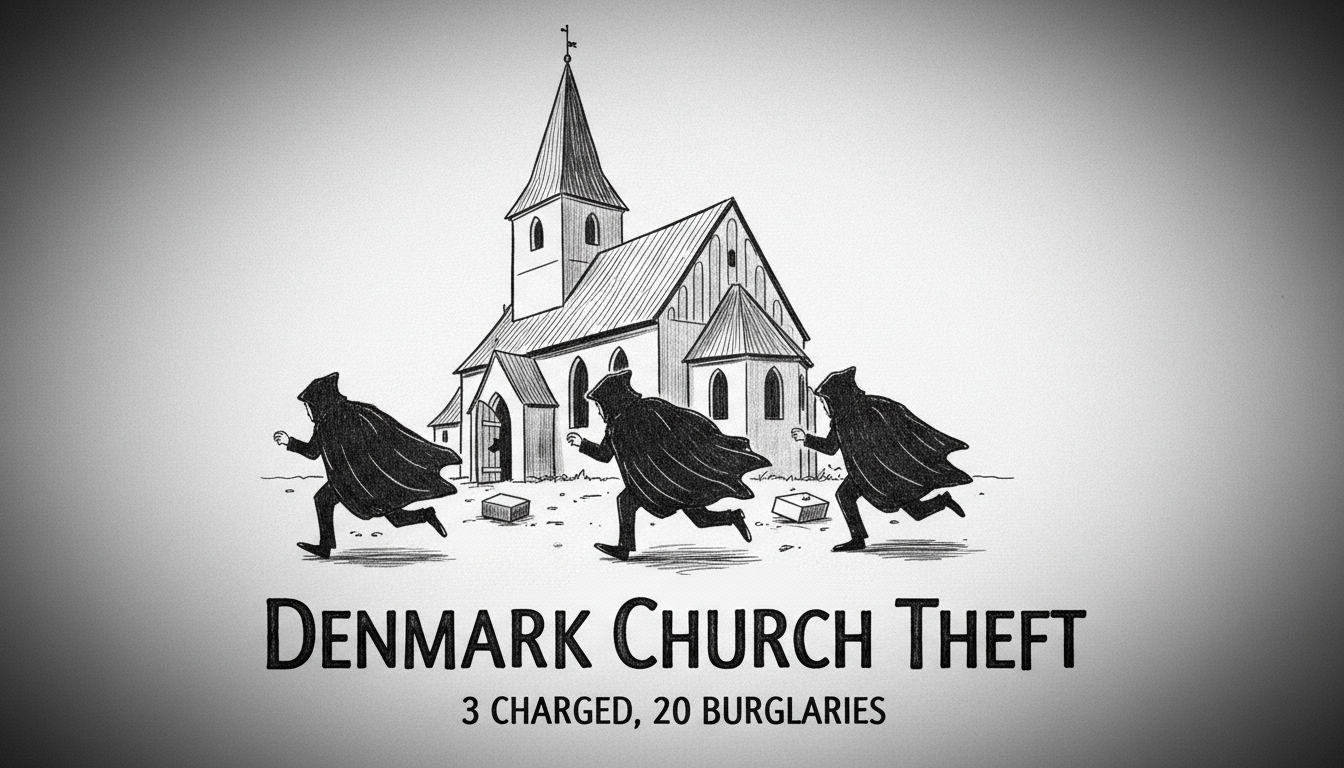
Denmark church theft has seen three individuals charged with a series of burglaries targeting 20 religious buildings across the country. The total value of stolen goods is estimated at half a million kroner, highlighting a persistent crime wave against vulnerable cultural institutions. This case opens a window into the complex security challenges facing Denmark's historic churches, which are deeply woven into the fabric of Danish society and its welfare model of public access.
For many Danes, the local church is more than a place of worship. It functions as a quiet community center, a historical landmark, and a symbol of cultural continuity. The theft of artifacts from 20 such spaces represents a violation that resonates on multiple levels. It is a property crime with significant financial impact, but also an attack on shared heritage and local identity. In a nation where the Evangelical Lutheran Church is the state church, these buildings hold a unique, protected status yet remain physically open and accessible by design.
The Scale of the Alleged Crime Spree
Police have formally accused two men and one woman of carrying out the coordinated burglaries. While specific details of the stolen items are not yet public, a valuation of 500,000 Danish kroner suggests the theft of more than petty cash. Church targets often include historical silver communion sets, antique candlesticks, collection boxes, and sometimes valuable artwork. The operational scale—targeting 20 separate locations—indicates a level of planning and repetition that alarms both authorities and congregational leaders.
Such crimes create a difficult balance for parish councils. Their mandate is to keep churches open as welcoming, reflective spaces for all, a principle aligned with Denmark's social policy of inclusive public institutions. Yet this openness makes them vulnerable. Installing robust security systems in centuries-old buildings is often technically challenging and prohibitively expensive for small congregations. The financial loss from theft can directly impact a parish's ability to maintain its building and fund community activities.
Cultural Loss in a Secular Society
The impact of these thefts extends beyond insurance claims. "When a historic chalice or baptismal font is stolen, we lose a tangible link to our community's past," explains a curator from the National Museum's church department, who asked not to be named as the case is active. "These objects are often irreplaceable, carrying stories of local families and traditions. Their monetary value is secondary to their cultural and emotional significance."
This sentiment touches on a paradox in modern Danish society. While regular church attendance is low, a majority of Danes are still members of the state church, and these buildings are widely regarded as public cultural heritage. They are venues for concerts, civic ceremonies, and quiet contemplation, serving a broad social function beyond religion. A burglary, therefore, feels like a theft from the entire community, not just the congregation. It undermines the trust and safety that are cornerstones of the Danish welfare model.
The Security Dilemma for Open Churches
Denmark's tradition of the 'open church'—where buildings are unlocked for visitors throughout the day—is now under pressure. This practice reflects a societal trust that is increasingly tested. "We are constantly evaluating our security measures," says a parish priest from a rural municipality in Jutland that has experienced previous thefts. "But locking the door goes against everything we believe in. The church should be a sanctuary, a freely available place of peace. We refuse to let criminals dictate how we operate."
Security experts consulted for this article suggest layered, discreet approaches. These can include improved lighting, the secure anchoring of valuable objects, and modern alarm systems that do not detract from a church's aesthetic. Some parishes have also increased community vigilance, encouraging local residents to keep a casual eye on the building. However, funding for such upgrades is uneven, often depending on the wealth of the individual parish or grants from cultural heritage funds, creating a postcode lottery for church security.
Broader Trends and Police Response
Comprehensive national statistics on church burglaries are not centrally aggregated in a public format. Anecdotal evidence from police districts and church authorities, however, suggests these crimes are cyclical, often linked to the market value of precious metals. When silver prices rise, thefts of ecclesiastical silverware tend to follow. The current case, given its high number of targets, may represent a significant spike in such activity.
The police investigation leading to these charges likely involved cross-district cooperation, as the 20 churches were probably spread across multiple jurisdictions. Successful prosecution will depend on linking the accused to each specific location, through evidence such as forensic data, witness testimony, or recovered stolen goods. A conviction could result in significant prison sentences, given the aggregated value and the cultural nature of the targets.
The Human and Community Cost
For volunteer parish council members, often elderly, dealing with the aftermath of a burglary is a distressing burden. Beyond the paperwork and police reports, there is a palpable sense of violation. "It feels personal," shares a council member from a village near Copenhagen, whose church was robbed last year. "We are custodians of this building for our community. When thieves break in, they steal from our neighbors, from our history. It takes a long time to feel safe again."
The financial cost also hits hard. Many smaller parishes operate on tight budgets. A loss of several thousand kroner from a stolen collection box or the insurance deductible on a stolen artifact can mean cancelling a youth group outing or delaying essential repairs. This directly impacts the church's social role, subtly eroding the very community services that help bind Danish society together.
A Look Forward: Preservation vs. Accessibility
This case forces a necessary conversation about preserving Denmark's vast religious heritage in an open society. The Danish model succeeds because of high levels of social trust. When that trust is exploited, the instinct is to retreat, to lock doors and install cameras. Yet doing so would fundamentally alter the character of these public spaces and contradict the social policy of inclusive access.
The path forward likely requires smarter investment and community partnership. National or regional funds dedicated to securing cultural heritage could be strengthened. Local police could increase sporadic patrols of rural church grounds. Perhaps most importantly, fostering a stronger sense of collective ownership among all citizens—church members or not—can be a powerful deterrent. When a church is seen as everyone's responsibility, it becomes harder to target.
Will Denmark find a way to protect its vulnerable churches without sacrificing their open-door philosophy? The trial of these three individuals will address a specific crime spree, but the larger question of safeguarding community anchors remains. The true value of what was taken from those 20 churches cannot be measured in kroner alone. It is measured in the shaken trust of a community and the ongoing challenge of preserving open, welcoming spaces in a changing world. The verdict will be about more than guilt; it will be a moment to reflect on what we value and how we choose to protect it.