
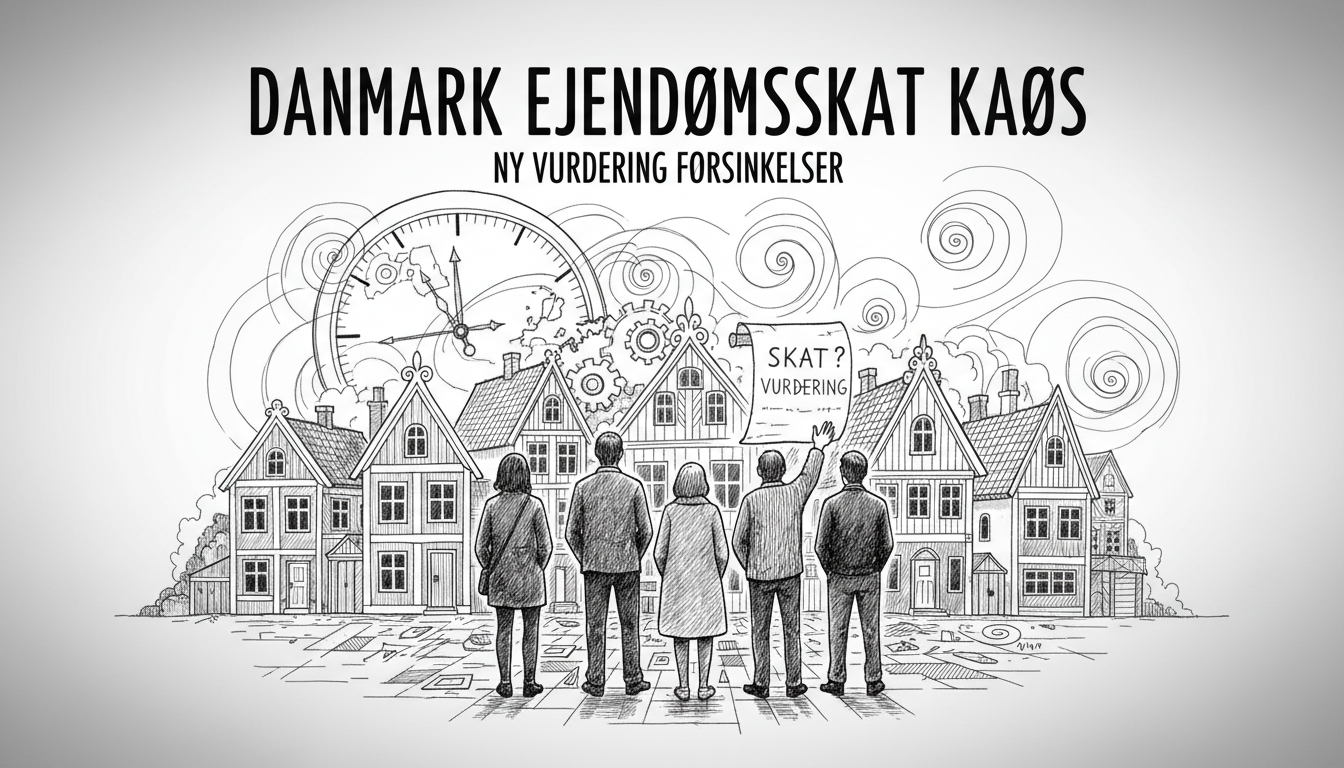
Denmark property tax chaos is deepening as homeowners face further delays in receiving crucial new valuations. The already troubled rollout of a nationwide property assessment system has hit another significant setback, leaving families and investors in financial limbo. This latest postponement impacts the final valuations for 2022, which are only now being issued, creating uncertainty for millions of property owners across the country. The situation highlights a critical tension within the Danish welfare system, where the need for fair taxation clashes with administrative capacity.
A System Under Strain
The core of the crisis lies in the transition from an old, discredited system to a new, complex model. The previous property valuation framework was plagued by widespread inaccuracies and faced numerous legal challenges. Homeowners frequently disputed assessments they believed were unfair, clogging the system with appeals. The new system was designed to correct these flaws by using updated data and more sophisticated modeling to determine a property's market value. Its implementation, however, has proven far more difficult than anticipated. The complexity of accurately valuing every single property in Denmark—from Copenhagen apartments to rural farmhouses—has overwhelmed the process. Experts point to the sheer scale of the task and the demand for transparency as primary causes for the repeated delays.
This administrative breakdown has real consequences for Danish society. Property valuations are not abstract numbers; they directly determine property tax (ejendomsskat) and wealth tax (formueskat) liabilities. Without a final, official assessment, homeowners cannot accurately plan their annual finances. Some may be setting aside insufficient funds for a future tax bill, while others might be overpaying based on outdated figures. The delay also freezes the housing market to a degree, as potential buyers and sellers lack a clear, government-assessed benchmark for a property's value. This uncertainty undermines the efficient functioning of one of the economy's most important sectors.
The Human Cost of Bureaucratic Delay
Behind the policy failure are individual stories of frustration and planning paralysis. Consider a family in Aarhus hoping to refinance their mortgage to fund a renovation. Banks require an official property valuation to approve the loan. With the new assessment delayed indefinitely, their project is stuck. A retiree in North Jutland, living on a fixed pension, anxiously awaits her valuation to know if her annual property tax will jump, potentially threatening her ability to stay in her home. These are not hypothetical scenarios but daily realities created by the systemic delay.
The issue also raises questions about equity and trust in public institutions. The Danish social contract is built on a high level of trust and a belief that the system is fundamentally fair. When a core function like property valuation—a direct input into taxation—falters, that trust erodes. Homeowners who have complied with all rules and paid taxes on time feel penalized by a government process they cannot control. This sentiment is particularly acute for younger first-time buyers and immigrants navigating the Danish system, for whom such instability can feel disproportionately disruptive.
Local municipalities, which rely on these valuations to calculate local tax rates (kommuneskat), are also operating with outdated data. This can lead to budgetary uncertainties, potentially affecting planning for local services from schools to elderly care. The ripple effects of the central government's valuation delays extend into the very fabric of local community governance, demonstrating how interconnected these systems truly are.
Expert Analysis: A Crisis of Capacity
Financial and policy analysts observing the situation identify a clear pattern. "The ambition for a perfectly accurate and fair system is laudable, but the execution has been a case of classic administrative overreach," says Lars Mikkelsen, a senior economist with a focus on housing policy. "The government underestimated the data processing power, the manpower, and the time required to value over 2.5 million properties with new parameters. They are trying to build the plane while flying it, and passengers are getting nervous."
Mikkelsen and other experts suggest the solution may require a significant reallocation of resources. This could mean hiring and training many more assessors, investing in more powerful data analytics infrastructure, or even temporarily simplifying the valuation model to get initial assessments out faster, with refinements to follow. The current path of indefinite delay, they argue, is the worst option, damaging public confidence and creating a growing backlog that becomes harder to clear.
Some experts also point to a potential political dimension. Property tax is a sensitive issue, and a new valuation system was always going to produce winners and losers. Homes in areas that have seen rapid price appreciation may face higher tax bills. The continuous delays could be seen, perhaps cynically, as a way to push these politically difficult announcements further into the future. However, this strategy risks a larger backlash when the valuations finally do arrive, especially if they are accompanied by retroactive tax calculations.
Looking Ahead: Searching for Solutions
The government now faces mounting pressure to provide a clear, revised timeline and a concrete plan to resolve the backlog. Simply acknowledging further delays is no longer sufficient. Homeowner associations and industry groups are calling for interim measures, such as provisional valuations that can be used for financial planning, with the understanding they may be adjusted later. They also demand clear communication about whether delayed valuations will affect tax bills for previous years, a prospect that causes significant anxiety.
The fundamental question for Danish policymakers is how to balance perfection with practicality. Does the pursuit of a theoretically flawless valuation system justify years of operational chaos and public distrust? Or is it time to adopt a more pragmatic, phased approach that delivers functional assessments now and refines them over time? The answer will define not only the future of Denmark's property tax system but also public faith in the state's ability to manage complex, nationwide reforms.
For now, Danish homeowners are left waiting. They watch as another deadline passes, their financial plans held hostage by a spreadsheet somewhere in a government office. The promise of a fairer system rings hollow when the system itself fails to deliver any answer at all. The resolution of this crisis will be a key test of Denmark's famed administrative competence, proving whether its systems can adapt under pressure or if they are buckling under their own complexity.