
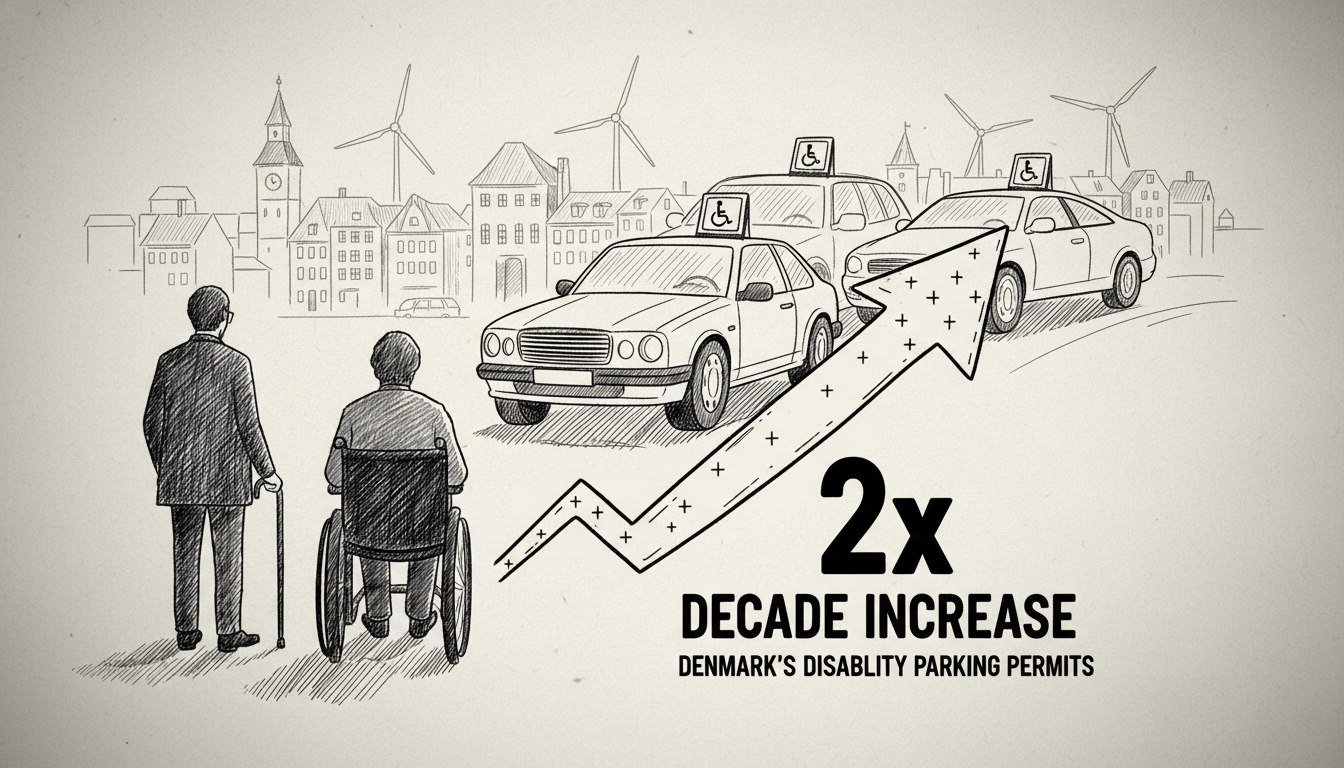
Denmark's disability parking permits have doubled in ten years, sparking a national debate over accessibility, system integrity, and aging populations. The Danish Disability Organisations now issue twice as many handicap parking cards as they did a decade ago. This sharp increase sits at the heart of a growing controversy, pitting calls for greater accessibility against warnings of potential system misuse.
A leading doctor has publicly questioned whether a conflict of interest exists within the permit-issuing process. The concern centers on the financial link between the card-issuing organizations and the medical professionals who provide the necessary health assessments. "When the organization issuing the card also has a financial relationship with the doctors who confirm the disability, it demands the highest level of scrutiny," said a Copenhagen-based GP who wished to remain anonymous. He argues this structure requires transparent oversight to maintain public trust.
Mikael Halby, director of the Danish Disability Organisations, firmly rejects these allegations. "There is absolutely no conflict of interest," Halby stated in an interview. He attributes the rising numbers to positive societal trends. "We are seeing two clear factors. First, Denmark's population is aging, leading to more age-related mobility impairments. Second, we have successfully reduced the stigma around seeking help. People are more willing to apply for the support they are legally entitled to."
A System Built on Trust
The Danish system for disability parking permits is unique in its decentralization. Unlike many countries where a government agency handles issuance, this task is delegated to the non-profit Danish Disability Organisations. Applicants must have their need certified by a medical doctor, who confirms a significant and permanent mobility impairment. The organization then processes the application and issues the blue EU parking card, which grants the holder the right to park in designated spaces.
This model is praised for its user-centric approach but relies heavily on the integrity of each step. "The entire Danish welfare model is built on trust," says Karen Højgaard, a social policy researcher at Roskilde University. "We trust citizens to claim benefits correctly, and we trust professionals to assess needs fairly. When numbers shift dramatically, it is our duty to examine whether that trust is still warranted or if the system needs adjusting."
The Pressure on Municipal Parking
The surge in permits has tangible effects in Danish cities, particularly Copenhagen. City officials report increasing competition for the limited number of designated parking bays. "We are constantly evaluating the placement and number of handicap parking spots," said a Copenhagen City Council spokesperson. "The goal is to ensure accessibility without creating untenable pressure on public space. A doubling of permit holders over ten years forces us to rethink these plans fundamentally."
For legitimate permit holders like Astrid Nielsen, 72, the increased competition is a daily frustration. "Sometimes I have to circle the block four or five times, and my back is screaming in pain," she says, sitting in her car outside a Frederiksberg pharmacy. "The card is supposed to give me freedom, not extra stress. If people are getting these cards without a real need, they are stealing independence from those who truly rely on it."
Between Accessibility and Abuse
The debate touches a raw nerve in Denmark's egalitarian society. On one side, disability advocates warn against stigmatizing legitimate users. "Every time this discussion comes up, I feel people looking at my permit with suspicion," says Mark Johansen, who has used a wheelchair since a spinal cord injury. "The real problem isn't too many cards; it's too few parking spaces and persistent physical barriers in our old cities."
On the other side, traffic experts and municipal planners point to the risk of "privilege creep," where a benefit designed for severe need is gradually extended to less severe cases. No official data suggests widespread fraud, but the lack of centralized government oversight makes comprehensive auditing difficult. The Danish Disability Organisations conduct internal checks, but critics argue for a fully independent review mechanism.
An Aging Nation's New Reality
Demographic data provides crucial context for the permit increase. Statistics Denmark reports that the number of people over the age of 80 has grown by over 30% in the last decade. This age group has a significantly higher prevalence of mobility impairments. Furthermore, medical advancements mean people survive accidents and illnesses with disabilities that might have been fatal in the past, adding to the pool of potential applicants.
"We are simply seeing the concrete result of an aging population and better healthcare," argues Director Mikael Halby. "To frame this as a system failure is to frame living longer as a problem. The discussion should be about how we, as a society, allocate resources to accommodate this new reality, not about questioning the needs of our elders and disabled citizens."
Seeking a Balanced Path Forward
The solution likely lies in systemic refinement, not wholesale change. Proposals from various stakeholders include standardizing medical assessment criteria more rigorously and implementing periodic permit renewals with fresh medical documentation. Some suggest a tiered system, with different permit levels for varying degrees of mobility need, though this idea is controversial for potentially creating hierarchies of disability.
For now, the Danish Disability Organisations hold their ground, emphasizing their mandate to serve a growing need. The doctor's warning about conflict of interest lingers, unanswered to the satisfaction of all. As Danish cities become more congested and the population grows older, this tension between inclusive access and sustainable resource use will only intensify. The doubling of the blue parking cards is not just a statistical spike; it is a mirror held up to Denmark's evolving social contract, asking how far trust can stretch before accountability must step in.