
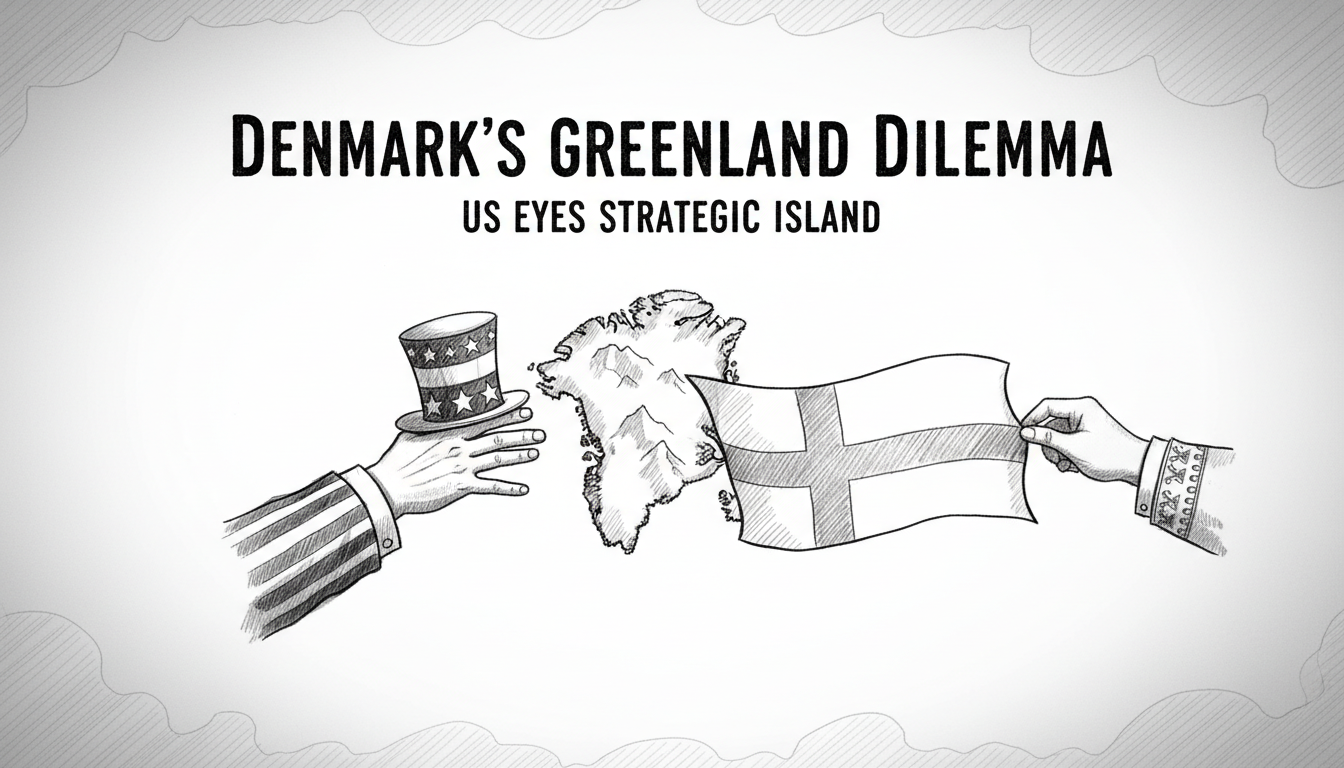
Denmark's relationship with its vast autonomous territory, Greenland, is under renewed international scrutiny as global powers refocus on the Arctic. The island's 56,000 inhabitants live atop a landmass of immense strategic value, caught between their historical ties to Copenhagen and the geopolitical ambitions of Washington and others. This complex dynamic forces Denmark to navigate a delicate balance between its NATO obligations and its role as Greenland's sovereign power, a task made more urgent by climate change and resource competition.
For Copenhagen, Greenland represents the nation's most significant foreign and security policy challenge. The Danish government handles defense and international relations for the territory, while Greenland's own government manages domestic affairs. This arrangement is tested whenever external interest surges, as it did in 2019 with a U.S. purchase proposal. That episode highlighted a fundamental tension: Greenland is integral to the Kingdom of Denmark, yet its global importance often pulls it into a wider sphere of influence.
The Persistent American Presence
The United States has maintained a continuous military footprint in Greenland since World War II, a fact that shapes the entire relationship. Thule Air Base, now called Pituffik Space Base, is America's northernmost military installation. It serves as a critical radar site for missile defense and space surveillance. This presence is a cornerstone of NATO's Arctic security architecture, sanctioned through agreements between the U.S. and Danish governments. For decades, it has been an accepted, if sometimes quietly debated, feature of Greenland's reality.
However, the nature of American interest is evolving. It is no longer solely about ballistic missile warning systems. Analysts point to three converging factors: the melting ice cap is opening new sea lanes and access to resources, Greenland is believed to hold vast deposits of rare earth minerals crucial for modern technology, and the Arctic is becoming a contested zone with Russia and China. This transforms Greenland from a remote outpost into a central piece on the global strategic board. Danish foreign policy officials must now engage with Greenlandic leaders on these issues with unprecedented frequency and depth.
Local Autonomy Meets Global Geopolitics
In Nuuk, the capital of Greenland, the perspective is distinctly different. The Self-Government Act of 2009 grants the local parliament control over areas like education, health, and resource management. There is a strong political movement towards full independence, a goal that requires economic self-sufficiency. This makes the potential for mining and tourism incredibly attractive. Yet, Greenlanders are wary of becoming a pawn in a great power game, sensitive to any perception that their future is being decided in foreign capitals without their consent.
The 2019 episode, where then-President Donald Trump publicly floated the idea of buying the island, was a cultural and political shock. It was swiftly and firmly rejected by both the Danish Prime Minister and Greenland's Premier. "Greenland is not for sale. Greenland is not Danish. Greenland belongs to Greenland," the Danish leader stated at the time. The event, while diplomatically jarring, underscored a vital point: Greenlandic public opinion is a powerful force. Any major foreign investment, especially from a military ally, requires careful social licensing and must align with local development goals.
The Danish Balancing Act
Copenhagen's role is that of a facilitator and a shield. It must ensure Greenland's security through its NATO membership and the U.S. defense agreement, while also protecting Greenland's right to self-determination. This involves channeling a substantial annual block grant, which funds about half of Greenland's public budget, and managing complex international dialogues. When U.S. officials or Chinese mining firms express interest, the Danish Ministry of Foreign Affairs becomes the first point of contact, tasked with aligning those interests with Greenland's own priorities and Danish foreign policy.
Experts on Arctic policy suggest Denmark's greatest challenge is coherence. "There is a tripartite relationship here: Washington, Copenhagen, and Nuuk," says a senior fellow at a Nordic foreign policy institute. "Denmark's success depends on its ability to listen to Greenlandic ambitions and represent them faithfully on the world stage, while also honoring its own security commitments. It is a tightrope walk over the melting ice." This requires constant dialogue and a recognition that Greenland's geopolitical weight is growing faster than its population.
The Climate Change Accelerant
No analysis of Greenland's strategic importance is complete without climate change. The island's melting ice sheet is a global climate indicator, but the physical changes are also redrawing the map. New shipping routes along the Northern Sea Route could cut transit times between Asia and Europe by weeks. Access to offshore oil, gas, and mineral resources becomes more feasible as the ice retreats. This environmental shift acts as an accelerant for geopolitical and economic interest, forcing all parties to make long-term decisions in a rapidly changing landscape.
For Denmark, this adds an environmental diplomacy layer to an already complex file. Denmark often champions global climate action, while Greenland's government seeks economic development that may involve extracting the very resources climate policies aim to phase out. Bridging this gap requires nuanced policies that support green transition and sustainable development in Greenland, ensuring its future prosperity is not built on a dying ecosystem. It is perhaps the most profound dilemma at the heart of the relationship.
Looking to an Uncertain Future
The path forward for Denmark and Greenland is one of negotiated evolution. Full independence remains a stated goal for many in Greenland, but its timeline is directly tied to achieving economic independence, likely through responsible resource development. Denmark's task is to support that development in a way that strengthens the realm without provoking destabilizing international rivalries on the island. This means investing in Greenlandic education and infrastructure today, to build capacity for tomorrow's choices.
The world's eyes will remain on Greenland. Its location between North America and Europe, its resources, and its symbolic position in the climate narrative ensure that. For Denmark, the lesson is clear: the relationship must be managed with partnership, transparency, and a deep respect for Greenlandic agency. The era when Copenhagen could make decisions about the island in isolation is over. The future of this vast, icy land will be written through a continuous conversation between Nuuk, Copenhagen, and the wider world—a conversation where Denmark must learn to speak as both a sovereign and a partner.