
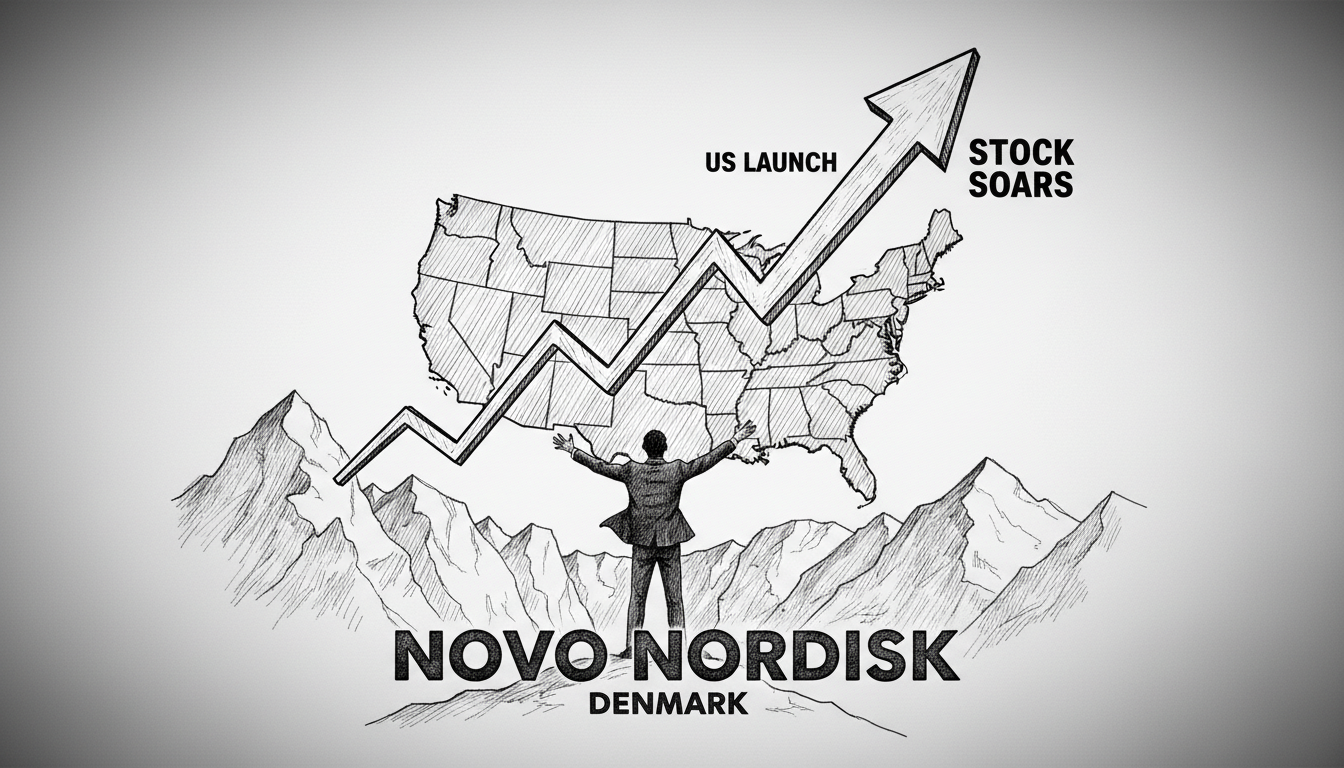
Novo Nordisk shares surged nearly 6% in Copenhagen trading Tuesday as the Danish pharmaceutical giant commenced US sales of its obesity medication Wegovy, sending ripples through the national economy. The stock jump added billions of kroner in market value before noon, reinforcing the company's overwhelming influence on Denmark's financial landscape. For investors in the Øresund region and beyond, the move represents a critical test for Novo's strategy to dominate the global weight-loss drug market.
Market Reaction and Economic Weight
Trading on the Nasdaq Copenhagen exchange saw brisk activity in Novo Nordisk stock (NOVO B) from the opening bell. The price climbed to approximately 1,086 Danish kroner per share, a significant rise from Monday's close. This single-day gain underscores the market's sensitivity to the company's US commercial strategy. Analysts at Copenhagen-based Danske Bank noted the positive sentiment but cautioned that sustained growth depends on supply chain execution. 'The US launch is a pivotal moment, but the real metric will be quarterly sales figures and the company's ability to meet what is clearly enormous demand,' said a senior equity analyst who requested anonymity due to firm policy.
Novo Nordisk's sheer size means its performance directly dictates the direction of the OMX Copenhagen 25 index, of which it constitutes a dominant share. A strong day for Novo often lifts the entire Danish market, while a decline can depress it. This concentration creates both stability and vulnerability for Denmark's investment climate. Pension funds and private investors across the country have significant exposure to the company's fortunes.
The Wegovy Rollout Strategy
Wegovy (semaglutide) received US Food and Drug Administration approval for chronic weight management in June 2021. Its launch, however, has been deliberately measured due to well-documented supply constraints. Novo Nordisk has prioritized ensuring a reliable supply for existing patients using its diabetes drug Ozempic, which contains the same active ingredient, before scaling up Wegovy availability. The controlled start of US sales this week suggests the company believes it has navigated the worst of these production challenges.
In a statement, Novo Nordisk's CEO Lars Fruergaard Jørgensen said the company was 'progressively increasing' Wegovy's availability in the US market. 'Our focus remains on responsible supply management to ensure patients who start treatment can continue it,' Jørgensen stated. This phased approach aims to avoid the prescription bottlenecks and patient frustration that have plagued other drug launches. The US obesity treatment market is estimated to be worth tens of billions of dollars, making it a primary battleground for pharmaceutical companies.
Supply Chain and Competitive Pressures
The celebratory market reaction comes with underlying notes of caution. Industry experts point to two persistent hurdles: manufacturing capacity and rising competition. Building sufficient production of the complex injectable pens is a capital-intensive and time-consuming process. Novo is investing heavily in expanding its facilities in Denmark and abroad, but these projects take years to complete.
Meanwhile, rival Eli Lilly has launched its own highly effective obesity drug, Zepbound (tirzepatide), applying direct pressure. Both companies are racing to secure market share, doctor loyalty, and insurance coverage. 'This is not a winner-takes-all market, but it is a race for leadership,' commented a healthcare portfolio manager in Copenhagen's financial district. 'Novo has a first-mover advantage with Wegovy's brand recognition, but Lilly is a formidable competitor with strong clinical data. The next few quarters will be about execution on supply and marketing.'
National Economic Implications
The company's success transcends shareholder returns. Novo Nordisk is a cornerstone of Danish export revenue and a major employer. Its research and development hub in Greater Copenhagen and massive production sites in Kalundborg are vital to the national industrial ecosystem. Tax revenue from corporate profits and highly paid employees contributes substantially to public finances. Danish Economy Minister Stephanie Lose has previously acknowledged the sector's importance, stating that life sciences are 'a central pillar of our economic future.'
This interdependence means national economic forecasts are sometimes revised based on Novo Nordisk's quarterly results. A strong performance can boost national GDP growth figures, while a slump can have the opposite effect. This unique situation places the Danish government in a position of observing a private company's performance with acute interest, though officials are careful to avoid comments on specific stock movements.
Analyst Outlook and Future Trajectory
Financial institutions have updated their price targets for Novo Nordisk stock following the launch news. Many maintain a 'buy' or 'overweight' rating, citing the long-term growth trajectory of the obesity care market. However, target prices vary based on expectations for Wegovy's sales peak and the durability of its patent protection. Some analysts project the global market for GLP-1 drugs for obesity and diabetes could exceed $100 billion annually by the end of the decade.
Beyond supply, key challenges include navigating insurance reimbursement in the US and expanding approval and access in other major markets like Europe and Asia. Novo is also investing in next-generation treatments, including oral versions of semaglutide and combination therapies, to maintain its pipeline advantage. 'The current product is just the beginning,' said a biotech analyst. 'Novo's real strength lies in its deep research in metabolic diseases. The question is whether they can translate that science into commercial products faster than their competitors.'
The Tuesday stock surge is a clear vote of confidence from the market, but it also raises the stakes. With Denmark's economic portrait increasingly tied to a single company's ability to ship and sell a weight-loss pen, the world will be watching Novo Nordisk's every move. Can the Danish giant scale its operations to meet historic demand, or will logistical hurdles and competitive forces temper its extraordinary growth story? The answer will be written not just in investor reports, but in the broader economic health of Denmark itself.