
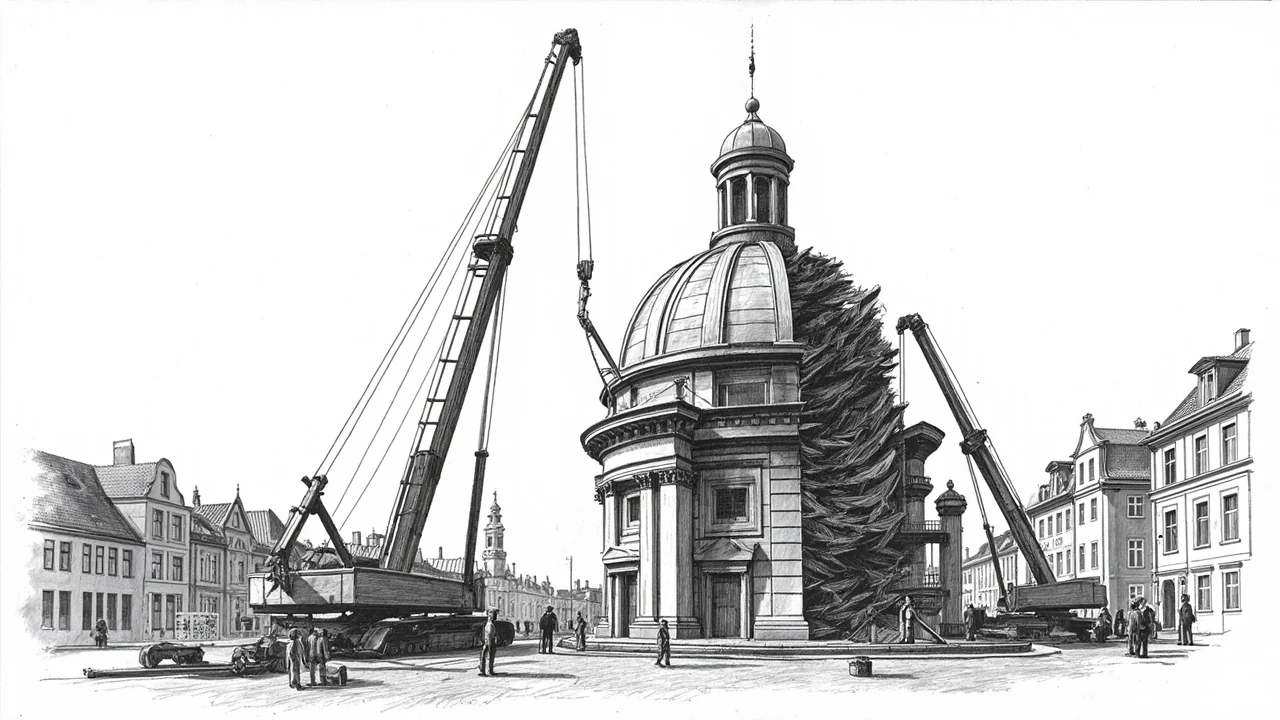
Denmark's iconic Rundetårn observatory saw its three-ton copper dome carefully lowered to the ground in a ten-minute operation on Monday morning. The massive green half-sphere hovered in the air above the 17th-century tower in central Copenhagen before being set down near its base to applause from onlookers. This marks the first major restoration of the dome's copper cladding in nearly six decades, a necessary step to address water damage and protect the historic structure.
For nearly 60 years, the copper roof on the dome has served as Copenhagen's skyline sentinel. Time and weather have taken their toll, with water beginning to infiltrate the structure. The meticulous removal was not just for restoration but also a critical safety measure. With hot copper work planned, lowering the dome eliminates a significant fire risk for the tower itself during the renovation period.
A Delicate Skyline Surgery
The operation was a feat of precision engineering. At 11 AM, the dome began its slow descent, completing the journey just ten minutes later. It now rests at the foot of the tower on the corner of Landemærket and Købmagergade. This is the same spot from which it was originally hoisted into place back in 1929. The location choice creates a tangible link between the structure's past and its present renewal.
Crowds gathered to witness the event, a rare public viewing of major heritage conservation in action. The successful lowering signals the start of a comprehensive restoration project valued at six million Danish kroner. Funding comes from Rundetaarn, the independent cultural institution that manages the tower and is owned by Trinitatis Church. This model of self-funded preservation is common for Denmark's historic church properties.
More Than Just a New Copper Skin
While replacing the dome's copper sheathing is the most visible task, the project encompasses far more. Copper smiths and carpenters will work on the dome until April, applying new handcrafted copper plates. Simultaneously, experts will undertake a sensitive restoration of the observatory's original 1929 telescope. Specialists from Germany will be involved in repainting the instrument and replacing its lens.
A series of other elements within the observatory will also be renewed and replaced. This holistic approach ensures the entire facility, built by King Christian IV as an astronomical observatory, returns to full function. The goal is not merely cosmetic repair but the preservation of a working scientific and cultural monument. The tower itself is currently closed to guests but is expected to reopen on February 6th, even as work continues on the ground.
Preserving a Public Observatory
The overarching mission is to return Rundetårn to its historic purpose. "We expect to be able to man the telescope and welcome guests back to the observatory by autumn," stated a representative from the Rundetaarn institution. This commitment underscores that the tower is more than an architectural landmark; it remains a place for public engagement with science and history.
Denmark has a strong tradition of maintaining public access to its cultural heritage, even during complex restorations. The temporary closure is a necessary pause for long-term preservation. When the dome returns to its perch in the spring, it will be secured for future generations. The observatory will then resume its role, allowing visitors to once again observe the stars from the heart of Copenhagen, just as astronomers have for centuries.
The Human Element of Heritage
Watching a three-ton piece of your city's skyline being lowered is a profound experience. For the bystanders who applauded, it was a moment connecting them directly to the craftspeople of 1929 and the original builders of the 1600s. Heritage conservation in Denmark is often a quiet, behind-scenes process. This public operation made the care and effort required vividly clear.
Projects like this rely on highly specialized skills that are becoming rarer. The copper smiths tasked with re-sheathing the dome practice a trade with roots deep in Danish architectural history. Their work, though hidden high above the streets, is crucial for protecting the building's fabric. This restoration safeguards both the physical structure and the transmission of traditional craftsmanship.
A Look to the Future Sky
The temporary absence of the iconic green dome will change Copenhagen's familiar silhouette for a few months. Its return in the spring will be another significant moment, marking the completion of a major conservation investment. The project demonstrates a sustainable model for heritage care, where revenue from visitors directly funds the preservation of the site they come to see.
Rundetårn's story is one of continuous adaptation. From a 17th-century royal observatory to a beloved public monument, it has always served a purpose. This careful restoration ensures it can continue to do so, blending its historical identity with modern preservation needs. When the dome is back in place, the view from the top will remain unchanged—a panorama of a city that knows how to cherish its past while looking firmly toward the future.