
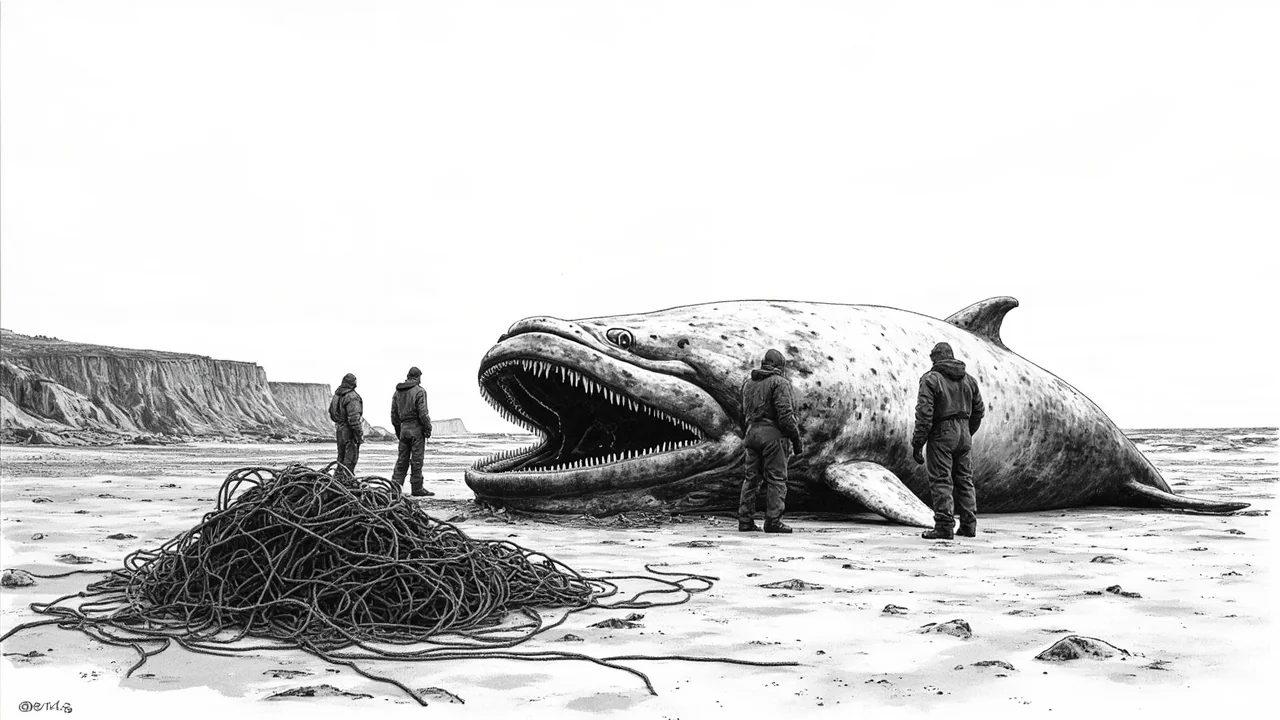
Denmark’s recent sperm whale autopsy aims to unlock secrets of the ocean's largest predator. A massive sperm whale washed ashore in Ålbæk Bugt in North Jutland about a week ago. The dead whale, the world’s largest toothed predator, was opened for examination on Thursday. Preliminary findings show the multi-tonne whale died from starvation after fishing net blocked its oesophagus. At least 11.9 kilograms of fishing gear was found inside it. This initial discovery was confirmed by Tim Kåre Jensen, a veterinarian from the University of Copenhagen.
A Race Against Time and Weather
The autopsy team worked urgently against an approaching snowstorm warning for northern Jutland. Researcher Peter Teglberg Madsen, a professor at Aarhus University's Department of Biology, led the procedure. He reported the work was progressing well, with the whale being fresher and less frozen than initially feared. To complete the massive task, the team used a large knife mounted on a ditch digger. This tool was essential for making the major cuts to remove most of the whale's blubber. Madsen stated that without this machinery, they would not have finished before the severe weather hit.
Twofold Purpose for a Rare Opportunity
According to Professor Madsen, the examination of this sperm whale served two primary goals. The first was forensic. Researchers cut into the deep-sea giant to determine its cause of death. They specifically looked for plastic in the stomach and injuries from fishing gear to see if human activity was responsible. The evidence strongly points to the ingested net as the fatal culprit. Madsen's immediate assessment is that the whale died at sea before later drifting ashore. The second purpose was purely scientific. Researchers rarely get the chance to study the anatomy of the world's largest predator up close.
From Anatomy to Ocean Understanding
Peter Teglberg Madsen's team at Aarhus University frequently studies sperm whales in the world's oceans. They use small computers attached to the whales' backs to understand their behaviour and hunting patterns. However, to fully grasp how the whale's body functions, knowledge of its internal anatomy is crucial. The autopsy of this individual provided a unique opportunity for this. Madsen gave a specific example. Measuring a sperm whale's heartbeat in nature provides a number with limited context. But when combined with knowledge of the heart's actual size from an autopsy, researchers can calculate the whale's energy requirements. This, in turn, reveals its precise need for food to survive.
The Human Impact on Marine Giants
The discovery of 11.9 kg of fishing net is a stark indicator of human impact on marine life. While the direct cause of death is clear, the full contents of the whale's stomach will be analysed for other plastics and debris. This data contributes to a growing body of evidence on ocean pollution. Each autopsy like this provides concrete metrics on the threats sperm whales face. It transforms an anecdotal concern about ocean trash into a measurable, pathological fact. The findings from this whale will be added to international databases tracking such incidents.
A Challenging Field of Study
Working on a beached whale of this size is a significant logistical and physical challenge. The location on the coast, the freezing temperatures, and the sheer mass of the animal require specialised planning and tools. The use of heavy machinery like a ditch digger is not standard laboratory equipment. It underscores the field-based nature of this type of marine biology. Success depends on adapting to harsh conditions while maintaining scientific rigor. The team's ability to work efficiently before the snowstorm demonstrates the practical realities of wildlife research.
A Legacy From a Loss
While the death of this majestic creature is a loss, the scientific examination ensures its story contributes to the protection of its species. The data points collected from its body will be used by researchers for years to come. They will help answer fundamental questions about how sperm whales live, feed, and navigate the deep ocean. This work turns a solitary event on a Danish beach into a piece of a global puzzle. The ultimate goal is to ensure that human understanding of these ocean giants grows, so future interactions are less fatal. The whale’s fate is a sombre reminder of our shared ocean environment, where human debris can have deadly consequences for its largest inhabitants.