
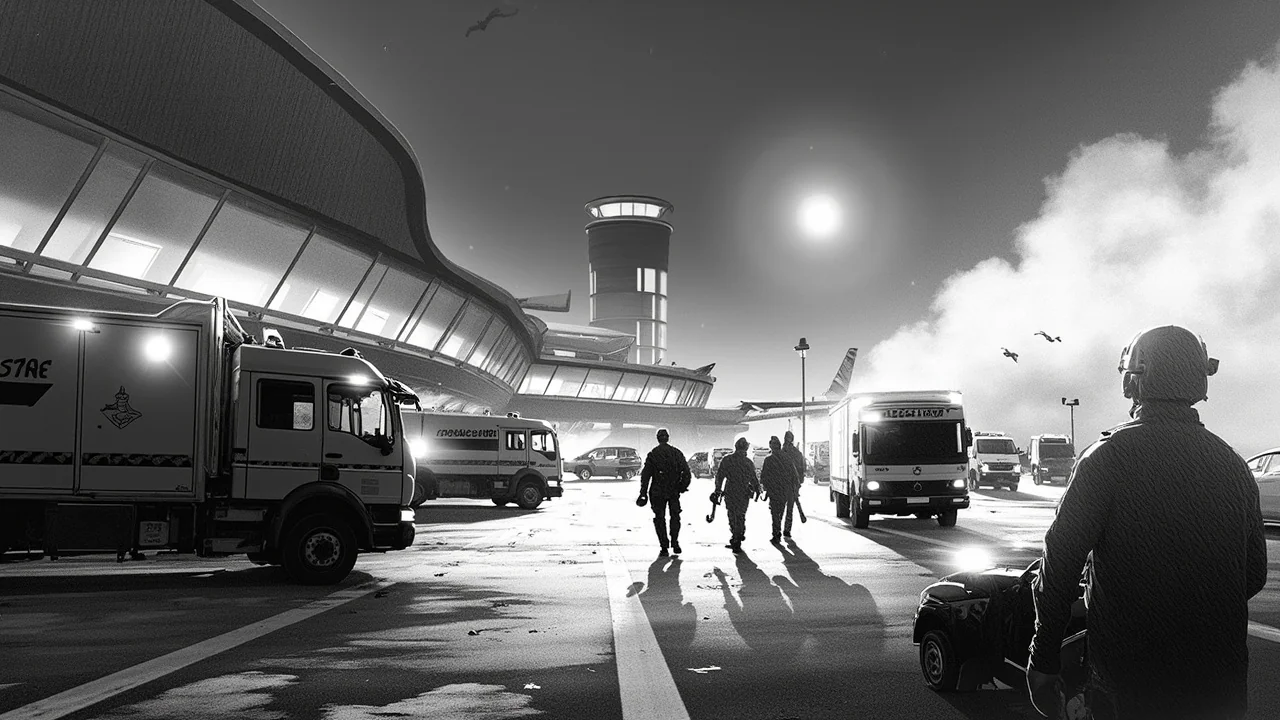
Finland's main international airport activated a major emergency alert this afternoon, dispatching 15 separate rescue service units to Helsinki-Vantaa Airport in response to what was initially reported as a large-scale air traffic accident. The alarm, which triggered the highest level of contingency response, sent police, fire, and medical teams racing to the aviation hub just outside the capital. No immediate details regarding casualties or the nature of the incident were available from authorities in the first chaotic minutes. The scale of the response, however, indicated officials were preparing for a worst-case scenario.
Initial Response and Site Mobilization
Emergency radio traffic described a full-scale mobilization at the airport, code-named EFHK. Units from the Vantaa rescue department, supported by neighboring Helsinki and Espoo services, converged on the premises. The deployment of 15 units represents a significant portion of the capital region's emergency capacity. Airport operations were severely disrupted. Flights were held on the ground at Vantaa, and incoming air traffic was diverted to other regional airports, including Tampere-Pirkkala and Turku. Social media feeds from inside the terminals quickly filled with images of emergency vehicles with flashing lights lining the runway perimeter and confused passengers being held at gates.
The Protocols of a Major Alert
The activation follows Finland's strict civil aviation emergency plans, which are coordinated by the Finnish Transport and Communications Agency (Traficom) and the airport operator, Finavia. Procedures for a "major accident" call for the immediate establishment of an on-scene command post, integrating airport fire services, municipal rescue departments, and police. The presence of so many external units suggests the incident was considered beyond the capability of the airport's own advanced fire and rescue team. Finland's Ministry of the Interior would typically activate its national crisis management center in such an event to monitor and support local responders. The last major emergency exercise simulating a full aircraft accident at Vantaa was conducted in 2022, involving over 30 organizations and 500 personnel.
Context and Historical Precedence
While details remain scarce, the alert immediately draws comparisons to past European aviation incidents and tests Finland's preparedness framework. Helsinki-Vantaa hasn't experienced a fatal commercial aircraft accident in decades, a safety record attributed to rigorous Nordic aviation standards and harsh-weather operational expertise. The airport is a critical node for Finnish connectivity, handling over 90% of the country's international air traffic and serving as a key transit point between Europe and Asia. Any prolonged closure has immediate economic ripple effects. The emergency also occurs amid heightened security awareness across European transport hubs, though there was no indication from early briefings that security was a factor. Finland's Border Guard, responsible for airport security, was part of the initial response cordon.
Analyzing the Emergency Framework
From an operational standpoint, this massive mobilization is a real-time test of inter-agency cooperation. "The first hour is absolutely critical in any mass casualty incident," explained Jari Lahtinen, a former chief of airport rescue services not involved in today's response. "The protocol is clear: secure the scene, triage the injured, and establish clear lines of command between airport authorities and municipal responders. The number of units suggests they were deploying for firefighting, urban search and rescue, and mass casualty management simultaneously." The integration of different rescue departments—each with its own equipment and command structure—under a unified incident command system is a complex logistical challenge, one drilled in exercises but rarely activated for real. The effectiveness of this coordination directly impacts survival rates.
Travel Disruption and Passenger Impact
For thousands of travelers, the immediate impact was severe disruption. Finavia's passenger guidance systems automatically triggered, instructing people to contact their airlines for information. The ripple effect on European flight schedules was instantaneous. Airlines like Finnair, which uses Vantaa as its sole hub, faced widespread cancellations. Long-haul flights from Asia and North America en route to Helsinki were forced to recalculate fuel loads and seek alternate destinations. The economic cost, even for a closure lasting several hours, runs into the millions of euros in direct operational losses and broader supply chain delays. Passenger rights under EU Regulation 261/2004, which mandates care and compensation for cancellations due to "extraordinary circumstances," will likely come into play, though the definition of an emergency like this is complex.
Awaiting Official Clarification
As evening approached, the situation remained fluid. A joint press conference was anticipated from the police, rescue services, and Finavia. The key questions officials needed to address: Was this a false alarm with an extraordinary response, a genuine accident with limited scope, or a near-miss that triggered worst-case planning? The initial alarm specifying a "large-scale air traffic accident" left little room for ambiguity in the response, regardless of what responders ultimately found. The coming hours would clarify whether Finland's emergency systems successfully averted a disaster or responded with overwhelming force to a less severe incident. The sight of 15 emergency units surrounding the quiet runway, however, won't soon be forgotten by those who witnessed it.