
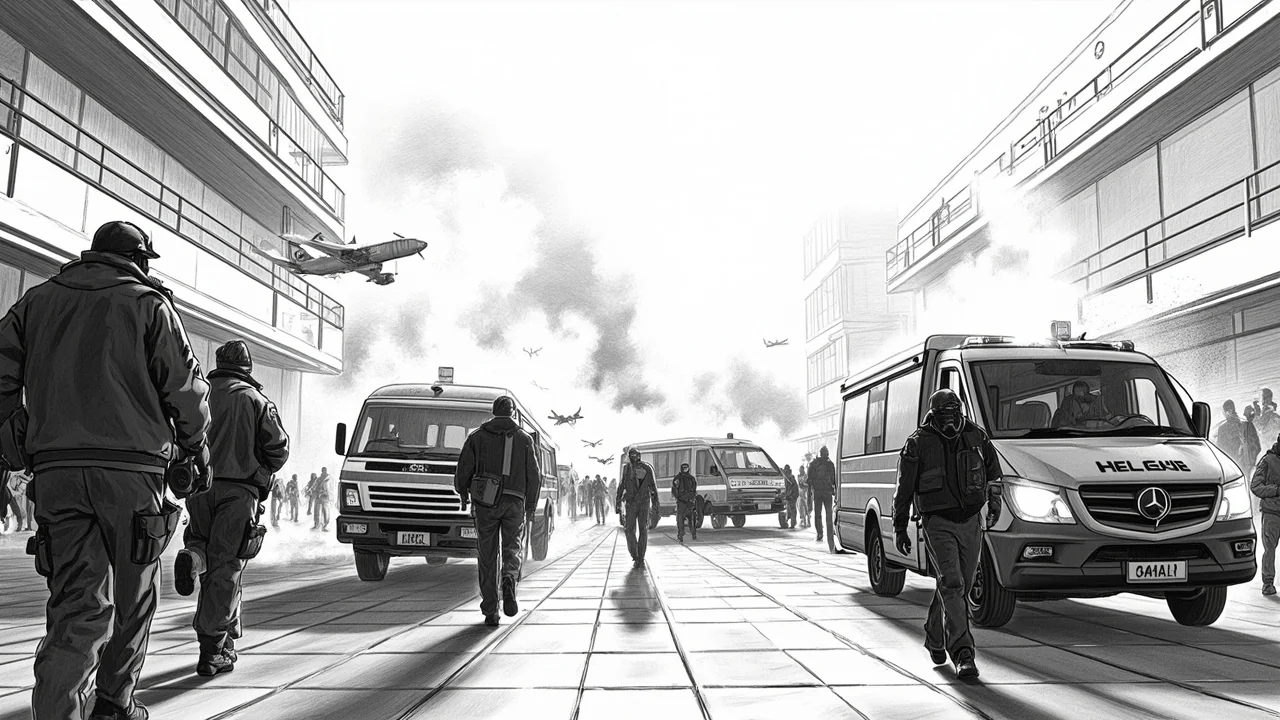
Finland’s largest airport activated a full-scale emergency protocol Tuesday night after rescue services received an alert reporting a major air traffic incident at Helsinki-Vantaa. The call came in just before 10 p.m., triggering an immediate and substantial mobilization of emergency units across the capital region.
First responders didn’t hesitate. Fifteen separate units from the rescue department were dispatched to the airport’s grounds. That kind of response isn't typical; it signals the authorities were preparing for a worst-case scenario. The scale suggests a potential incident involving a commercial aircraft, though officials have yet to confirm the nature of the alert. Helsinki-Vantaa is a critical hub, the main international gateway for the entire country. Any disruption there sends immediate ripples across the national transport network.
Mobilization at Vantaa
The scene at the airport was one of controlled urgency. Emergency vehicles, their lights cutting through the dark evening, converged on the runways and terminals. Standard procedure in such situations is to secure the area, establish a command post, and prepare for potential casualty extraction and firefighting. The number of units—fifteen—points to a multi-agency response. This wouldn’t just be the airport’s own fire crews; it would involve municipal rescue services from Vantaa, Helsinki, and likely neighboring Espoo. They’d be coordinating with airport security, border guards, and possibly the Finnish Defence Forces, which have a presence nearby.
Air traffic was undoubtedly affected. While the exact operational status wasn’t immediately public, a major emergency alert typically forces a ground stop. Arriving flights would be held at their departure points or diverted. Departing aircraft would be held at their gates. For passengers inside the terminals, the first sign of trouble might have been the sight of emergency vehicles or unexplained delays. The psychological impact of seeing such a response at an airport is profound, even if the ultimate cause proves less severe.
The Official Silence
As of 10:15 p.m., the rescue department’s communications were tightly controlled. In a brief statement to media, they said they would issue information shortly but declined further comment at that stage. This silence is standard and crucial. It allows the incident commander on the ground to assess the situation without public speculation interfering. It prevents the spread of unconfirmed information that could cause panic among passengers' families or compromise the operational response. The authorities’ priority in the first hour is managing the incident, not managing the media narrative.
That information vacuum, however, creates intense speculation. Social media likely lit up with reports from passengers seeing the response. Unverified videos and photos would circulate. The job of the authorities is to fill that vacuum with confirmed facts as quickly as operational safety allows. The Finnish transport safety agency, Trafi, would have been notified immediately. Their investigators have a legal mandate to examine all serious incidents in Finnish airspace or at Finnish airports. Their role is separate from the rescue operation; they begin the meticulous work of determining cause.
Finland's Aviation Safety Context
This alert comes against a backdrop of Finland's exemplary aviation safety record. The country’s airports and airspace are among the safest in the world, governed by strict EU-wide regulations and meticulous national oversight. Helsinki-Vantaa, in particular, undergoes regular safety drills and audits. Its emergency services are trained to ICAO (International Civil Aviation Organization) standards, capable of responding to a full-scale crash. The last major accident involving a commercial aircraft in Finland was decades ago. This strong record makes a large-scale emergency alert all the more startling.
The protocols being followed tonight are part of a well-rehearsed plan. Finland’s Ministry of the Interior has detailed contingency plans for major accidents, integrating local, regional, and national resources. The Helsinki University Hospital (HUS) district, which includes the Meilahti and Töölö hospitals, has major incident plans that would be activated for mass casualty events. Whether those hospital plans were triggered tonight remains unknown, but the rescue service dispatch suggests they were on standby.
What Happens Next
The immediate next steps are clear. Rescue crews will work to confirm the nature of the alert. Was it a verified incident, a false alarm, or a drill mistakenly communicated as real? If it was a real incident, they will secure the site, treat any casualties, and mitigate any immediate danger like fire or fuel spills. The airport’s crisis management team will be in constant session, liaising with airline operators and national authorities.
Once the scene is stable, the investigative phase begins. Trafi will take the lead. If an aircraft is involved, its flight data recorder and cockpit voice recorder will be secured. Air traffic control communications will be reviewed. The weather conditions at the time of the alert will be examined—Tuesday night was overcast with light winds in Vantaa. Every detail, from maintenance records to crew schedules, becomes relevant. This process is methodical, not swift. A preliminary report might take weeks; a final one could take over a year.
For the traveling public and the airlines, the focus is on disruption. Even a false alarm can ground flights for hours. Passengers will be looking for rebooking options and accommodations. Finnair, the national carrier and hub operator at Vantaa, would have its own crisis team activated, dealing with the logistical nightmare of disrupted schedules and worried customers. The economic impact of closing a major hub, even temporarily, runs into millions of euros per hour.
And for the public watching the news, it’s a grim reminder of the complex, high-stakes world of aviation. It’s a system built on redundancy and preparation for the worst, even while delivering remarkable daily safety. Tonight, that preparation was visibly activated at Helsinki-Vantaa. The coming hours will reveal what exactly triggered Finland’s extensive emergency response apparatus into action. All eyes will be on the runway at Vantaa when the sun comes up.