
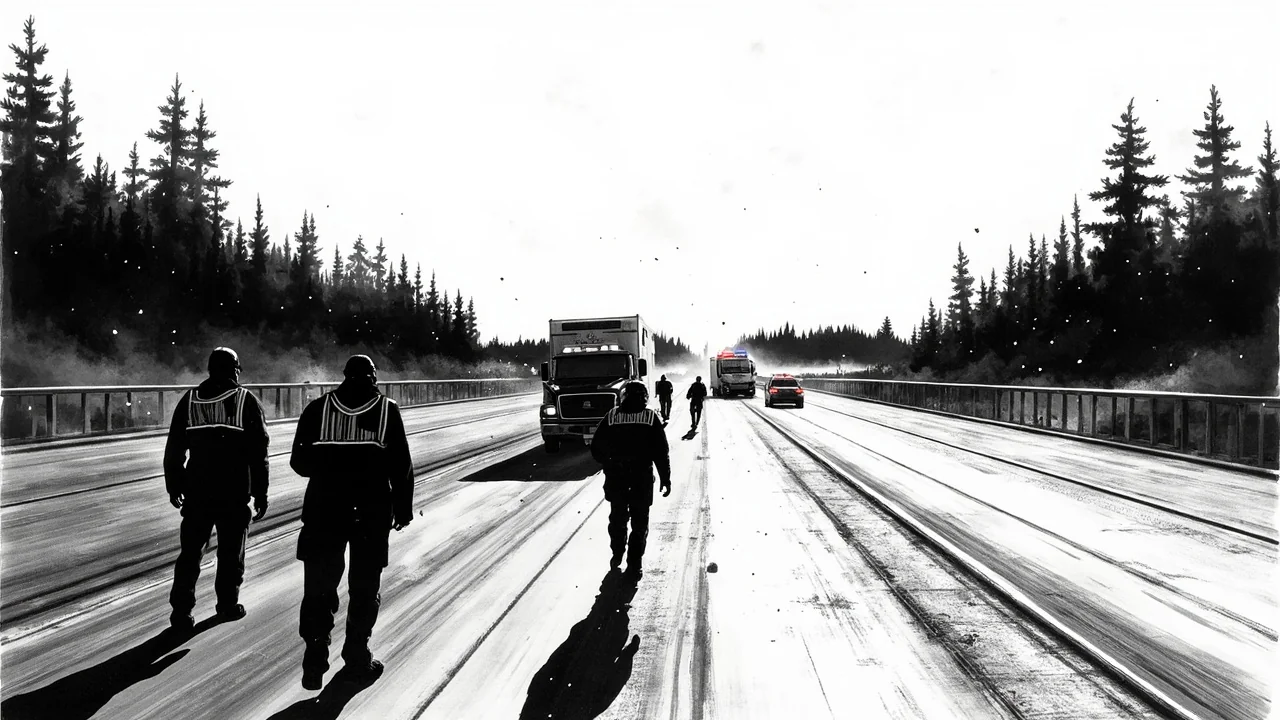
Finland's Highway 3 was closed in both directions near Ylöjärvi on Tuesday afternoon following a serious collision between a passenger car and a truck-trailer combination. The South Ostrobothnia Police Department received the alert shortly after 4:00 PM, dispatching units to the scene where the road remains shut for rescue and clearing operations.
Emergency responders from the Pirkanmaa rescue service are conducting operations at the site. Police are directing traffic onto designated detour routes while their preliminary investigation into the cause of the crash is underway. No details regarding potential injuries or the number of people involved have been released by authorities at this time.
Emergency Response and Traffic Chaos
The immediate closure of Highway 3, a major north-south arterial route connecting Helsinki to Tampere and beyond, has caused significant disruption to regional traffic. Police are managing diversions, but drivers are experiencing substantial delays during the afternoon commute. The duration of the closure remains uncertain, dependent on the complexity of the scene clearance and the forensic examination required by investigators.
Such incidents trigger a coordinated response under Finland's emergency services protocol, involving police, rescue services, and if necessary, the Finnish Border Guard's helicopter unit for medical evacuation. The focus of the initial response phase is on securing the scene, providing urgent medical care, and preventing further dangers, such as fuel spills or fire.
The Context of Finnish Road Safety
This crash occurs against the backdrop of Finland's generally strong road safety record, a result of decades of stringent policy. Finland's traffic safety strategy is anchored in the 'Vision Zero' goal, aiming for no fatalities or serious injuries on its roads. Key to this has been the enforcement of strict laws on drunk driving, investment in road engineering, and comprehensive winter maintenance on crucial highways like Highway 3.
According to official statistics from the Finnish Transport and Communications Agency, Traficom, the number of fatal accidents on Finnish roads has seen a long-term decline. However, main highways outside urban centers remain locations where high-speed collisions, often involving heavy goods vehicles, can have the most severe consequences. The two-plus-two lane configuration of much of Highway 3, without a continuous central barrier in all sections, can be a factor in certain types of cross-over collisions.
Investigation and Legal Framework
The police investigation will follow a standard procedure for severe traffic incidents. This includes a technical inspection of the vehicles, analysis of any available tire marks on the road surface, and the retrieval of data from event data recorders, commonly known as 'black boxes,' which are mandatory in new vehicles. Officers will also seek to establish driver conditions, including factors like fatigue, distraction, or impairment.
Finland's legal framework for traffic offenses is severe, particularly for dangerous driving causing bodily harm. The process is meticulous, often relying on expert reconstructions from the Traffic Safety Agency of Finland (Liikenneturva). The findings of the police investigation will determine whether any charges are filed. A parallel administrative investigation may also be conducted by Traficom to identify any systemic safety issues relevant to the road section.
Economic and Commuter Impact
Beyond the immediate human tragedy, a prolonged closure of a major transport corridor like Highway 3 has tangible economic effects. The road is vital for freight transport between the Port of Helsinki and industrial centers in Pirkanmaa and Ostrobothnia. Delays ripple through supply chains, affecting logistics costs and punctuality.
For daily commuters between towns like Ylöjärvi and Tampere, the closure forces reliance on alternative local roads, which are less capable of handling high traffic volumes and may not be as well-maintained. This highlights the vulnerability of regional transport networks when a primary artery is blocked and underscores the importance of robust contingency planning by municipal and regional authorities.
A Look at Broader EU Road Safety Goals
Finland's response to this incident will also be viewed through the lens of European Union transport policy. The EU has its own road safety policy framework, aiming to halve the number of road deaths by 2030. Member states report detailed collision data, and the European Transport Safety Council (ETSC) regularly benchmarks performance.
Finland has traditionally been among the top-performing EU nations in terms of fatalities per million inhabitants. A serious crash like this one brings a renewed focus on the ongoing challenges, such as improving safety on rural highways and mitigating risks associated with commercial transport. It reinforces the need for continuous investment in both infrastructure and new vehicle safety technologies, many of which are mandated by EU regulations.
The Path Forward for Highway 3
Once the scene is cleared and the immediate investigation concludes, the focus will shift to any recommended safety improvements. Data from this crash will contribute to the national accident database, informing future road investment decisions by the Finnish Transport Infrastructure Agency (Väylävirasto). Potential measures could include enhanced barrier systems, improved road signage, or speed management adjustments in specific high-risk sections.
The community's reaction often leads to local advocacy for safety upgrades. Municipal councils in the affected area may debate and propose specific measures to state authorities, leveraging this incident to argue for accelerated infrastructure funding. The final report from the authorities, though it may take months to complete, will be a critical document in that process. For now, the priority remains on supporting those affected and determining exactly how a routine afternoon journey turned into a major emergency on a key Finnish highway.