
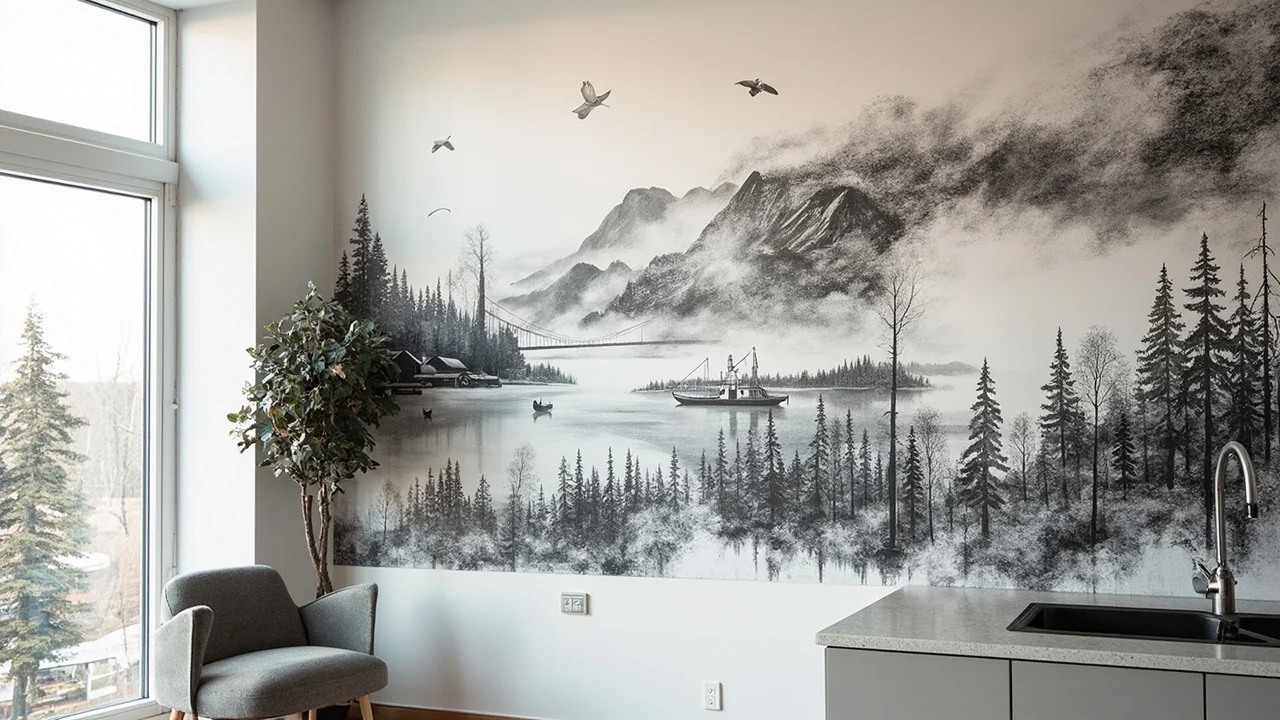
Finland mental health rehabilitation residents in Suolahti now have a permanent mural on their walls, created from their personal memories and favorite places. The large-scale artwork, titled Unelmain säteitä (“Rays of Dreams”), covers two walls—about 22 square meters—and features animals, landscapes, and cherished recollections shared by the residents of Attendo Tallisaari care home.
A Mural Born from Shared Stories
The project began in a weekly art group at the facility, where residents painted and created together under the guidance of volunteer artist Siiri Jäkkö. As the group’s sessions progressed, the idea emerged to leave behind something lasting—a mural that would continue to bring joy even after the group ended. “We painted and made art in the group, and the idea came up to create a permanent painting that everyone could enjoy even after the group was over,” said Kirsi Viitala, manager of the Attendo facility.
Jäkkö took the lead in designing and executing the mural but based every element on conversations with the residents. She didn’t work from her own imagination alone, instead, she asked them about their favorite animals, meaningful places, and powerful memories. “I designed this together with the residents, even though I painted it myself,” Jäkkö explained. “We talked about power animals and memories. People shared life stories and suggested themes for the painting.”
From Personal Memory to Public Art
One resident’s fondness for foxes directly shaped part of the mural. “Someone said they really loved foxes because fox cubs are so cute, so of course I included foxes,” Jäkkö said. The final composition includes playful foxes near a lakeshore, birch groves, and a green meadow with a swing hanging from a tree branch. On another wall, a moose and a hare stand quietly in a forested landscape.
The imagery avoids abstract symbolism in favor of concrete, emotionally resonant details drawn straight from residents’ lives. There are no generic scenes—each element reflects a specific memory or preference voiced during the collaborative planning phase. The result is a visual diary of the group’s collective inner world, rendered in bright, welcoming colors across the common area walls.
Art as Continuity in Care
For many residents in long-term mental health rehabilitation, routines and environments can feel static or institutional. The mural introduces a dynamic, personalized presence into their daily space. Unlike rotating art exhibits or temporary decorations, this piece is fixed—meant to be lived with, not just viewed. Its permanence signals that their stories matter beyond the moment of sharing.
Viitala emphasized that the goal wasn’t just aesthetic enhancement but emotional anchoring. “It was important that the artwork would remain and bring joy to everyone, even after the art group concluded,” she said. The mural now serves as both a backdrop for daily life and a reminder of the creative capacity within each resident, regardless of their current health status.
The Artist’s Role: Listener First, Painter Second
Siiri Jäkkö approached the project not as a solo artistic statement but as a facilitator of others’ voices. Her role required active listening more than technical skill—though her painting ability brought the visions to life. She translated verbal descriptions into visual form, ensuring that symbolic choices (like the swing or the fox cubs) carried the emotional weight intended by the residents.
This method reflects a growing understanding in therapeutic art: that the process of co-creation can be as healing as the final product. While Jäkkö handled the brushes, the residents provided the narrative spine of the work. Their participation wasn’t limited to approval—it was foundational. “People told their life stories,” Jäkkö noted, underscoring how storytelling became the bridge between memory and mural.
Beyond Decoration: A Statement of Belonging
In a care setting, walls often remain bare or feature generic prints chosen by administrators. This mural breaks that pattern by asserting the residents’ identities in a shared space. The inclusion of local elements—birch trees, Finnish lakeshores, native animals like moose and hares—also roots the artwork in a familiar cultural and natural landscape, reinforcing a sense of place and belonging.
The project didn’t require major funding or institutional backing, it grew organically from an existing activity group and a volunteer’s commitment. That grassroots origin makes its impact more intimate. It’s not a top-down wellness initiative but a bottom-up expression of community within the facility.
What Remains When the Group Ends
Art therapy groups in mental health settings often face an unspoken challenge: when the sessions stop, so does the sense of purpose they provide. The mural addresses that gap by creating a tangible legacy. Even if individuals move on, relapse, or disengage, the painting remains—a silent witness to their contributions and a source of comfort for those who stay.
Residents now pass by images born from their own words every day. A swing in a green field might recall childhood summers, foxes playing by a lake might evoke a memory of quiet observation in nature. These aren’t just decorative motifs—they’re anchors to personal history, which can be especially vital for people navigating mental health recovery.
A Model for Other Facilities?
While the article doesn’t mention plans to replicate the project elsewhere, the approach offers a low-cost, high-impact model for other care homes. It requires only a willing artist, engaged residents, and administrative support to dedicate wall space. More importantly, it demands a shift in perspective: seeing residents not as passive recipients of care but as creators with stories worth preserving.
The success of Unelmain säteitä lies not in its scale or technique but in its fidelity to the people it represents. In a system often focused on symptoms and treatment protocols, this mural centers humanity—memory, preference, imagination.
As Finland continues to refine its mental health services, small-scale initiatives like this highlight the importance of dignity and self-expression in recovery. Policy discussions in Helsinki may focus on funding and staffing, but on the walls of a care home in Suolahti, healing also looks like a fox cub, a swing, and a lakeshore remembered with love.
What if more public spaces in care settings reflected the inner worlds of those who live there? The mural in Suolahti suggests that sometimes, the most powerful intervention isn’t a new drug or a revised protocol—but a brushstroke guided by someone’s dearest memory.
Candidates in Central Finland.
Read more: Two Named as First parliament
Read more: Finnish Army Launches Major Exercise in Central Finland.