
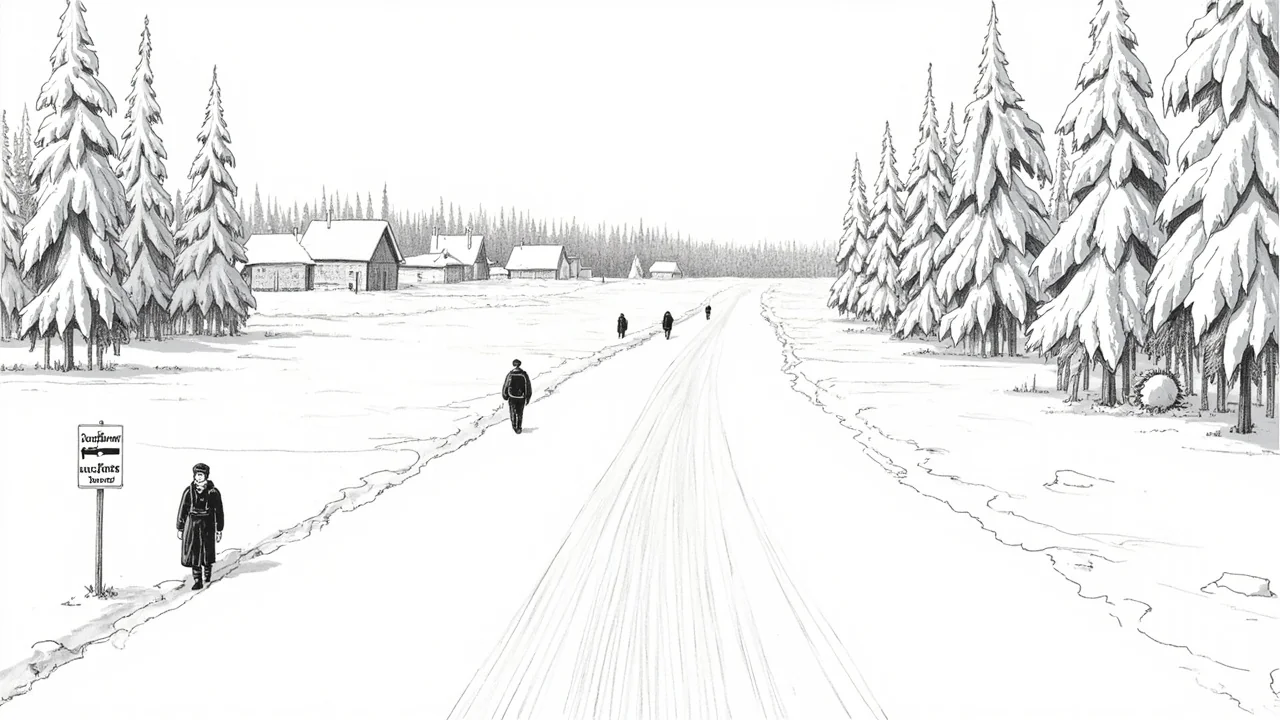
Finland's seasonal ice road network saw a key link activated this week as the Anttola crossing to Paajalansaari and Piekälänsaari islands finally opened for winter traffic. The opening followed confirmation on Monday from local official Matti Kiljunen that the ice thickness had reached the critical minimum safety standard of 27 centimetres. An initial obstacle blocking the route from Anttola harbour was cleared in the afternoon, allowing the traditional frozen passage to come into operation for the first time this winter. The delayed start was attributed to challenging early winter conditions, including a layer of slushy snow floating on top of the ice formed by water rising through fissures, which had hindered the strengthening and measuring process.
A Precise Threshold for Safety
The 27-centimetre benchmark is not an arbitrary figure but a well-established safety regulation for civilian vehicle traffic on lake ice in Finland. This standard is based on decades of hydrological research and practical experience conducted by the Finnish Transport and Communications Agency Traficom and the Finnish Environment Institute. The thickness requirement can vary depending on the type of vehicle, heavier trucks or buses require significantly thicker ice, often exceeding 40 centimetres. For the residents of Paajalansaari and Piekälänsaari, the opening signifies the return of a direct, albeit temporary, road connection to the mainland, drastically shortening travel times compared to summer boat routes. Kiljunen's role in measuring and authorizing the opening underscores the local municipality's responsibility for monitoring these seasonal infrastructures.
The Economic and Social Lifeline
Ice roads function as vital economic and social arteries for hundreds of Finnish island and lakeside communities during the winter months. They enable the reliable transport of goods, provide access to schools and services on the mainland, and facilitate social connections that would otherwise require lengthy detours or expensive water transport. The Anttola route, located in the heart of the Finnish Lakeland, is one of numerous officially maintained ice roads that form a sprawling, ephemeral network across the country from December through March. Their operation is a finely tuned logistical process involving regular thickness measurements, snow clearing, and the placement of road markers. The financial burden for maintaining these routes falls on the local municipalities, which must balance this essential service against its significant operational costs.
Navigating a Warming Climate's Challenges
The delayed opening in Anttola highlights the broader vulnerabilities of Finland's winter infrastructure to changing climatic conditions. Milder winters and unpredictable freeze-thaw cycles pose an increasing challenge to the reliability and operational window of ice roads nationwide. Scientific studies from the Finnish Meteorological Institute indicate a trend towards later freeze-up and earlier break-up dates for lakes across the country. This shrinking window directly impacts community planning, transportation budgets, and long-term viability. While some municipalities explore alternative fixed-link solutions like bridges or causeways, these projects involve multi-million-euro investments that are often prohibitive for sparsely populated regions, making the preservation of ice road knowledge and safety protocols more critical than ever.
A Tradition of Winter Mobility
The practice of travelling on frozen lakes and seas is deeply embedded in Finnish culture and history, dating back centuries as a necessary method of winter travel. Modern ice road construction, however, is a precise science. After the initial clear ice forms, crews work to manage the insulating snow cover, which if left untouched, can actually slow further ice growth. The problematic "slush snow" encountered this season, known as "rotten ice," is a particular hazard. It forms when water from beneath the ice sheet is forced up through cracks or around the edges, saturating the snow layer on top and creating a weak, unstable structure that complicates accurate thickness assessment and compromises strength.
The Rigorous Protocol Behind the Opening
The decision to open an ice road is never taken lightly. It follows a strict protocol where certified inspectors like Kiljunen drill multiple measurement holes along the planned route, often following a standardized grid pattern. The minimum reading from these points determines the go-ahead. Once open, monitoring continues daily, with load limits strictly enforced and the road immediately closed if conditions deteriorate. Signage indicating maximum weight limits is erected, and speed limits—typically around 50 km/h but often lower—are imposed to prevent dangerous pressure waves from forming under the vehicle's weight. This regulatory framework ensures that, despite its natural and temporary nature, an official ice road is a controlled and managed transport route.
The Broader Network's Status
The activation of the Anttola crossing is a single data point in a vast national system. Other famous routes, like the longer ice roads across Lake Pielinen or the sea ice tracks in the Archipelago Sea, will have their own unique timelines based on local conditions, salinity, and currents. Each opening is a community event, reported in local newspapers and discussed in cafes, symbolizing the deep, practical relationship Finns maintain with their winter landscape. It is a reminder that infrastructure is not solely made of steel and concrete but can also be forged, quite literally, from the season itself, serving immediate needs with an understanding of its inherent impermanence.