
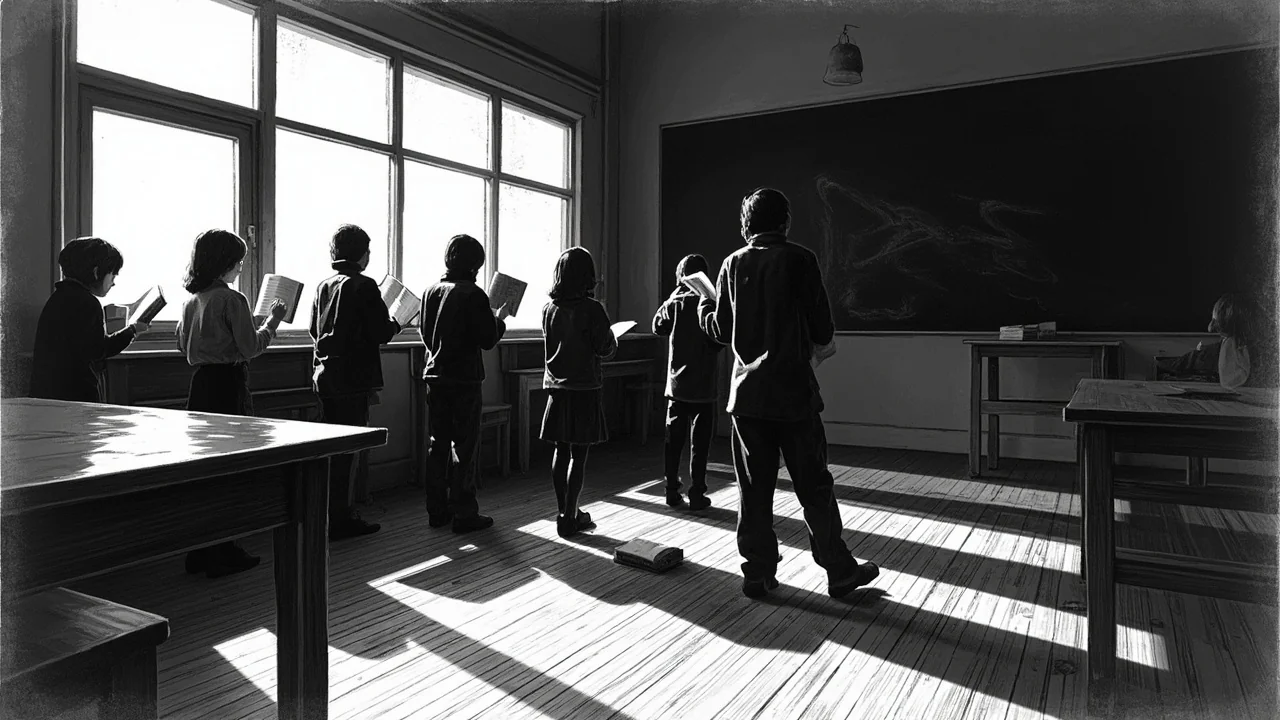
Finland's municipality of Laukaa is implementing a stark cost-saving measure in its schools, where pupils are erasing answers from workbooks so the books can be reused next year. The practice, debated on local social media, has been described as absurd and devaluing to children's schoolwork. It highlights the tangible impact of municipal austerity on classroom resources.
The Pencil Eraser Policy
Sivistysjohtaja (Director of Education) Jussi Silpola confirmed the reports, stating the municipality's per-pupil allocation for books is among the lowest in Finland. "Apparently, schools have made their own decisions to achieve savings and to make the allocation sufficient for next academic year's purchases," Silpola commented. He provided concrete figures: an exercise book costs about 1.50 euros, while a textbook is around 20 euros. "If, for example, a thousand workbooks are in use, the saving is already 20,000 euros," Silpola explained. He noted that many schools in Laukaa already had a practice of completing exercises in separate notebooks.
A National Debate in Microcosm
The situation in Laukaa has ignited a local debate that reflects broader national concerns over municipal finances and education funding. Finland's highly decentralized system places significant responsibility on municipalities for providing education services. Laukaa's current budget allocates 270,000 euros for textbook purchases, which breaks down to 80 euros per student. An additional 50 euros per student is calculated for pupils requiring extensive support. The gap between these allocated sums and the actual cost of materials appears to be driving the extreme measure of reusing consumable workbooks. Social media commentators have labeled the erasure practice as "clownery" and a saddening action that underestimates children's academic work.
The Mechanics of Municipal Austerity
The decision to reuse workbooks is not an isolated policy but a direct consequence of defined budgetary constraints. Municipalities like Laukaa operate within strict financial frameworks set by their own councils and influenced by state subsidies and local tax revenue. The sivistysjohtaja's breakdown clarifies the economic logic, however unpalatable: the marginal cost of a new workbook versus the labor-intensive process of erasing and reusing. This represents a classic trade-off in public administration where labor costs (the time for pupils or staff to erase books) are not directly monetized in the budget, while tangible goods like paper and printing are. The practice raises questions about the long-term cost, both in material quality and pedagogical value, versus the short-term line-item saving.
Historical Context and Pedagogical Norms
Finland's education system has long been celebrated for its equity and high-quality, publicly funded resources. The standard practice has been for schools to provide students with new, clean learning materials each year. This Laukaan departure from that norm signals a shift. Silpola's mention that many schools already use separate notebooks for exercises indicates a pre-existing trend towards more reusable solutions, potentially driven by gradual budgetary tightening over several years. The current step—asking children to erase the books themselves—pushes this trend into new territory, blurring the line between a consumable resource and a reusable asset. It challenges the traditional Finnish expectation of a uniformly high standard of freely provided educational tools across all municipalities.
Searching for Sustainable Solutions
The controversy forces a discussion on sustainable resourcing models. While the immediate reaction focuses on the indignity of erasing books, the underlying issue is a structural funding calculation. The 80-euro-per-student allocation must cover all textbooks and workbooks across all subjects for an entire year. As Silpola's math shows, even small per-unit costs multiply quickly across a school district. Municipalities are caught between maintaining service levels and balancing their budgets. Other solutions beyond erasure could include a greater shift to digital platforms, which require upfront investment but lower recurring material costs, or a more aggressive procurement strategy to lower unit prices. However, these require capital or coordination that strained municipal administrations may lack.
The Human Impact in the Classroom
The policy's most direct impact is felt by teachers and pupils. For teachers, it adds an administrative and supervisory burden—ensuring workbooks are adequately erased without damage, managing the distribution and collection, and potentially dealing with complaints from parents. For pupils, the message is mixed. On one hand, it could be framed as a lesson in frugality and environmental sustainability through reuse. On the other, it physically devalues their previous year's work, literally rubbing it out, and provides them with a worn, potentially marked-up learning tool. The psychological impact of receiving visibly used materials versus new ones, in a system built on equality, should not be underestimated in its potential to signal diminished institutional investment in a child's education.
A Lens on Local Government Finance
Laukaa's erasure policy serves as a precise lens on the state of Finnish local government finance. It moves the debate from abstract budget deficits and debt ratios into the tangible reality of a child's desk. The 20,000-euro saving cited by Silpola is a significant sum for a single school's material budget but a tiny fraction of a municipality's overall spending. This raises the question of whether such measures are the last resort of a genuinely cash-strapped administration or a symbolic action to demonstrate frugality in one visible area while other less visible budgets remain intact. The public scrutiny generated by the social media debate ensures that these trade-offs are no longer made in the darkness of a finance committee meeting but in the full light of public opinion.
The Road Ahead for Laukaa and Others
The immediate future likely holds continued debate within Laukaa's council and school boards. Pressure from parents and the public may force a reevaluation of the education budget's priorities. Nationally, the case may be cited by teacher unions and educational advocates arguing for stronger minimum funding guarantees from the state to prevent such disparities in resource provision. The long-term solution lies not in better erasers but in a recalibration of how Finland funds its cornerstone public service. Will other municipalities with similarly tight budgets follow Laukaa's lead, or will this case stand as a cautionary tale? The quality of Finland's future workforce, long nurtured by a stellar education system, may depend on the answer to that question.