
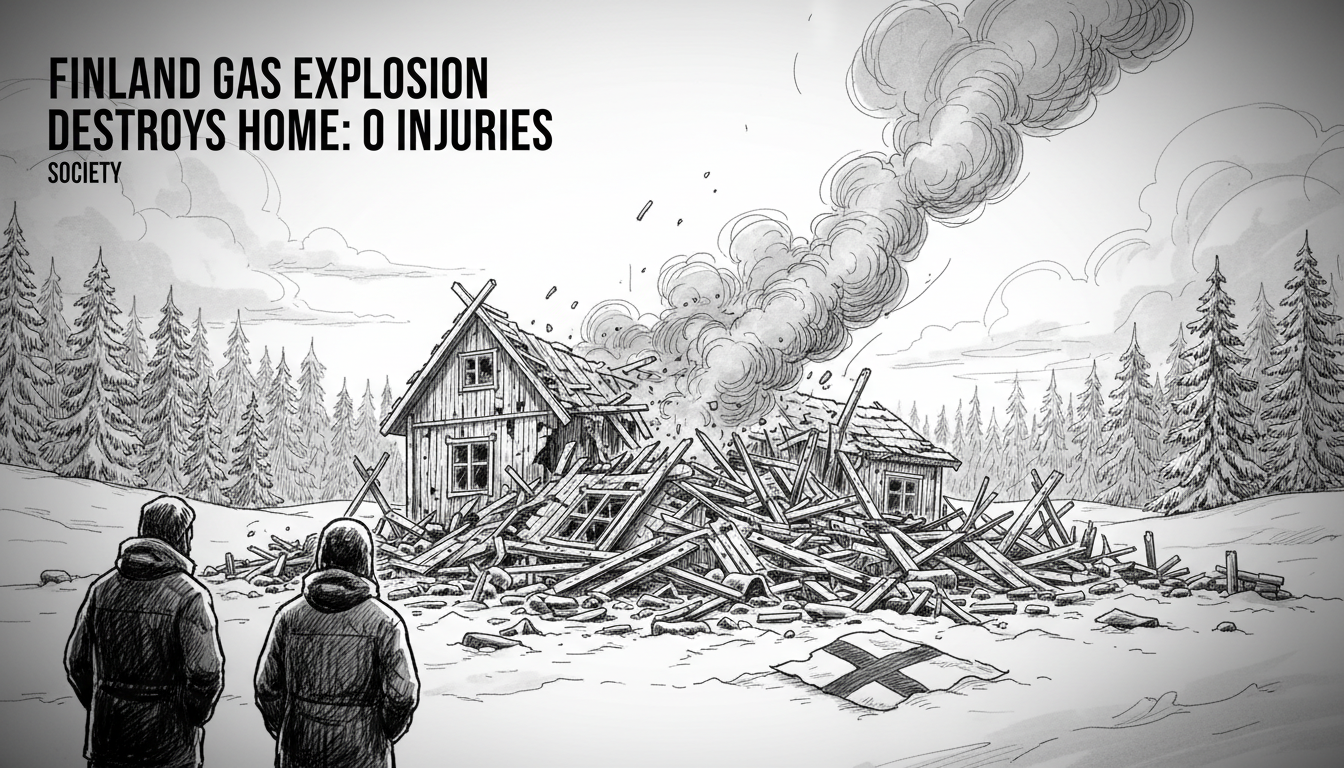
Finland house explosion in Lapinlahti has destroyed a family home but caused no injuries, with police pointing to a suspected gas cylinder leak as the likely cause. The blast at a detached house on Ahvenkuja street around 1:30 PM on Saturday tore the garage doors from their hinges and sent them flying across the road into a neighbor's yard. A small fire ignited but was quickly extinguished by nearby residents, preventing a larger disaster in the quiet community.
Police and rescue services conducted a detailed investigation at the scene throughout Saturday afternoon and evening. Their preliminary findings, released in a statement, ruled out the use of explosives or a fault in the house's technical systems. The focus shifted squarely to a liquid gas cylinder stored in the garage. Investigators suspect gas leaked into the enclosed space and was ignited by a spark, potentially from an electrical device, triggering a powerful explosion.
“Based on the information currently available, the primary cause of the explosion is considered to be a liquid gas cylinder that was in use in the garage,” the police statement said. “Gas may have leaked from the cylinder into the garage and possibly ignited from a spark caused by an electrical device in the garage.” The force of the blast rendered the house irreparable, according to the owner's initial assessment. While the structure stands, the damage is so extensive that it is considered beyond repair, a total loss for the homeowners.
A Sudden Blast in a Quiet Neighborhood
The incident has shaken the municipality of Lapinlahti, located in the Northern Savonia region. Detached houses, or omakotitalot, are a cornerstone of Finnish residential life, especially in towns and rural areas where space is plentiful. The explosion highlights a latent risk present in many such homes, where garages often double as storage and workshop spaces. The fact that the garage doors were hurled such a distance underscores the violent pressure released in the confined space.
Neighbors played a crucial role in the immediate aftermath. After the deafening blast, they rushed to the property and managed to put out the resulting small fire before rescue authorities arrived. This quick action contained the damage and ensured no one was hurt. Police confirmed there were no personal injuries, a stroke of immense fortune given the scale of the destruction to the property itself. The event transitions from a potential major tragedy to a severe material loss, though the psychological impact on the community and the displaced family will be significant.
The Challenge of Pinpointing an Exact Cause
Despite a thorough investigation, police acknowledge that absolute certainty about the explosion's trigger may remain elusive. “Even after the investigation, complete certainty about the cause of the explosion may not necessarily be obtained,” the police statement noted. This is a common challenge in forensic investigations of explosions, particularly when the evidence is heavily disrupted by the event itself. Determining the precise sequence—the exact point of the leak, the specific source of the ignition spark—can be like reconstructing a puzzle with missing pieces.
Safety experts in Finland would likely stress that such incidents, while rare, are preventable. Proper handling, storage, and maintenance of gas cylinders are governed by safety regulations and manufacturer guidelines. Cylinders should be stored upright, in well-ventilated areas, and away from potential ignition sources like electrical panels, heaters, or power tools. Regular inspection of hoses and connectors for wear and tear is critical, as a slow leak can allow gas to build up to dangerous concentrations in an enclosed space like a garage.
“The key is ventilation and awareness,” a Finnish safety inspector might explain. “A garage is not an ideal place for a gas cylinder if it's sealed tight. Gas is heavier than air, so a leak will pool at ground level. A single spark from a refrigerator motor kicking on, a light switch, or a power tool can be enough to ignite it.” The Lapinlahti incident serves as a stark, real-world reminder of these basic safety principles that can sometimes be overlooked in the familiarity of one's own home.
A Common Home Feature with Uncommon Risks
The context of Finnish housing makes this event particularly resonant. Finland has one of the highest rates of home ownership in Europe, and detached houses are a deeply ingrained part of the national ideal, offering space, privacy, and a connection to nature. The garage, in this context, is more than just a place for cars; it is often a workshop, a storage room for gardening equipment, bicycles, and yes, gas cylinders for grills or auxiliary heating.
This explosion will likely prompt local rescue departments and insurance companies to reiterate safety advisories. While national building and safety codes provide a framework, ultimate responsibility for safe storage and appliance maintenance within a private home falls to the occupant. The incident in Lapinlahti demonstrates that the consequences of a minor oversight—a cracked hose, a poorly fitted regulator—can be catastrophically disproportionate, resulting in the total loss of a family's largest asset in a matter of seconds.
Looking Ahead: Recovery and Prevention
For the affected family, the path forward involves navigating insurance claims and finding temporary housing, a stressful process after a traumatic event. The community, while relieved by the absence of injuries, will feel the shockwaves of the blast for some time. For Finnish homeowners nationwide, the story offers a moment for a safety check. It is a prompt to inspect gas equipment, consider storage locations, and ensure that ventilation is adequate where flammable materials are kept.
The Lapinlahti explosion stands as a powerful testament to both chance and cause. It was fortunate, almost miraculously so, that no one was in the garage or the immediate vicinity at the moment of ignition. Yet the suspected cause points not to random misfortune, but to a specific and identifiable chain of events involving a common household item. As the police conclude their investigation, the lesson for the public remains clear: in the safety of our own homes, vigilance with volatile substances is never a trivial matter. The integrity of a hose, the seal on a valve, the placement of a cylinder—these small details guard against the kind of force that can tear doors from their frames and a home from a family.