
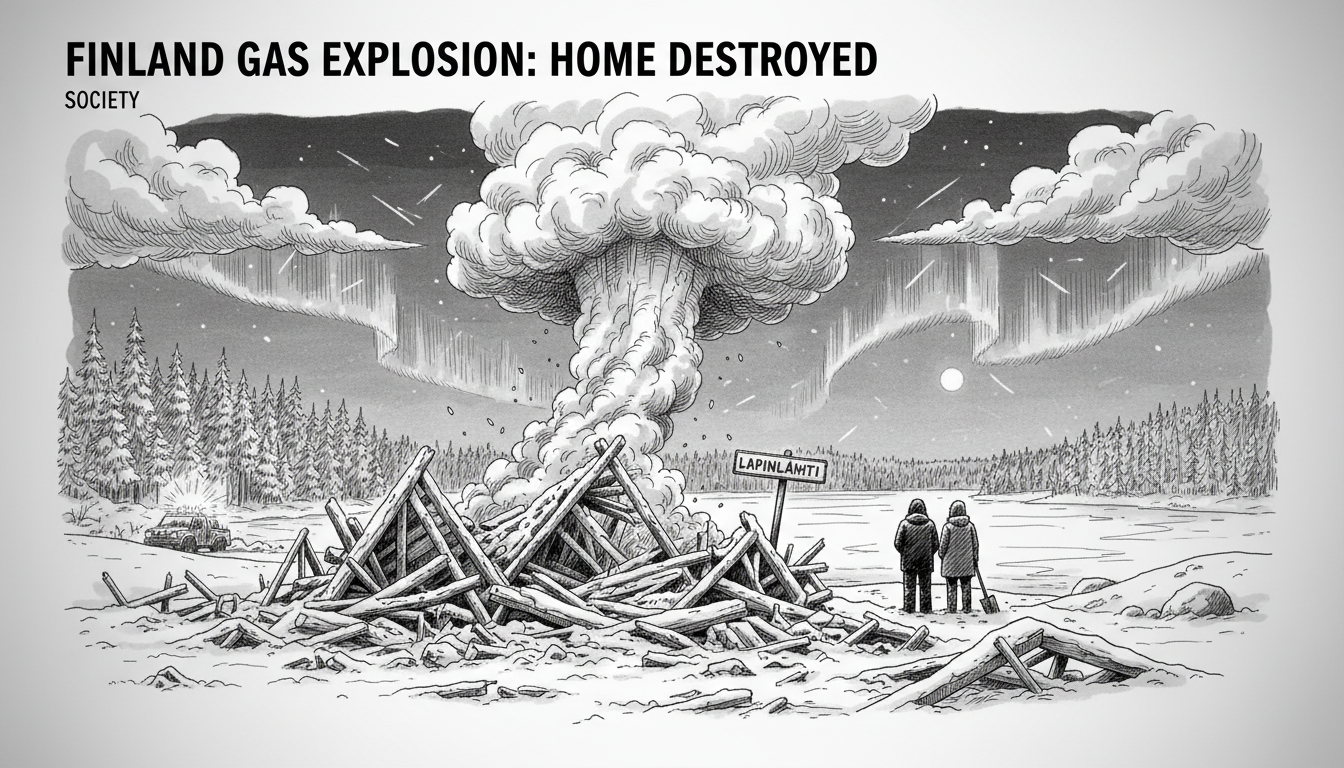
Finland house explosion investigators are focusing on a leaking liquefied petroleum gas (LPG) cylinder as the likely cause of a devastating blast that destroyed a detached house garage in Lapinlahti. The East Finland Police Department stated on Monday that gas from the cylinder may have leaked into the garage, where a spark from an electrical device potentially ignited it, causing an explosion that collapsed the structure. No one was injured in the Saturday afternoon incident, as the homeowners were away, but a neighbor had to extinguish a small fire that broke out after the initial blast.
A Sudden Blast in a Quiet Community
The emergency call came in around 1:30 PM on a Saturday afternoon in Lapinlahti, a municipality in the Northern Savonia region. The force of the explosion was substantial, causing the garage of the omakotitalo, or detached house, to collapse completely. Debris from the building was thrown into the yards of neighboring properties, illustrating the violence of the event. Quick action by a neighbor, who rushed to put out the ensuing small fire, prevented a more serious secondary blaze. Preliminary assessments by the homeowner suggest the house itself is now beyond repair, rendered uninhabitable by the damage.
Police have confirmed the sequence of events is under active investigation. "The case will be investigated further, but it may be that full certainty about the cause of the explosion will not be obtained," the police said in their statement, acknowledging the forensic challenges. The central hypothesis, however, is clear: a gas leak, an ignition source, and a catastrophic result. This incident highlights a silent risk present in many Finnish homes, where LPG cylinders are commonly used for summer cottages, barbecues, and auxiliary heating.
The Silent Hazard of Domestic Gas
Finland maintains strict technical safety regulations regarding the handling, storage, and installation of gas systems. The Finnish Safety and Chemicals Agency (Tukes) oversees these regulations, which cover everything from the certification of cylinders to requirements for ventilation in spaces where gas appliances are used. LPG is heavier than air, meaning leaked gas can pool in low-lying areas like garage floors, creating an invisible, highly flammable cloud waiting for an ignition source.
That source, in this Lapinlahti case, is preliminarily believed to have been an electrical device. "A spark from an electrical device in the garage may have ignited the gas," police stated. This could be anything from a refrigerator compressor kicking on, a faulty light switch, or a tool being plugged in. The investigation will meticulously examine the wreckage to identify the specific appliance and the condition of the gas cylinder valve and hose. Experts will be looking for signs of wear, damage, or improper installation that could have led to the leak.
While such dramatic explosions are relatively rare in Finland, they prompt immediate scrutiny of safety practices. "Every incident of this nature is a tragic reminder that gas is a potential hazard if not treated with respect and according to code," says a Helsinki-based fire safety consultant who wished to remain anonymous as the investigation is ongoing. "The rules exist for a reason—proper storage in well-ventilated areas, regular checks of hoses and fittings, and ensuring cylinders are turned off when not in use are not just recommendations; they are critical preventative measures."
A Narrow Escape and Community Response
The most significant fact from this Lapinlahti explosion is that no one was hurt. The homeowners' absence at the time of the blast was a matter of sheer luck. Had they been in the garage or the adjoining house, the results could have been fatal. This near-miss aspect will form a key part of the official investigation's conclusions, which always aim to derive public safety lessons.
The role of the neighbor in quickly dousing the initial fire also prevented the incident from escalating. A structure collapse combined with a growing fire would have posed a much greater threat to adjacent properties and complicated the emergency response. The event, while localized, undoubtedly sent a shockwave through the small community, raising awareness and likely prompting residents to check their own gas cylinders and electrical safety.
Finland's approach to such incidents is methodical. The police investigation runs parallel to assessments by insurance companies and possibly Tukes if systemic safety issues are suspected. The focus is not on assigning blame but on definitively understanding the cause to prevent recurrence. Was the cylinder past its inspection date? Was it stored correctly? Was the garage adequately ventilated? These are the practical questions investigators seek to answer.
Broader Implications for Finnish Household Safety
This explosion in Lapinlahti serves as a stark, real-world test case for Finland's domestic safety regulations. The country's high standard of living and generally strict building codes contribute to a strong safety record, but they cannot completely eliminate risk from human error or equipment failure. The incident is a reminder that danger can exist in the most mundane of places—a family garage.
In the Nordic context, where the use of propane and other bottled gases is widespread for summer cabins and in homes beyond the district heating network, public awareness campaigns periodically highlight cylinder safety. Key advice includes storing cylinders upright and outdoors in a well-ventilated shelter, protecting them from frost and direct sunlight, and having installations performed by certified professionals. Consumers are urged to listen for the hiss of a leak and to use soapy water to check for bubbles at connections if a leak is suspected.
The psychological impact on the homeowners and the immediate neighbors is considerable. Losing one's home to a sudden, violent event is deeply traumatic, even without physical injury. The process of dealing with insurance, finding temporary housing, and deciding whether to rebuild will be a long and challenging journey for the affected family.
Looking Ahead: The Path of the Investigation
The East Finland Police have indicated their investigation is continuing. Forensic specialists will likely reconstruct the scene, analyzing the pattern of the debris field to pinpoint the epicenter of the blast. The remnants of the gas cylinder and the suspected electrical device will be examined in a lab. Investigators will interview the homeowners about the cylinder's age, its last use, and the general state of the garage's electrical system.
While the police note that absolute certainty is not always possible, the evidence currently points strongly to the gas cylinder hypothesis. The final report will contribute to the national body of knowledge on such accidents. Its findings may be used by Tukes and fire safety authorities to refine public guidance or, if a specific product defect is found, to issue a safety alert.
For now, the shattered garage in Lapinlahti stands as a quiet testament to a potent combination of combustible gas and a single spark. It is a story of both destruction and fortune—a home destroyed but lives spared, a violent event contained by a neighbor's swift action. As the clean-up begins, the fundamental question for every Finnish household that uses similar equipment is simple and urgent: When was the last time you checked your gas cylinder?