
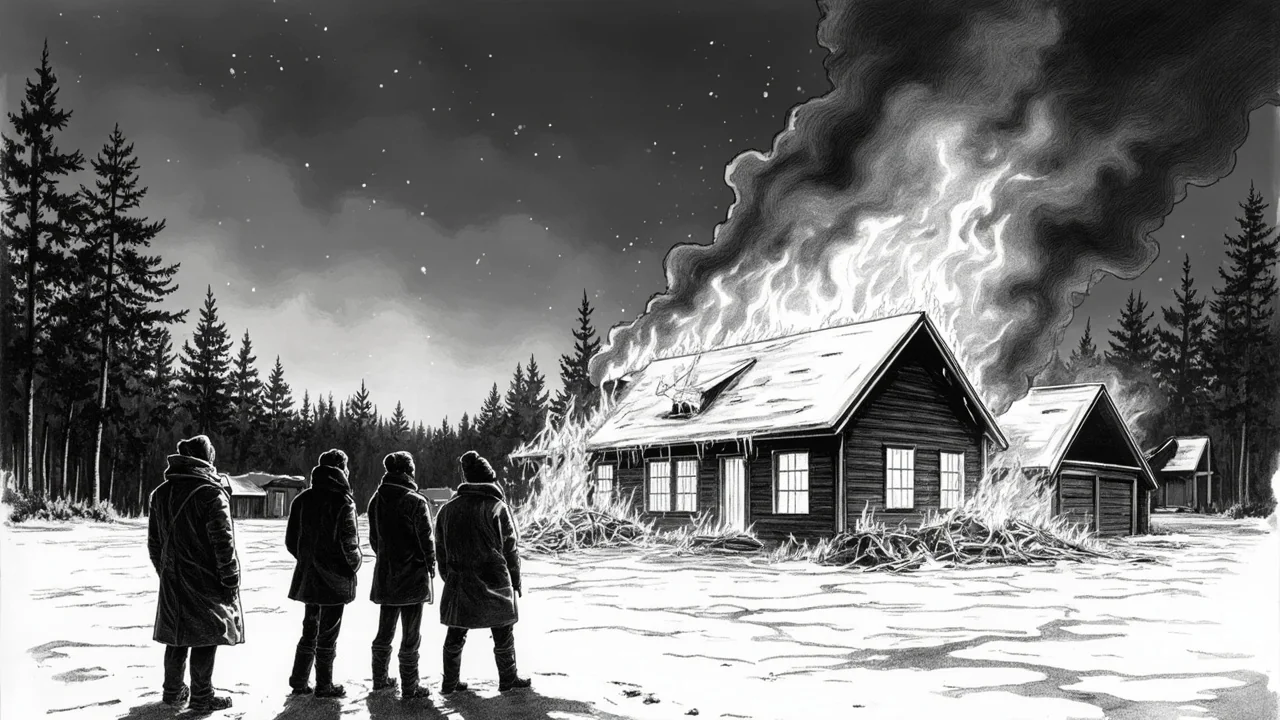
Finland's West Uusimaa Rescue Department battled a fierce overnight blaze that completely destroyed a detached house and an outbuilding in Lohja. The fire, reported by a neighbor just before 2 a.m. on Sunday, had already engulfed both structures when firefighters arrived, preventing immediate entry due to intense heat radiation. No information on potential casualties is yet available, with authorities confirming police are actively trying to locate the property's occupants.
"When the rescue department arrived on the scene, both buildings were already in the full blaze stage and the heat radiation was high, so the firefighters could no longer get inside the house at that point," said Pasi Kääriäinen, the on-duty fire chief for West Uusimaa Rescue Department. He added that details on possible injuries would likely become clearer during Sunday. The cause of the fire in the Nummi church village area remains unknown, though officials suspect the secondary structure was some type of shed or carport.
A Community Awakened by Flames
The quiet residential area of Nummi, within the larger Lohja municipality, was abruptly awakened in the early hours of Sunday. A neighbor, witnessing the terrifying glow, made the crucial emergency call that summoned firefighters from the West Uusimaa Rescue Department. By the time crews reached the scene on the secluded plot, the situation was dire. The main house and a separate outbuilding were both fully involved, with flames consuming the structures and generating extreme heat that created a defensive barrier for first responders.
Fire Chief Kääriäinen described a scene of total destruction. Only a few walls remained standing from each building, and the roof of the detached house had completely collapsed into the inferno. The intensity of the fire necessitated a prolonged response. Firefighters worked through the night and into Sunday morning, with mop-up operations—damping down hot spots and ensuring the fire was completely extinguished—continuing until approximately 11 a.m. Officials confirmed the blaze posed no threat to neighboring homes, a critical relief in a densely built area.
The Lingering Question of Occupancy
The most pressing and unsettling unknown following the Lohja fire is the status of the people who lived there. Finnish authorities have not released any information about potential victims, a standard practice until next of kin are notified and investigations progress. Fire Chief Kääriäinen directly addressed this central concern in his statements. "Certainly the police are trying to reach these people," he said, referring to the house's residents.
This process is a meticulous and sensitive one. Police will work to establish who was registered as living at the address, contact family members, and check with hospitals. In severe fires, identification can be a complex and time-consuming forensic process. The lack of immediate information, while anxiety-inducing for the community, reflects the careful protocol followed in such tragedies. The possibility that the house was unoccupied at the time, or that occupants escaped without contacting authorities, remains open until police complete their outreach.
Understanding Finland's Fire Response Framework
This incident in Lohja activates a well-rehearsed chain of response within Finland's municipal rescue services. The West Uusimaa Rescue Department, covering the city of Lohja and surrounding regions, operates as a professional fire and rescue service. Finland's rescue system is decentralized, organized at the municipal level, but operates under national guidelines and standards set by the Ministry of the Interior. This structure ensures local knowledge and rapid response, as seen in this case where a neighbor's call brought local units to the scene within minutes.
The response typifies standard procedure for a major structural fire. Upon confirmation of a fully developed blaze, the focus shifts from interior attack to exterior containment and defense, precisely the scenario described by Fire Chief Kääriäinen. The priority becomes preventing the fire from spreading to adjacent properties and protecting firefighters from structural collapse and extreme heat. The subsequent investigation will be a joint effort. The rescue department will produce a technical report on the fire's behavior and their response, while police will lead the investigation into the cause and circumstances, particularly relating to the occupants.
From Emergency to Investigation
The transition from firefighting to investigation began as the last embers were being cooled. With the fire extinguished, the site transforms from an emergency scene to a forensic one. Investigators from the police and rescue department's fire investigation unit will conduct a meticulous examination of the ruins. They will work to locate the seat of the fire—its point of origin—which is key to determining the cause.
Common causes investigated in such cases include electrical faults, heating system malfunctions, accidental ignition from appliances or open flames, or issues related to the secondary structure, which may have been used for storage or as a workshop. The complete destruction complicates this task, as evidence is often heavily damaged. Investigators will map the scene, interview the neighbor who reported the fire and other witnesses, and review any available data. The process is deliberate; a definitive cause may take days or weeks to establish, if one can be determined conclusively at all.
The Ripple Effect in a Tight-Knit Area
While the physical danger to other homes was minimal, the psychological impact on the Nummi community is significant. Lohja, a city known for its beautiful archipelago and historic church, is a community where people often know their neighbors. The sight of a home utterly destroyed, the acrid smell of smoke lingering in the air, and the swirling emergency lights in the dead of night create a profound sense of vulnerability and shared concern.
Local social media groups and community networks likely buzzed with speculation and offers of help throughout Sunday. This collective anxiety underscores the human dimension of the tragedy beyond the property loss. The wait for official information about the residents is a heavy burden for those nearby. Community support systems, both formal and informal, will mobilize, offering everything from temporary housing to emotional support for those directly and indirectly affected. The incident serves as a stark reminder for all residents to check their own smoke alarms and review household escape plans.
A Look at Finnish Fire Safety in Detached Housing
This devastating fire in Lohja brings national fire safety statistics into sharp focus. Detached houses, or omakotitalot, are the most common housing type in Finland, especially in suburban and rural areas like Nummi. According to data from the Finnish National Rescue Association (SPEK), structural fires in detached homes, while less frequent than in apartment buildings, often result in greater total damage due to the speed at which fire can consume an entire standalone structure. The presence of auxiliary buildings like sheds or garages, which may store flammable materials such as gasoline, paints, or gardening equipment, can contribute to the fire's intensity and rapid spread, as suspected in this case.
Finnish building codes have strict regulations for fire safety, including requirements for smoke alarms, which are mandatory in all homes. However, the effectiveness of these measures ultimately depends on proper maintenance and occupant behavior. Winter months can also see a rise in fires related to alternative heating sources, though this late-season blaze points to other potential causes. The investigation will scrutinize whether all safety devices were present and functional, a standard part of the post-fire analysis aimed at preventing future tragedies.
The Long Road Ahead
For the property owners, the coming days and weeks will involve navigating a difficult landscape of insurance claims, dealing with authorities, and facing the total loss of their home and belongings. For the community, the charred remains of the house will stand as a somber landmark until cleared. The official findings from the police investigation will provide some closure, answering the critical questions of how the fire started and, most importantly, the fate of the residents.
This fire in Lohja is a single entry in the log of the West Uusimaa Rescue Department, but it represents a life-altering event for a Finnish family and their neighbors. It highlights the relentless work of Finland's rescue services, who confront such destruction routinely, and the fragile line between safety and catastrophe in everyday life. As the investigation continues quietly behind the scenes, the community's thoughts remain with those whose home vanished in the night, awaiting the simple, crucial confirmation of their safety.