
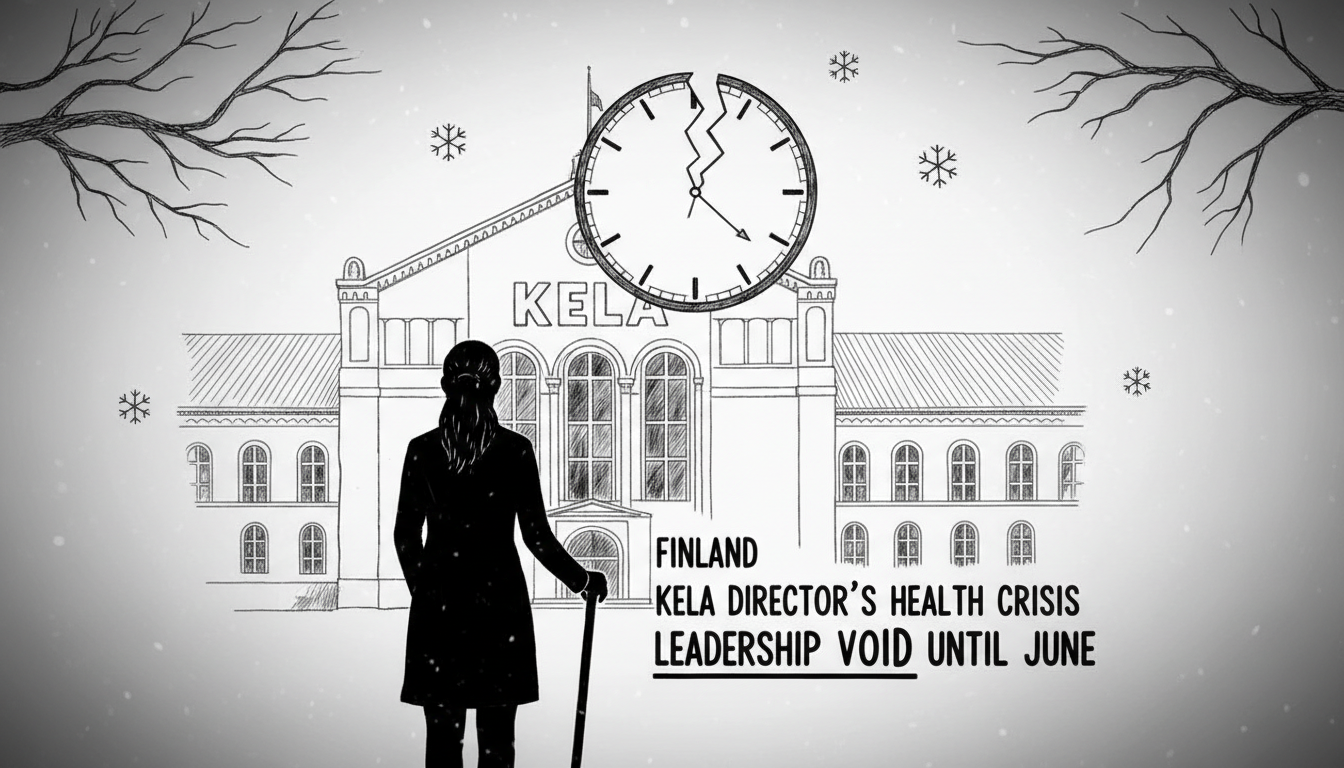
Finland's Social Insurance Institution Kela faces a prolonged period of leadership uncertainty after Director General Outi Lehtonen was diagnosed with a serious illness. Her medical leave has been extended through the end of May, confirming a significant absence at the helm of the nation's most critical welfare agency. Kela's board chairman Vertti Kiukas announced the extension, stating the institution wishes Lehtonen and her family peace for her recovery. Acting Director General Kari-Pekka Mäki-Lohiluoma will continue leading the agency in her stead.
Lehtonen returned to Finland via air ambulance last Saturday and continues to receive treatment within the Finnish healthcare system. Both Lehtonen and her family consented to the public disclosure of her condition, a move that provides transparency but underscores the gravity of the situation. This development creates an unexpected leadership challenge for Kela during a period of significant budgetary pressure and ongoing social security debates in the Eduskunta, Finland's parliament.
A Pillar of Finnish Society in Transition
Kela, or Kansaneläkelaitos, forms the bedrock of the Finnish welfare state. The institution administers the national safety net, distributing everything from child benefits and housing allowances to pensions and unemployment security. In 2022 alone, Kela disbursed 16.6 billion euros in benefits to Finland's population of approximately 5.5 million residents. The Director General oversees this vast operation, making strategic decisions that directly impact the economic security of every household in the country.
Outi Lehtonen assumed the role in 2020, succeeding Outi Antila who served for a decade. Her tenure has been marked by navigating post-pandemic economic turbulence and responding to inflationary pressures on benefit levels. The sudden and extended nature of her absence removes a key experienced voice from both domestic policy discussions and Finland's representation in Nordic and EU social security forums. Continuity is paramount for public trust in the system's stability.
The Mechanics of Interim Leadership
The appointment of Kari-Pekka Mäki-Lohiluoma as acting Director General follows Kela's standard succession protocols. Mäki-Lohiluoma, a seasoned official within the institution, now carries the responsibility for daily operations and strategic continuity. His primary task is to ensure the machinery of Finland's social security runs smoothly without interruption in payments or services.
Board Chairman Vertti Kiukas's statement emphasized a desire for recovery peace for Lehtonen, signaling the board's support for the current interim arrangement. This approach aims to project calm and operational normality. However, analysts note that an acting leader may have limited authority to initiate major new policy directions or long-term strategic shifts, potentially placing some broader reform projects on a slower track until a permanent leadership situation is resolved.
Political and Operational Implications in Helsinki
The timing of this health crisis intersects with active political debate in Helsinki's government district. Finland's coalition government, led by Prime Minister Petteri Orpo, is engaged in delicate negotiations concerning social security spending and potential reforms. Kela's leadership provides crucial technical expertise and data to these discussions. While the acting director can fulfill this role, the absence of the confirmed Director General may subtly influence the dynamics between the civil service and political leadership.
"The stability of Kela's operations is the absolute priority," said a social policy researcher from the University of Helsinki, speaking on background. "The system is designed to function administratively without disruption. The greater question mark lies over strategic decision-making and high-level advocacy within government circles. An acting director may be more hesitant to stake out strong positions on forthcoming reforms." Key areas requiring steady guidance include the implementation of any new government austerity measures affecting benefits and the ongoing digital transformation of Kela's services.
Public Trust and Institutional Resilience
Public confidence in Kela is essential for the social contract in Finland. The transparent handling of Lehtonen's situation—publishing the medical leave extension with family consent—aims to maintain that trust. It avoids a vacuum of information that could fuel speculation. Citizens need assurance that their benefits, from parental leave payments to pension disbursements, will arrive without fail.
The institution itself is testing its resilience. Kela employs thousands of experts across Finland, and its operational framework is built on legislation and established processes, not solely on one individual. This event is a real-time test of that structural strength. The coming months will demonstrate how effectively a major Finnish agency can maintain its course during an unexpected, prolonged leadership gap.
Looking Beyond May: Scenarios for the Future
The extension of leave until the end of May creates a clear timeline for the immediate future. All eyes will be on Lehtonen's recovery and a potential update as spring turns to summer. Several scenarios are possible. A positive recovery could see Lehtonen resume her duties later in the year. Should a longer-term or permanent absence become necessary, the Kela board would need to initiate a formal process to appoint a new Director General, a significant undertaking that involves government consultation.
For now, the Finnish welfare state continues its work. Kela's offices process applications, its systems calculate benefits, and payments reach bank accounts. The human story at the top is one of personal health and recovery, while the institutional story below is one of continuity. This dual narrative will define the coming months for one of Finland's most vital public institutions. The ultimate measure of success will be if, for the millions of Finns relying on its services, this period of internal challenge passes without notice.