
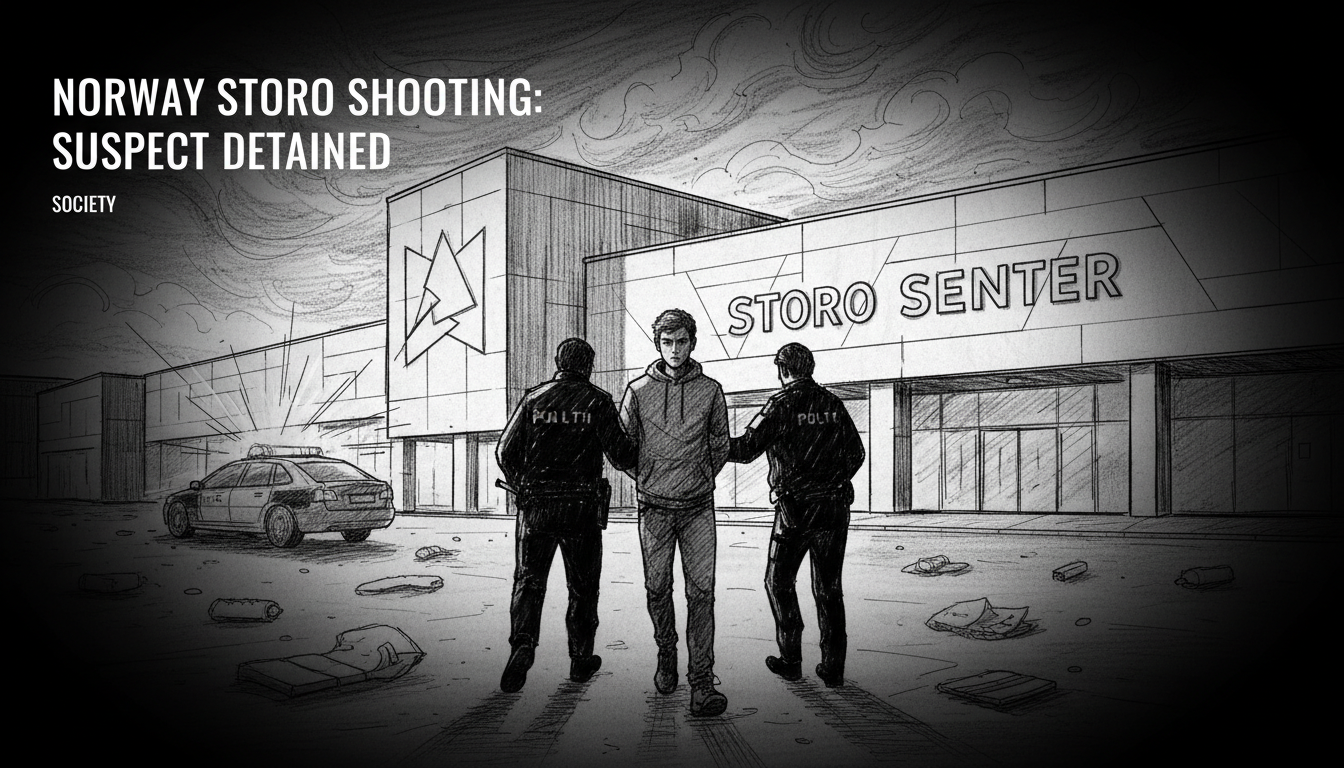
Norway's strict gun control laws were tested by a shooting incident at Oslo's Storo Storsenter shopping center. A 19-year-old man has admitted to the facts of the case and will remain in custody for four weeks, a court has ruled. The decision cites a significant risk of evidence tampering as the primary reason for his detention. This rare public shooting in one of Europe's safest capitals has sparked a national conversation about security and youth violence.
Defense attorney Dennis Nysted confirmed his client's connection to the event. The court also imposed strict controls on the suspect's mail and visitation rights. These measures are standard in Norwegian pre-trial detention when prosecutors argue a defendant may interfere with an investigation. The four-week custody period allows police to continue their work without obstruction.
A Breach of the Norwegian Social Contract
Public shootings in crowded spaces represent a profound breach of Norway's social contract. The country maintains some of the world's toughest firearm regulations, with ownership largely restricted to hunting and sport. Violent crime rates are consistently low by international standards. An incident at a major retail hub like Storo Storsenter, located in a busy northern district of Oslo, therefore carries an outsized psychological impact. It challenges the public's fundamental sense of safety in everyday life.
"When violence erupts in a place dedicated to community and commerce, it shakes the foundation of our social trust," said Kari P. Høiland, a sociologist at the University of Oslo who studies urban safety. "Norwegians are not accustomed to calculating risk in their local shopping centers. This case will inevitably lead to questions about whether something is changing, even if statistically such events remain extremely rare."
The Legal Path Forward
The suspect's acknowledgment of the factual circumstances does not equate to a formal guilty plea. Under Norwegian law, it means he does not contest the prosecution's basic description of events—that a shot was fired at the location. His defense strategy will now focus on intent, circumstances, and legal justification. The court's concern about evidence tampering suggests the investigation is ongoing and may involve digital evidence, witness testimony, or forensic analysis that could be compromised.
Pre-trial detention, known as varetekt, is not granted lightly in Norway. Judges must be convinced that reasons such as flight risk, risk of re-offending, or risk of evidence tampering are present. A four-week initial detention is common for serious charges while police complete their investigation. The court can extend this period in subsequent hearings if necessary.
"The imposition of mail and visit control is a clear signal the court sees this as a serious matter where outside influence is a concern," explained legal analyst Torje Halvorsen. "It isolates the suspect from his network during the critical evidence-gathering phase. The system is designed to balance the rights of the accused with the state's duty to conduct a thorough investigation."
Context in a Low-Crime Society
To understand the reverberations of this case, one must look at Norway's crime statistics. The nation's homicide rate is approximately 0.5 per 100,000 inhabitants, one of the lowest globally. Gun violence is particularly uncommon. Most police officers do not carry firearms on routine patrol. This context makes any public shooting automatically a top-tier news story and a political issue.
Security protocols at large public venues like Storo Storsenter are now under scrutiny. While major Norwegian airports and some government buildings have visible security, shopping centers typically do not. The incident raises difficult questions about whether the Norwegian model of open, trusting public space can be maintained without adaptation. Any move toward increased surveillance or security checks would represent a cultural shift.
The Ripple Effects of a Single Gunshot
The consequences of the Storo shooting extend beyond the courtroom. Local businesses in the center faced disruption and potential loss of customer confidence. Parents in the residential neighborhoods surrounding Storo may reassess their children's independence. The incident also feeds into a broader, often tense, political debate in Oslo concerning youth gangs, social integration, and crime prevention.
While Norway's largest city remains incredibly safe by global metropolitan standards, it is not immune to the challenges of urban growth and inequality. Isolated incidents can quickly become symbols in larger political narratives about social cohesion. How authorities handle the judicial process and communicate with the public will be critical in managing these societal ripples.
A Test for Norway's Justice and Social Model
As the investigation proceeds, all eyes will be on the Oslo Police District and the Norwegian prosecuting authority. Their handling of the case must demonstrate both efficiency and absolute adherence to the rule of law. The integrity of the process is paramount for public confidence. The suspect's right to a fair trial must be scrupulously protected, even as the public demands answers and security.
This case serves as a sudden, stark test of Norway's celebrated equilibrium between freedom and safety, between trust and control. The nation's response will be measured not just in the verdict, but in the calmness and rationality of its public discourse in the weeks to come. The goal will be to address a serious crime without eroding the communal trust that defines Norwegian society.
Can a society built on transparency and low suspicion maintain its character when confronted with random violence in its shared spaces? The answer will unfold in Oslo's courtrooms, media debates, and the quiet corridors of Storo Storsenter as it returns to daily life.