
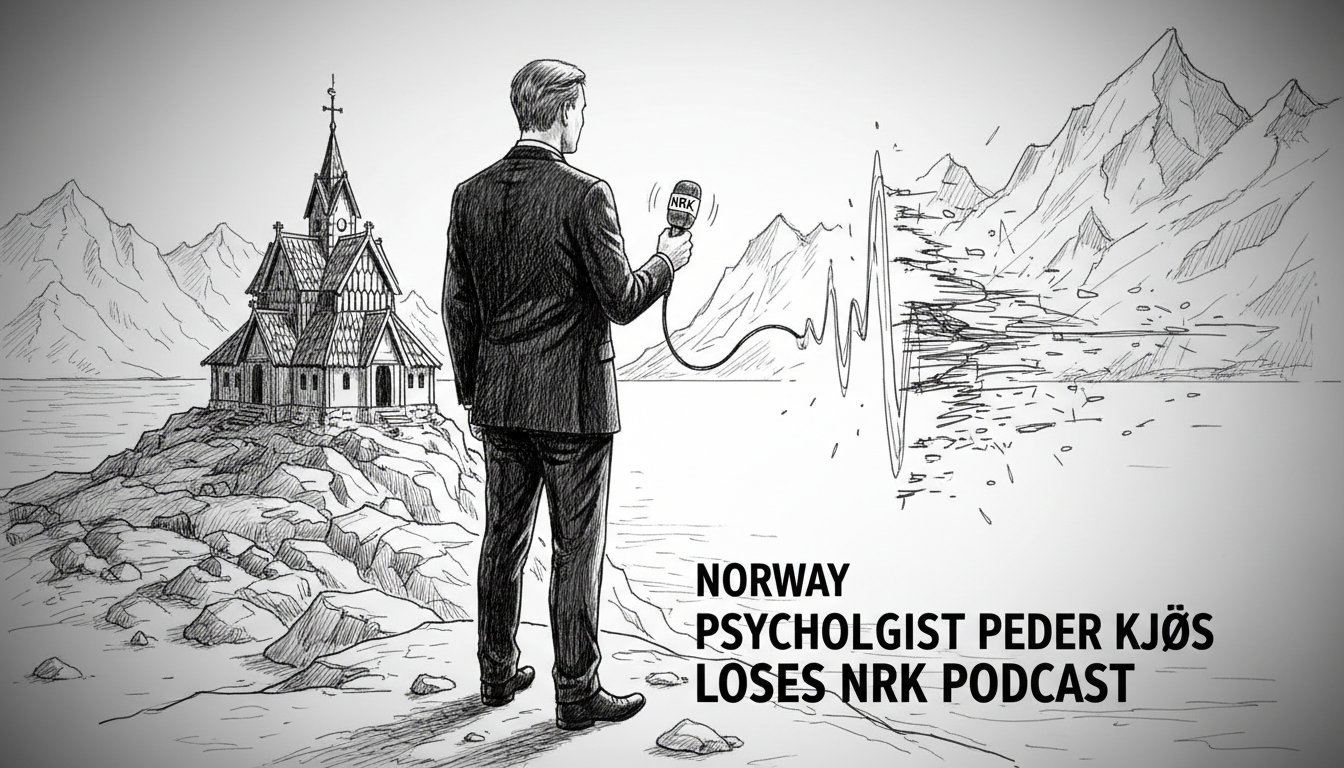
Norway's public broadcaster NRK has removed all episodes of a popular podcast series hosted by psychologist Peder Kjøs. The decision follows a formal restriction placed on Kjøs's professional license by the Norwegian Board of Health Supervision, known as Helsetilsynet. This move has ignited a debate about ethics, media responsibility, and the credibility of health professionals in the public sphere.
Jostein Olseng, an executive editor at NRK, confirmed the decision to another media outlet. "We are going to make it unavailable, and that applies to the entire series," Olseng stated. He directly linked the action to the health board's recent assessment of Kjøs's professional conduct. The broadcaster's swift removal of content underscores the weight given to regulatory decisions in Norway's tightly governed media and healthcare sectors.
A Regulatory Intervention with Media Repercussions
The Norwegian Board of Health Supervision is the national authority tasked with overseeing the quality and safety of healthcare professionals. Its decision to restrict Peder Kjøs's authorization is a significant disciplinary measure. While Kjøs can continue practicing, he must now operate under specific, mandated conditions set by the board. The exact nature of these conditions and the violations that prompted them have not been made public, as Helsetilsynet's disciplinary processes are typically confidential.
This confidentiality creates a tension between regulatory privacy and public transparency, especially when the professional in question maintains a high-profile media presence. NRK, as a publicly funded institution with a mandate for trustworthy content, faced a clear dilemma. Continuing to host content featuring a psychologist under official sanction could undermine public trust in both the broadcaster and the profession. Olseng's statement indicates NRK viewed the board's ruling as a definitive factor in its editorial judgment.
The Challenge of Blending Therapy and Entertainment
Peder Kjøs rose to prominence by discussing relationship psychology and personal dilemmas in an accessible, often direct manner. His podcast for NRK fit within a broader genre of popular psychology media, where complex personal issues are explored for a mass audience. This format inherently walks a fine line between public education and entertainment, and between general advice and implied therapeutic counsel.
"When a licensed psychologist hosts a program on a major platform like NRK, their professional authority is implicitly stamped on the content," says Dr. Anette Thommessen, a professor of media ethics at the University of Oslo. "The audience trusts that the information is not just engaging, but also ethically sound and professionally correct. A sanction from Helsetilsynet directly challenges that foundation of trust. For NRK, the editorial risk became too high."
Experts note that the core issue isn't about freedom of expression, which is strongly protected in Norway. Kjøs remains free to express his opinions. The conflict arises at the intersection of his state-regulated professional title and his role as a media content creator. By using the title "psychologist," he invokes a set of legal and ethical standards enforced by Helsetilsynet. The board's action suggests a perceived breach of those standards in his professional practice, which in turn contaminated his media work in the eyes of the broadcaster.
The Precedent for Public Trust in Norway
Norway consistently ranks high in global surveys of institutional and social trust. This trust is built on transparent systems and clear accountability, particularly in public institutions like NRK and regulatory bodies like Helsetilsynet. The swift delisting of the podcast can be seen as a protective action for this ecosystem of trust. It signals that professional oversight has real consequences and that public media takes its role as a curator of credible information seriously.
However, the action is not without critics. Some media commentators argue that removing the entire archive is a form of digital erasure that prevents the public from contextualizing the controversy or judging the content for themselves. They question whether a restriction on a professional license should automatically render past media work unfit for public access, especially without detailed public explanations.
"There's a principle of proportionality at stake," argues Lars Inge Staveland, a journalist specializing in media law. "Was every piece of advice in every episode deemed harmful or unethical? Probably not. The blanket removal is the safest administrative choice for NRK, but it may also be an overcorrection. It sets a precedent where any future sanction against a professional with a media profile could lead to immediate content purges."
The Path Forward for Kjøs and Media Partnerships
The immediate professional future for Peder Kjøs involves operating within the strict confines set by Helsetilsynet. Rebuilding his public standing, should he wish to do so, will be a longer process heavily dependent on the nature of the board's concerns. For other health professionals in media, this case serves as a stark reminder that their media activities are inextricably linked to their licensed professional status.
For NRK and other broadcasters, the episode reinforces the need for rigorous vetting and ongoing monitoring of contributors who represent regulated professions. It may lead to more explicit contractual clauses regarding professional conduct and the consequences of regulatory sanctions. The broadcaster's decision, while dramatic, aligns with its statutory duty to provide content that is "subject to high professional and ethical standards."
Ultimately, the story of the delisted podcast is less about a single personality and more about the robust, sometimes collision-prone, systems Norway has built to manage professional ethics and public information. The Helsetilsynet protects the standards of a vital profession. NRK protects the integrity of its platform. The friction between these two protective actions highlights the complex reality of being a public figure in a field where trust is the primary currency. The silence left by the removed podcast episodes speaks volumes about the high stakes involved when that trust is called into question.
Will this case lead to clearer guidelines for health professionals in media, or does its resolution through swift removal simply reinforce the current system's powerful deterrents? As digital archives grow, the question of how past work is treated when a creator faces present-day sanctions is one all media institutions will grapple with.