
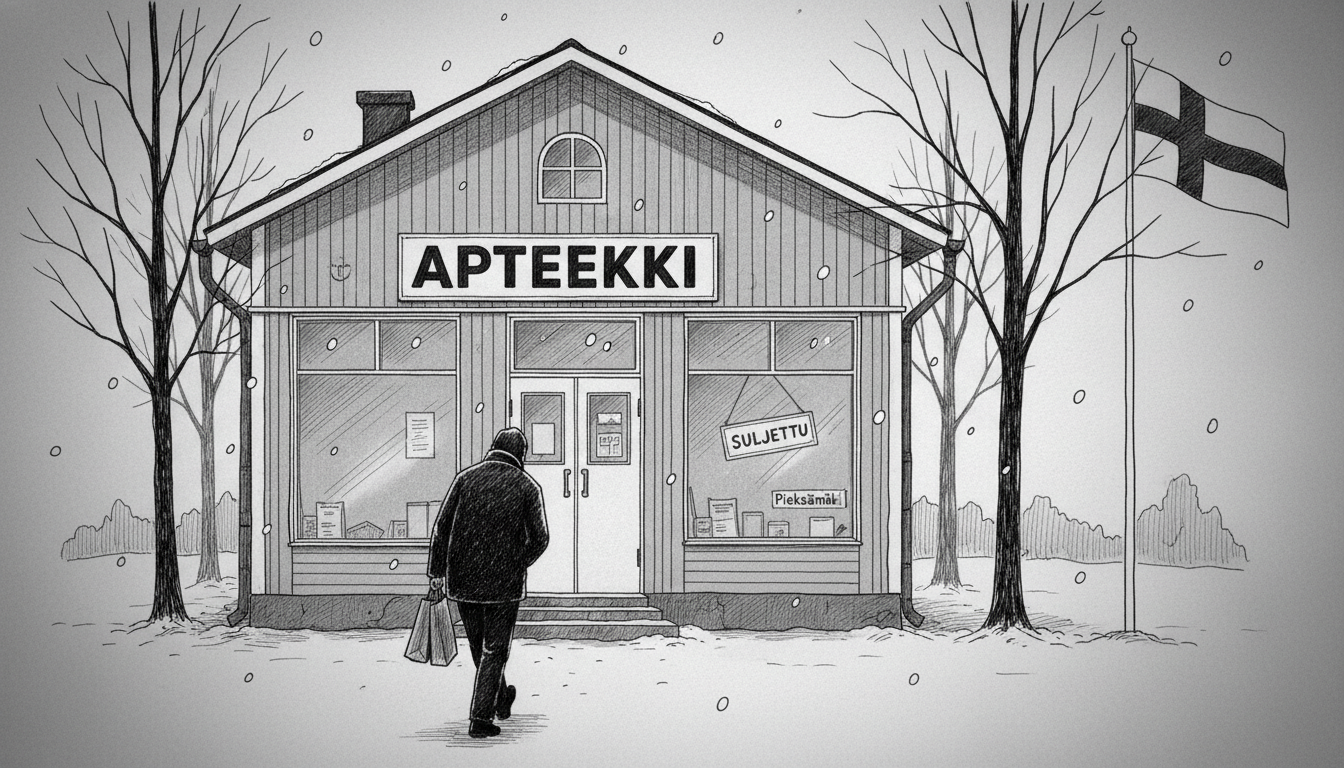
Finland's tightly regulated pharmacy network faces a new pressure point as the Kontiopuisto pharmacy in Pieksämäki prepares to close its doors for good on December 31. Pharmacist Antti Mäntylä confirmed the closure, citing years of declining profitability that made the operation unsustainable. This shuttering highlights the fragile economic balance within Finland's unique pharmaceutical system, where fixed margins and controlled licensing collide with market realities in smaller population centers.
For residents in the Kontiopuisto district, the closure means losing a neighborhood institution. They must now travel to the Ykkösapteekki located within the Prisma Pieksämäki hypermarket, which Mäntylä will continue to manage. While another pharmacy remains in the town, the loss of a local outlet raises immediate questions about access for elderly residents, those without cars, and people with mobility challenges. A simple trip for medicine becomes a more complex logistical task.
The Economics Behind a Pharmacy Shutdown
Antti Mäntylä's decision stems from a straightforward financial calculation. "The pharmacy's profitability weakened year after year," he stated, describing a slow but relentless trend. Finland operates a fixed-margin system for pharmacies, meaning their income is a set percentage of medicine sales. This model prioritizes stability and prevents aggressive commercial competition, but it also ties a pharmacy's financial health directly to its sales volume.
In a smaller community like Kontiopuisto, a dip in customer numbers or changes in prescription patterns can quickly erode the bottom line. Operating costs, including salaries for trained pharmacists and mandatory regulatory compliance, remain largely fixed. The total turnover for all Finnish pharmacies reached approximately 4 billion euros in 2022, but that revenue is not evenly distributed. Larger pharmacies in urban hubs or attached to major retailers like Prisma benefit from significantly higher foot traffic and sales volume.
A System Designed for Equality Faces New Strains
Finland's pharmacy model is deliberately designed for equitable access. The Finnish Medicines Agency (Fimea) grants operating licenses and controls the total number of pharmacies, aiming to ensure all citizens, whether in Helsinki or rural Lapland, have reasonable access to pharmaceutical services. As of 2022, there were about 620 pharmacies serving the country's 5.6 million people.
This closure in Pieksämäki tests that principle of geographical equality. The system successfully prevents pharmacy deserts in remote areas by mandate, but it cannot always guarantee economic viability. When a pharmacist like Mäntylä decides a unit is no longer financially tenable, the state does not typically intervene to subsidize its continued operation. The result is a slow-motion consolidation, where services gradually concentrate into fewer, larger locations, often in retail complexes.
"Pharmacy closures in smaller towns create real gaps in the healthcare safety net," explains a healthcare policy analyst familiar with the Nordic region. "It's not just about dispensing pills. Pharmacists provide crucial consultations, monitor drug interactions, and are often the most accessible healthcare professional. For an aging population, losing a nearby pharmacy can mean reduced medicine adherence and worse health outcomes."
The Broader Trend of Retail Centralization
The fate of the Kontiopuisto pharmacy mirrors a wider retail and service trend across Finland. Smaller, neighborhood-based shops struggle against the draw of large, multipurpose hypermarkets like Prisma, which offer convenience and one-stop shopping. Ykkösapteekki's location within Prisma Pieksämäki gives it inherent advantages in customer numbers and operational synergies with the store's traffic.
Consumer behavior is also shifting. While online pharmacy sales are still regulated in Finland, the growing public comfort with e-commerce in general places pressure on all physical retail models. Patients are increasingly comfortable ordering non-prescription items online, and discussions about broader online prescription services continue within the EU framework. This evolving landscape asks difficult questions about the future role of the community pharmacy.
Political and Regulatory Crossroads
The closure presents a subtle challenge for policymakers in Helsinki. The government, led by Prime Minister Petteri Orpo's coalition, must balance fiscal responsibility with commitments to social and healthcare equity. The pharmacy system is a point of national pride, often cited as a example of the well-functioning Nordic welfare state. Each closure chips away at that image and prompts scrutiny of the underlying regulations.
Could the fixed-margin system be adjusted for pharmacies in low-population areas? Should municipal health services play a role in ensuring pharmaceutical access? These are complex questions that touch on EU competition law, national healthcare financing, and regional policy. The Finnish Parliament, the Eduskunta, has periodically reviewed the Pharmacy Act, but major reforms have been avoided to maintain system stability.
What the Closure Means for Pieksämäki
For the town of Pieksämäki, the immediate impact is practical. The remaining Ykkösapteekki in Prisma will absorb the patient base. Pharmacist Antti Mäntylä's expertise remains in the community, just at a different address. The municipality may need to examine transportation links to ensure those reliant on the closed pharmacy can still reach the Prisma location without undue hardship.
The longer-term implication is symbolic. The loss of a local service is often felt as a loss of community vitality and self-sufficiency. It signals a retrenchment, a step back from the dense network of services that defines Finnish societal planning. Other small towns across the country will watch Pieksämäki's experience closely, wondering if their local pharmacy faces a similar fate.
Finland's pharmacy system is at a crossroads, caught between its laudable founding principle of universal access and the hard math of operational costs. The silent closure of the Kontiopuisto pharmacy at year's end is not a crisis, but it is a warning. It is a data point suggesting that even the most carefully engineered systems must adapt when the ground beneath them shifts. The challenge for Finland is to find an adaptation that preserves access without sacrificing the quality and integrity that make its pharmacies trusted pillars of community health.