
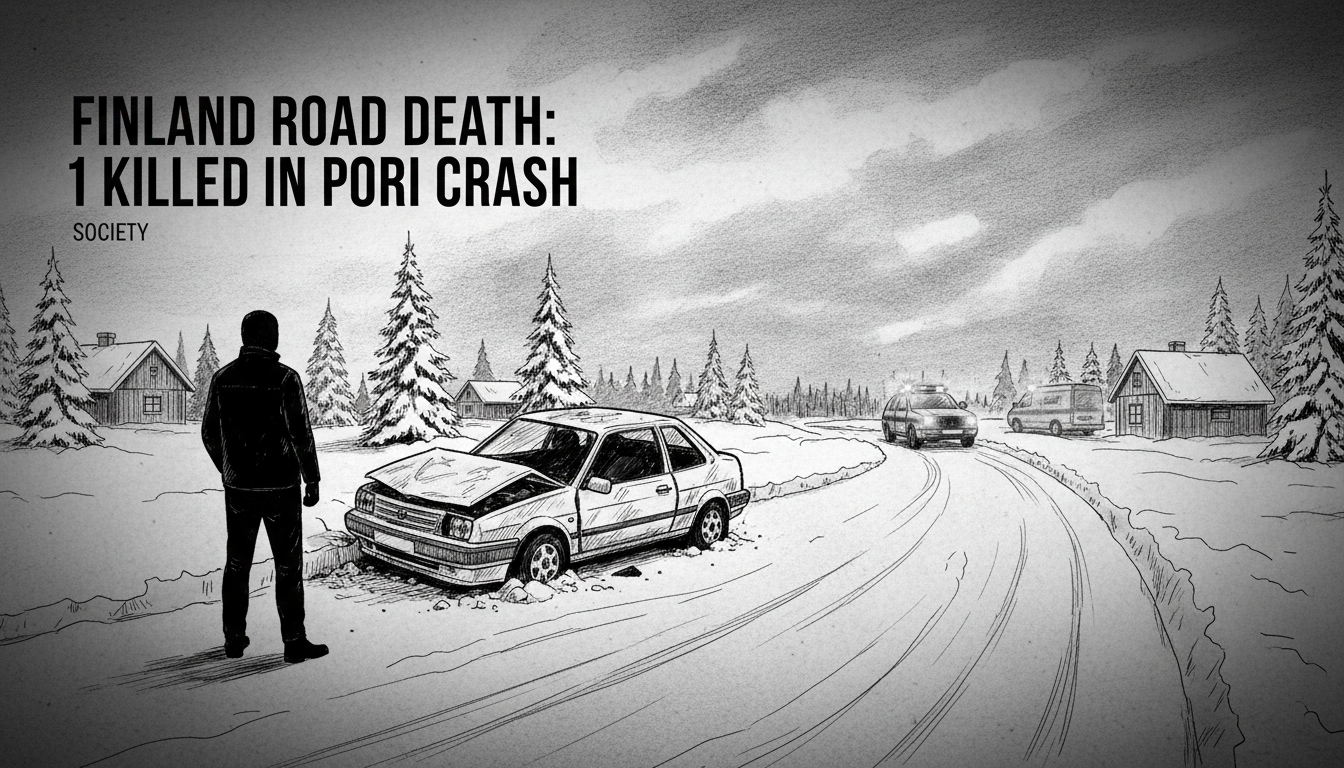
Finland's road safety record was marred by tragedy this week when a fatal collision on a major highway claimed one life. The crash occurred on Tuesday afternoon at the intersection of Highway 23 and Rauhalammintie in Noormarkku, a district now part of the city of Pori. Police received an emergency call just before 5 p.m. reporting a serious rear-end collision between two vehicles. One adult died at the scene, while another person was transported to a hospital for treatment. The incident serves as a stark reminder of the persistent dangers on Finnish roads, even as the nation maintains some of Europe's most stringent safety standards.
A Sudden Tragedy on Highway 23
The quiet afternoon in Noormarkku was shattered by the sound of impact. The precise sequence of events leading to the rear-end collision is now the focus of a police investigation. Highway 23, where the crash occurred, is a significant arterial route in southwestern Finland, connecting Pori to the inland regions and carrying a steady flow of commuter and commercial traffic. The intersection with Rauhalammintie is a known point where local traffic merges with the faster-moving highway flow. Police have cordoned off the area for a detailed forensic examination, a standard procedure aimed at reconstructing the moments before impact. Investigators will analyze skid marks, vehicle damage, and data from any onboard systems to determine speed, braking, and potential contributing factors like driver distraction or fatigue.
Finland's Road Safety in Context
This fatal accident occurs against the backdrop of Finland's long-term campaign to eliminate traffic deaths. The country is often cited as a global leader in road safety, thanks to decades of systematic work on infrastructure, vehicle standards, and driver education. According to the latest official statistics from Statistics Finland, 221 people lost their lives in road traffic accidents in 2022. This figure represents a dramatic decline from previous decades; in 1990, for instance, over 700 people died on Finnish roads. The reduction is attributed to a multi-pronged strategy: continuous improvement of road engineering, the widespread adoption of safety technologies like electronic stability control, and rigorous enforcement of traffic laws, including famously strict drink-driving limits. Yet, as Tuesday's crash demonstrates, the risk is never zero.
"Every fatal accident is one too many, and each represents a profound human tragedy," said a senior traffic safety expert from Traficom, the Finnish Transport and Communications Agency, when asked for comment. "Our work is based on the Vision Zero principle—that no loss of life is acceptable. Investigations like the one now underway in Pori are crucial. They are not about assigning blame but about understanding the chain of events so we can break it in the future. Was it a matter of road design, driver behavior, vehicle condition, or a combination? We need to know."
The Human Cost Behind the Statistics
While the police report states facts—one adult deceased, one hospitalized—it cannot convey the personal catastrophe that unfolds for the families and communities involved. A death on the road sends shockwaves through the small, close-knit communities typical of regions like Satakunta, where Pori is located. The victim's identity has not been publicly released, pending notification of next of kin, a standard practice in Finland that underscores the respect for privacy during acute grief. The person hospitalized faces an uncertain physical and psychological recovery. Road trauma specialists note that survivors of serious collisions often contend with long-term injuries and post-traumatic stress, requiring extensive medical and social support.
Local authorities, including social and healthcare services, are typically mobilized to support those affected. The psychological impact also extends to first responders—police officers, paramedics, and fire crews—who are trained to handle such scenes but are not immune to their emotional weight. This human dimension is the central focus in the immediate aftermath, even as the procedural wheels of investigation and infrastructure review begin to turn.
Analyzing the Factors: From Speed to Distraction
Expert analysis of Finnish traffic accidents consistently points to a familiar set of contributing factors. Speed remains a primary determinant of crash severity; the force of impact increases dramatically with velocity. Finland employs extensive speed camera networks and variable speed limits, particularly on highways like the 23, to manage this risk. Driver inattention, often linked to mobile phone use, is another major and growing concern globally. A momentary glance away from the road can be fatal, especially on high-speed routes where situations develop rapidly.
Road conditions, particularly during the challenging Finnish winter, play a significant role. While the crash occurred outside the peak winter season, autumn brings its own hazards like wet leaves, lower sun angles causing glare, and increasingly slippery morning frosts. Vehicle maintenance, especially tire condition, is critical. Finnish law mandates the use of winter tires from December to February, but experts recommend their use whenever temperatures hover near freezing. The police investigation will scrutinize all these elements. They will also check if the vehicles involved had any technical faults and review the drivers' records and conditions at the time of the accident.
The Path Forward: Investigation and Prevention
The police investigation in Pori will follow a meticulous protocol. Once the on-scene investigation is complete, the vehicles may be subjected to further technical examination. Witness statements will be gathered, and any available traffic or dashcam footage will be reviewed. The final report, which can take several months to complete, will be forwarded to the prosecutor's office for consideration of any possible charges. More importantly for public safety, its findings contribute to the national database of accident causation.
This data is vital for agencies like the Finnish Transport Infrastructure Agency (Väylävirasto) and Traficom. It informs decisions on where to install new safety barriers, which intersections require redesign, or where additional signage or lighting is needed. It also shapes public awareness campaigns. For example, if distraction is identified as a key factor in a cluster of accidents, it might prompt a targeted national ad campaign. The goal is always proactive prevention. "Safety is a system," the Traficom expert emphasized. "We look at the road, the vehicle, and the driver as interconnected parts. A failure in one part must be compensated for by the others. Our job is to strengthen every link."
A National Goal of Zero Fatalities
Finland's official target is ambitious: to reduce annual road fatalities to fewer than 100 by 2030 and to achieve zero deaths and serious injuries by 2050. This aligns with the European Union's broader road safety policy framework, which Finland often helps to shape. Current EU initiatives focus on mandating advanced vehicle safety technologies, improving infrastructure safety management, and promoting safe road user behavior. As a member state, Finland integrates these directives into its national strategy, often implementing them with even stricter parameters.
The tragedy on Highway 23 is a somber data point in the pursuit of that zero goal. It underscores that despite advanced safety systems—from autonomous emergency braking to lane-keeping assistance—the human element remains both the most critical and the most variable component in road safety. It reinforces the need for constant vigilance, both from drivers and from the authorities tasked with regulating the transport system.
As the community in Noormarkku and Pori mourns, the broader national conversation about road safety continues. Each accident prompts a quiet, determined reassessment. Are the speed limits right for that stretch of road? Is the intersection design optimal? Could more public education make a difference? The work to save the next life begins with understanding the last loss. The memory of the person who died on Tuesday will, in this way, become part of Finland's relentless drive to make its roads safer for everyone. The ultimate question remains: How many more data points of tragedy must be collected before the system becomes foolproof?