
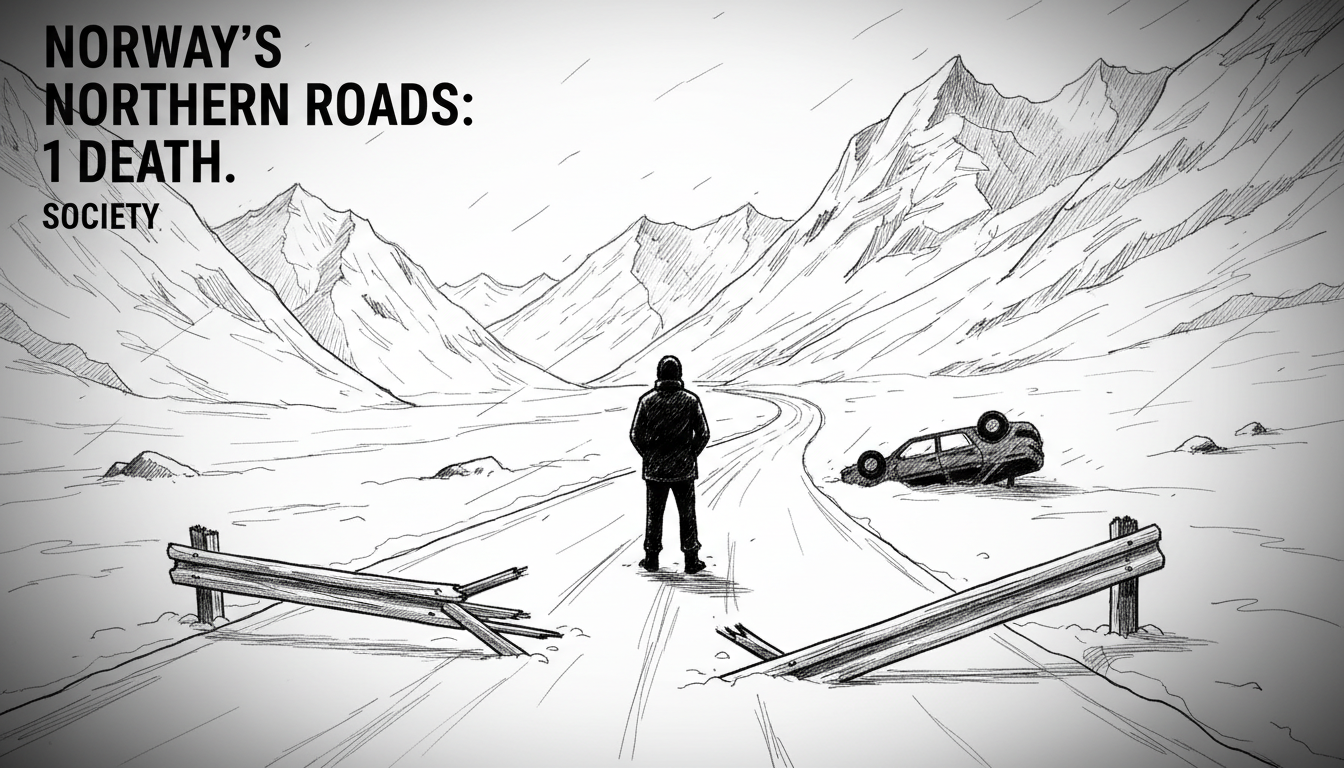
A female pedestrian has died after a collision with a car on County Road 82 between Melbu and Stokmarknes in Hadsel municipality. Police in Nordland confirmed the fatality after being alerted to a life-threatening traffic incident at 2:15 PM on Tuesday. The victim succumbed to her injuries at the scene on Fylkesvei 82, a crucial local artery in the Vesterålen region.
This tragic event casts a stark light on road safety in Norway's northern counties. It raises urgent questions about the protection of vulnerable users outside urban centers.
The Incident on Fylkesvei 82
Emergency services responded to the report near the communities of Melbu and Stokmarknes. The exact location and circumstances leading to the collision remain under active police investigation. Authorities have not released the identity of the deceased woman, following standard Norwegian practice to notify next of kin first.
Fylkesvei 82 runs along the coast of Hadseløya island. It connects several population centers. The road sees mixed use from private vehicles, cyclists, and pedestrians, especially near settlements. Tuesday afternoon's weather in Nordland was reportedly overcast with some rain, factors often examined in such probes.
Police have cordoned off the area for technical investigation. Officers are speaking with witnesses and the involved driver. "Our thoughts are with the deceased and her relatives," a police spokesperson said in a statement.
A Regional Safety Challenge
Nordland county presents distinct challenges for road safety. Its vast area and low population density can mean longer distances between emergency medical services. Response times are a critical factor in trauma outcomes. The region's climate also plays a role, with limited daylight during winter months and frequently wet or icy road conditions.
This accident occurs within a national context of generally improving, but still imperfect, traffic safety. In 2023, 117 people died on Norwegian roads. This figure represents a long-term decline, yet each fatality prompts scrutiny of persistent risks. Pedestrians and cyclists remain disproportionately vulnerable in collisions with motor vehicles.
The Norwegian Public Roads Administration (Statens vegvesen) sets national safety standards. Local municipalities are responsible for maintaining county and local roads. This division of responsibility can lead to variations in infrastructure quality. Ongoing national strategies, like "Vision Zero," aim to eliminate all traffic fatalities and serious injuries.
National Policies and Local Realities
Norway invests heavily in road engineering and safety campaigns. Measures include reduced speed limits in populated areas, improved lighting, and separated paths for pedestrians and cyclists. The effectiveness of these measures in rural northern Norway, however, is an active topic of discussion.
"Every fatal accident is a tragedy and a signal that we must not become complacent," said a senior advisor from the Norwegian Council for Road Safety (Trygg Trafikk). "In areas with combined traffic on county roads, we must continuously assess if speed limits are appropriate and if infrastructure adequately protects those outside vehicles."
Expert analysis often highlights three key factors: speed, visibility, and road design. Investigations typically examine the posted speed limit on the road section, sightlines for the driver, and whether designated pedestrian crossings or walkways were available. The stretch of Fv82 where the incident occurred will be analyzed against these criteria.
The Human Cost Beyond Statistics
Behind the annual number of 117 fatalities are individual stories of profound loss. The death in Hadsel will ripple through a local community where people often know each other. Such events are felt deeply in smaller population centers across Nordland.
Local politicians often face difficult budgetary choices. They must balance the high cost of comprehensive road upgrades across large geographical areas with other public services. Safety improvements like widening shoulders, installing barrier-separated walkways, or adding lighting require significant investment.
Community advocates argue this investment is non-negotiable. They point to the fundamental right to safe travel for all citizens, whether by car, bicycle, or foot. The accident between Melbu and Stokmarknes will likely renew local debates about infrastructure priorities on specific road sections perceived as dangerous.
Looking Ahead: Investigation and Action
The police investigation will seek to establish a definitive sequence of events. Officials will determine if any traffic laws were violated. Findings could lead to recommendations for specific safety measures on Fylkesvei 82 or similar roads across Nordland.
National transport authorities monitor such incidents for patterns. They use the data to inform future policy and funding allocations. A cluster of accidents on a particular type of road can trigger revised national guidelines for its design and regulation.
For now, the community mourns. The immediate focus is on supporting the victim's family and the driver involved. The longer-term focus, for authorities and residents alike, will be on answering a difficult question: How can remote and rural roads be made as safe as the country's best urban and major highway infrastructure? Norway's commitment to "Vision Zero" means this question demands a concrete answer, not just in Oslo or Bergen, but on every county road from Lindesnes to the North Cape.