
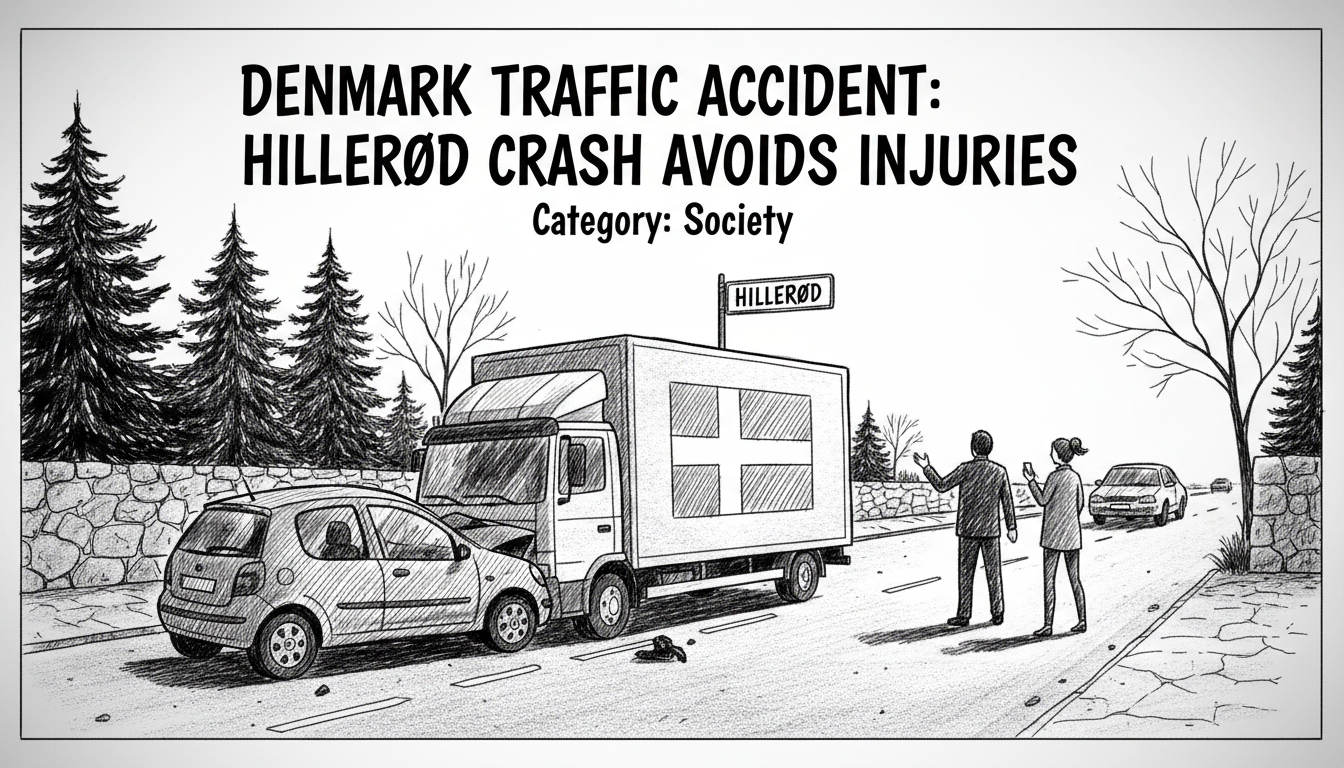
Denmark traffic accident investigators in Hillerød are examining a collision where a car driver failed to yield, crashing into a bus at 50 kilometers per hour. The incident on Milnersvej resulted in significant vehicle damage but, remarkably, no injuries were reported among the bus passengers or the car driver. North Zealand Police confirmed the driver is being charged with a traffic violation, highlighting a common yet dangerous error on Danish roads.
A Common Error with Uncommon Luck
On a quiet evening in Hillerød, a routine drive turned into a startling crash. A car pulled out onto Milnersvej, directly into the path of an oncoming bus. The impact, at a speed police estimate was around 50 km/h, crumpled the front-left corner of the bus and shattered its windshield. Glass and twisted metal littered the road, forcing authorities to close the street for several hours. Despite the violent nature of the collision, everyone involved walked away unharmed. This outcome is a point of focus for traffic safety experts, who note that speed and vehicle design played crucial roles in preventing tragedy.
Vagtchef Jakob Tofte from Nordsjællands Politi stated the investigation is straightforward. "The driver overlooked his duty to yield," Tofte said, confirming the motorist faces legal consequences. Failure to yield, or 'vigepligt', is a foundational rule in Danish traffic law, governing interactions at intersections and when merging. Violations are a persistent cause of accidents across the country. This incident serves as a stark, physical reminder of what happens when that rule is ignored, even at moderate speeds.
The Mechanics of a Non-Injury Crash
Traffic analysts point to specific factors that likely contributed to the lack of injuries. A collision speed of 50 km/h is significant but falls within a range where modern vehicle safety systems can be highly effective. The bus's size and construction, designed to protect many passengers, and the car's crumple zones, engineered to absorb impact energy, both performed their functions. The point of impact—the corner of the bus rather than a direct broadside—may also have dissipated force differently. These technical details separate a serious traffic report from a devastating local tragedy.
"We often see that the difference between a scare and a catastrophe can be a matter of degrees, speed, and sheer luck," explains a former traffic safety instructor with the Danish Road Directorate. "At 50 km/h, the kinetic energy involved is substantial. The fact that this resulted in property damage only is fortunate. It underscores why the yield rule exists: to prevent two masses from occupying the same space at the same time, which physics always wins." The analyst emphasizes that while vehicle safety improves, driver vigilance remains the primary prevention tool.
Hillerød's Response and Road Safety Context
The local response followed a well-rehearsed protocol. Emergency services secured the scene, attended to those involved, and began clearing the wreckage to reopen Milnersvej. For residents, such incidents briefly disrupt the rhythm of daily life, prompting conversations about specific intersections or driver behavior in their community. Hillerød, with its mix of historic charm and modern commuter traffic, faces the same challenges as many Danish towns: balancing efficient flow with absolute safety.
Nationally, failure-to-yield accidents represent a consistent slice of Denmark's traffic statistics. They are often categorized under 'human error' rather than mechanical failure or road condition issues. This classification drives ongoing public education campaigns by the Danish Road Safety Council, which repeatedly stresses the importance of attention, patience, and strict rule adherence at junctions. The Hillerød case will likely become a minor data point in this broader statistical picture, notable mainly for its zero injury count.
The Legal and Personal Repercussions
For the driver involved, the aftermath now moves from the physical to the legal and financial realms. A charge for violating the yield rule typically carries a fine and penalty points on the driver's license. The insurance process for covering the substantial damage to both vehicles will be lengthy. More intangible is the psychological impact. Being the cause of a violent crash, even without physical harm, can be a profoundly sobering experience, one that traffic psychologists say can permanently alter a person's driving habits.
This aspect of traffic incidents is less frequently discussed but is integral to Danish society's approach to safety. The system is designed not just to punish but to educate and deter. The financial and administrative hassle following an accident is itself a powerful disincentive. The driver's experience, from the moment of impact through the police report and insurance claims, becomes a personal story of the high cost of a momentary lapse in judgment.
A Near-Miss as a Community Reminder
As the debris was cleared from Milnersvej and traffic resumed its normal flow, the incident left a lingering question for the community. How many similar near-misses occur daily without consequence, gradually building a false sense of security? This single reported crash is the one where variables aligned to cause material damage. It acts as a visible reminder of the invisible risks present every time a driver approaches an intersection.
The ultimate takeaway from the Hillerød crash is not its novelty, but its normality. It was a common error with an uncommonly lucky outcome. It reinforces a fundamental truth in Danish traffic safety: the rules are not suggestions. They are engineered protocols for survival in a complex system. The sound of crushing metal on Milnersvej is a noise every driver hopes never to hear, and the best way to avoid it is to look, yield, and proceed only when the space is truly yours. Will this event lead to a local review of that specific junction, or will it fade as an anecdote of good fortune? The answer often depends on whether anyone was hurt. This time, they were not.