
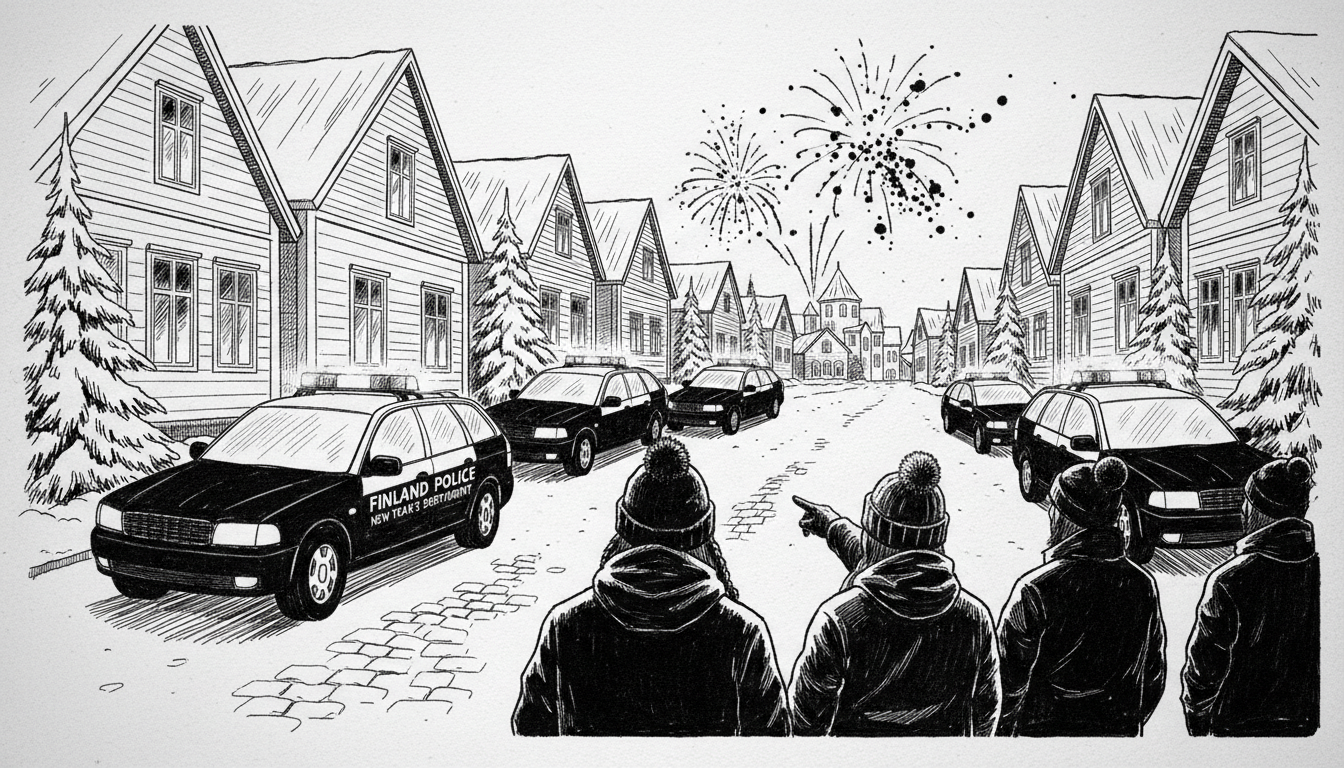
Finland police deployed six patrols to a residential apartment in Virkkala, Lohja, during the early hours of New Year's Day. The significant response followed an emergency call reporting a person being threatened at a private address. Officers arrived at the scene just after 3:30 AM to find no dangerous situation. They located and spoke with an individual in the apartment, confirming the person was safe and well. The operation concluded without any restrictions on public movement in the area.
A Calm Resolution After Heightened Alert
The coordinated police action in the small village of Virkkala highlights standard Finnish protocol for potential threat assessments. A call indicating a direct threat to a person triggers an immediate and substantial response. The national police force, Poliisi, operates on a principle of caution, especially during public holidays when incident rates can be higher. The Emergency Response Centre Administration (Hätäkeskuslaitos), which fields all 112 emergency calls, determined the initial report warranted multiple units. The swift resolution, confirming no actual threat existed, demonstrates the system working as intended: erring on the side of safety while efficiently verifying facts on the ground.
‘Our duty is to respond to every call with appropriate seriousness,’ a police spokesperson later noted in a statement. ‘When a person’s safety is reported to be at risk, we mobilize sufficient resources to secure the situation immediately. In this case, we were able to quickly establish the well-being of the individual involved.’ This incident underscores the balance between rapid response and the reality that many emergency calls, while made in good faith, do not reflect an active crime.
Holiday Policing and Resource Deployment in Finland
New Year’s Eve and Day present unique challenges for police services across Finland. The celebration, marked by fireworks and private gatherings, typically sees a spike in calls related to public disturbances, noise complaints, and minor injuries. A report of a personal threat within a home would naturally be prioritized within this context. The deployment from Lohja police station, part of the Western Uusimaa Police Department, involved officers likely already on heightened holiday duty.
The efficient handling of this call meant resources were freed for other potential incidents. Finnish police strategy emphasizes geographic coverage and the ability to escalate force presence rapidly. This model is supported by national funding and training, which avoids the fragmented local department structure seen in some other countries. The incident in Virkkala, while minor in outcome, was a real-time test of that readiness.
The Local Context of Lohja and Virkkala
Lohja is a municipality of approximately 46,000 people, situated about 55 kilometers northwest of Helsinki. It blends suburban commuting communities with a strong industrial and agricultural history. Virkkala, once a significant center for limestone mining and cement production, is a quieter village within the Lohja area. The call to a kerrostalo, or standard Finnish apartment block, in such a location is representative of typical police work across suburban and rural Finland.
These communities generally experience low levels of serious violent crime. This fact makes a coordinated police response to a reported threat even more noticeable to residents. The presence of multiple patrol cars in Virkkala in the early morning would have been a conspicuous event. The police’s ability to resolve it without public disruption is a key aspect of maintaining community trust and a sense of security.
Analysis of Emergency Response Protocols
This event offers a clear window into Finland’s integrated emergency response framework. The Hätäkeskuslaitos operator’s initial risk assessment set the response in motion. Their training focuses on extracting critical details from callers who may be stressed or frightened. Keywords like ‘threatened’ trigger specific protocols, which in this case led to the dispatch of several patrols rather than a single unit.
From a policy perspective, such incidents are logged and reviewed. Data on false alarms or unfounded threats help refine dispatch guidelines and training. The goal is always to ensure public and officer safety without creating unnecessary alarm. The system is designed to be resilient; even if one call proves non-critical, the capacity remains for simultaneous responses to other emergencies.
Senior researcher Jari Kääriäinen, who studies public safety systems at the University of Helsinki, explains the broader context. ‘The Finnish model is built on a high degree of public confidence in authorities. People are encouraged to call 112 if they are genuinely concerned. This sometimes leads to responses that, in hindsight, seem disproportionate. However, it is a preferable alternative to underreacting to a serious situation. The New Year’s incident in Lohja is a textbook example of this principle in action.’
Kääriäinen also notes that these protocols are periodically evaluated against EU-wide standards for emergency services. Finland consistently ranks highly for its effective and trusted police service, a fact reflected in annual citizen surveys.
The Path Forward for Public Safety Communications
The Lohja call ended peacefully, but it prompts questions about public awareness of emergency service use. Authorities continuously stress that 112 is for emergencies only, yet defining an ‘emergency’ can be subjective for a caller. Community outreach focuses on clarifying this, aiming to reduce non-essential calls while steadfastly encouraging reporting of real danger.
For the local police command in Western Uusimaa, the first of January was likely a busy shift. The Virkkala response was one entry in a long log of duty. Its successful and calm resolution is what officers train for. It also serves as a reminder of the unseen work done on public holidays to maintain safety across Finland’s towns and cities.
As Finland continues to integrate new technologies into its emergency response network, including improved location tracking for mobile calls, the human element remains central. The operator who takes the call, and the officers who respond, must still make split-second judgments. The events in Virkkala show that when those judgments lead to an overabundance of caution, the result is simply a quiet street and a safe citizen—an outcome that is never a failure. The question for policymakers is how to maintain this effective, precautionary stance in an era of tight public budgets and evolving societal risks.