
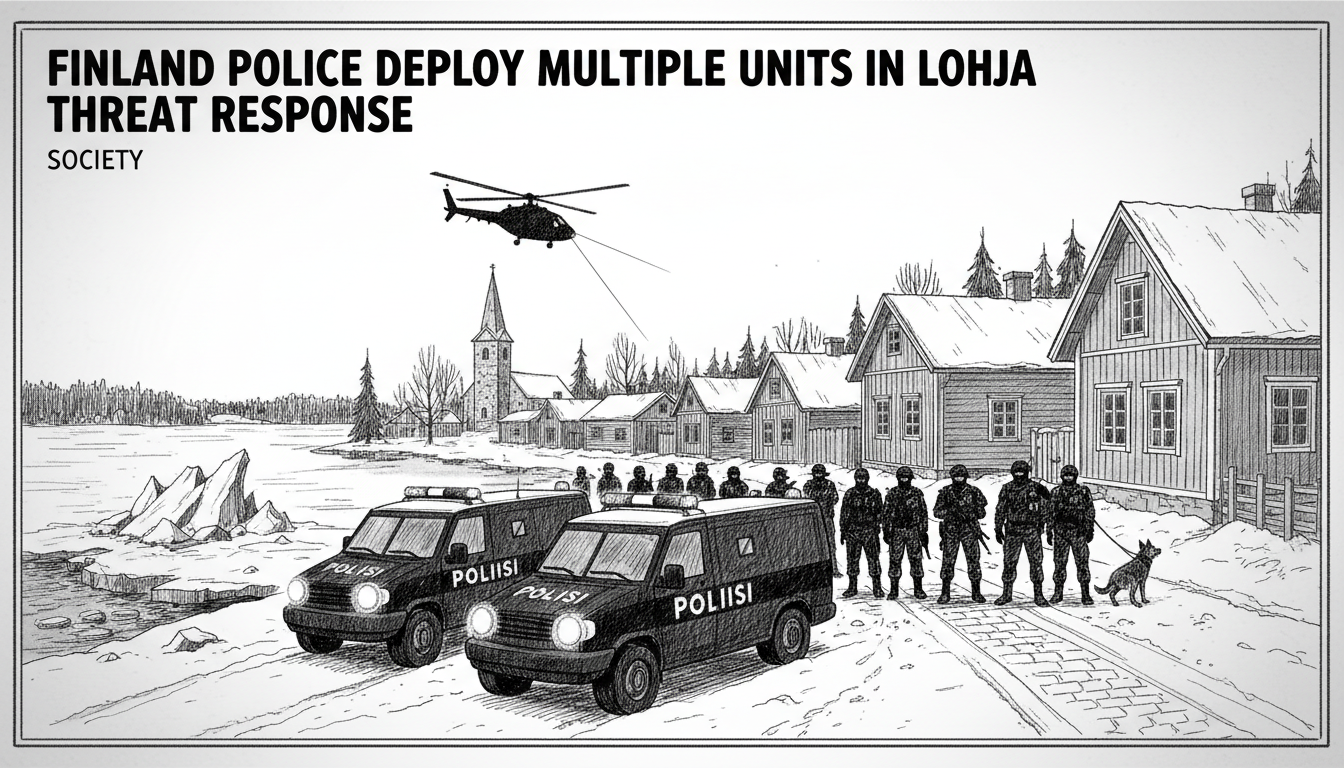
Finland police launched a multi-unit response to a reported threat in Lohja on New Year's morning, a deployment that underscores standard national protocols for potential violence. Officers from the Western Uusimaa Police Department converged on a residential apartment building in the Virkkala village shortly after emergency services received a call concerning an individual under threat. The operation, which concluded without incident after police made contact with an unharmed person, highlights the cautious and resource-intensive nature of initial threat assessments. This incident in a quiet municipality 50 kilometers from Helsinki reveals the unseen volume of police work that prioritizes rapid response over risk.
A Swift and Serious New Year's Morning Deployment
Multiple police patrols were dispatched to Virkkala in the early hours of January 1st following a precise emergency call. The report indicated a specific threat against a person within a private apartment, triggering an immediate and coordinated police action. Finnish police procedures treat such reports with high seriousness, often erring on the side of deploying sufficient resources to contain any potential danger. The presence of several units at the scene in Lohja reflects this operational doctrine, designed to secure the area, protect any potential victims, and isolate any threat before it escalates. Residents in the vicinity reported seeing police activity but experienced no restrictions on their movement, indicating a controlled and focused operation.
This response aligns with Finland's nationally coordinated police service structure, where local departments like Western Uusimaa can rapidly scale operations based on the nature of an emergency call. The absence of a visible public disruption during the incident points to a professional handling of the situation. Police spokespersons later confirmed the core facts: a threat was reported, resources were deployed, an investigation at the scene found no active threatening situation, and the individual involved was safe. The entire episode from call to resolution was a demonstration of routine, yet critical, police work that often remains out of public view.
The Protocol Behind the Police Presence
The decision to send multiple units is not taken lightly but is governed by strict national guidelines. When a call to the emergency number 112 involves a direct threat to a person's safety, the system is designed to prioritize a swift and decisive response. The initial information is all dispatchers have, and they must assume the report is accurate until proven otherwise. A perceived threat of violence in a confined space like an apartment requires enough officers to secure the perimeter, make entry if necessary, and manage any suspects or victims safely. Sending a single patrol could potentially place officers in an untenable position or fail to prevent harm.
‘Our duty is to ensure the safety of all citizens, and that means responding to every threat report with the appropriate level of resources,’ a senior police officer familiar with response protocols explained. ‘A multi-unit deployment is a standard precautionary measure. It is always better to have resources on scene that are not needed than to need them and not have them.’ This protocol is consistent across Finland’s regions, ensuring that whether in Helsinki or Lohja, the initial reaction to a serious threat is calibrated for maximum safety. The fact that the situation in Virkkala was resolved peacefully does not indicate an overreaction, but rather a successful application of this safety-first principle.
Community Impact and Policing in Rural Municipalities
For residents of Lohja and its surrounding villages, the sight of multiple police cars can be a jarring event. Lohja, with a population of approximately 45,000, is known for its lakeside charm and historical sites, not for high crime. Incidents requiring a significant police presence are relatively uncommon in such municipalities, making them more noticeable when they occur. The police action in Virkkala, while ultimately a false alarm, serves as a reminder of the 24/7 nature of police work and the geographic reach of emergency services. It also demonstrates the interconnectivity of the system, where resources can be focused on a specific point in the vast Uusimaa region within minutes.
The efficient resolution of this case, with no injuries or collateral disruption, reinforces public trust in the police's ability to handle sensitive situations discreetly and effectively. There was no lockdown, no public alarm, and the incident was contained to the specific address. This minimizes the societal impact while fulfilling the police's duty of care. In the context of national discussions about police resources and response times in rural areas, this incident in Lohja shows the system functioning as intended. Resources were available and deployed without delay to a location outside the major urban center, addressing a citizen's concern thoroughly.
Analyzing the Balance Between Caution and Resources
Every police response involves a calculated balance between caution and the efficient use of resources. The Lohja incident presents a classic case study in this balance. From a purely operational standpoint, the deployment of multiple units to a report that turned out to be non-threatening could be viewed as an expenditure of manpower. However, from a public safety and ethical standpoint, it was the only justifiable course of action. The police cannot afford to downgrade a threat assessment based on probability alone when a specific threat against a person is communicated.
Experts in law enforcement operations stress that the cost of under-responding is infinitely greater than the cost of over-responding in initial deployments. ‘The metric for success in such cases is not whether a crime was in progress, but whether everyone is safe at the conclusion,’ a security analyst noted. ‘Police work is fundamentally reactive to information from the public. If the public loses confidence that their reports will be taken with utmost seriousness, the entire system of community safety is undermined.’ Therefore, the Virkkala response, while ending quietly, validates the emergency reporting system and reinforces to the public that calls for help will be met with decisive action.
The Unseen Volume of Preventive Police Work
The events in Lohja on New Year's Day represent a significant portion of police activity that never makes headlines. For every major crime or crisis that dominates the news, there are dozens of similar call-outs where the police arrive, assess, de-escalate, and find no major issue. These are not failures or wasted efforts; they are the essential, preventive backbone of public safety. Each such intervention is a potential crisis averted, a possibility of violence negated by a professional presence. They also serve as vital touchpoints between the police and the community, often in non-confrontational circumstances.
This volume of work requires continuous training in communication, assessment, and de-escalation techniques. The officers in Lohja, upon determining there was no active threat, shifted from a tactical response to a community service role, ensuring the well-being of the individual involved. This aspect of policing—the human contact, the reassurance, the follow-up—is as crucial as the initial armed response. It reflects the Finnish police model's dual role as both enforcers of law and a broad social service. The New Year's morning operation, therefore, was complete not when the threat was disproven, but when the situation was fully resolved for all involved.
A Resolution Reflecting Standard Procedure
In the end, the Lohja police operation concluded as many do: with a calm resolution and a return to normal duty. The individual in the apartment was confirmed to be safe, the initial report was logged and investigated, and the police units cleared the scene. No arrests were made, and no further action was required. For the police involved, it became another logged incident, a demonstration of their readiness. For the resident who made the emergency call, it was a serious concern addressed by the authorities. For the community, it was a brief, unnoticed glimpse into the machinery of safety that operates daily.
This incident underscores a fundamental truth about modern policing in Finland. Security is maintained not just by solving crimes, but by responding to every flicker of potential danger with a proportionate and professional force. The peaceful streets of towns like Lohja are a product of this relentless, often invisible, work. As Finland continues to debate the allocation of its police resources and community safety strategies, operations like the one in Virkkala serve as a practical example. They show a system that is cautious, responsive, and ultimately measured by the safety it preserves, not just the alarms it answers.