
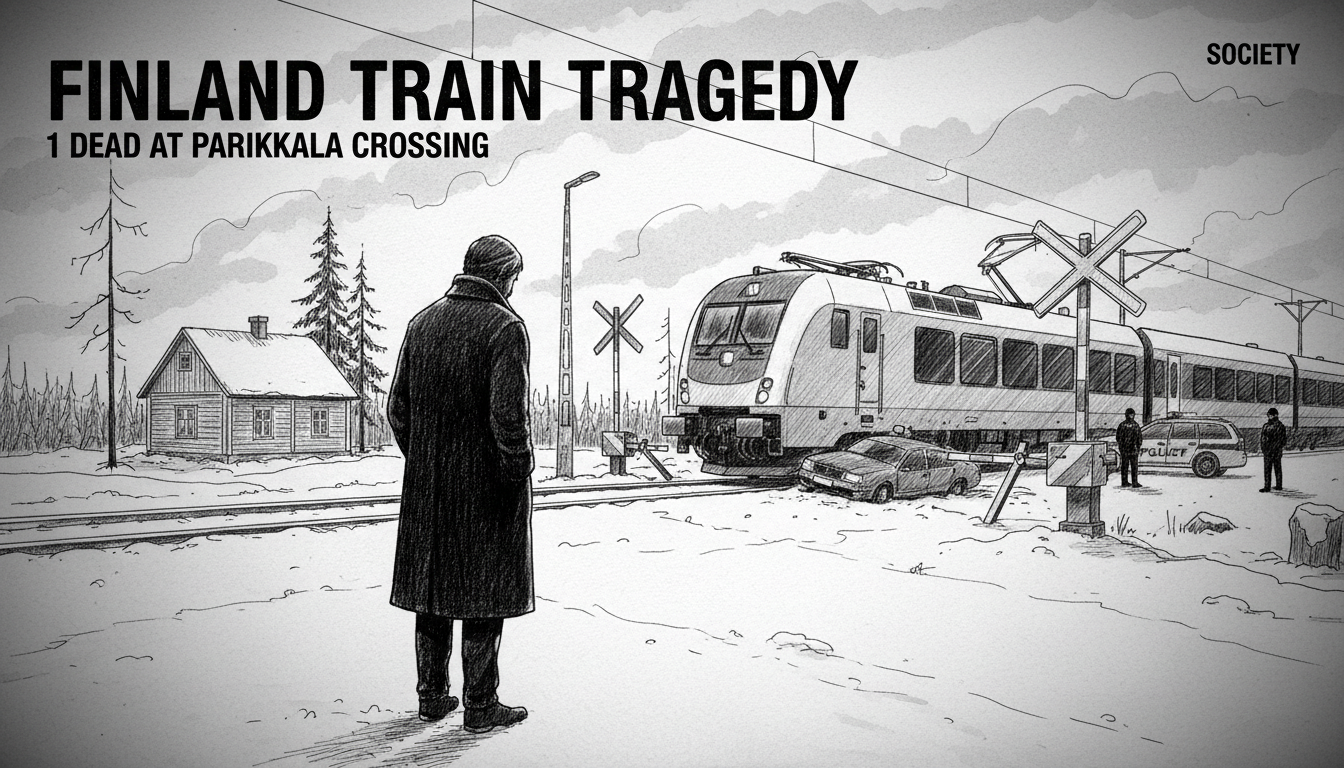
Finland train accident investigators are examining the fatal collision at the Savikummunsalo level crossing in Parikkala, where a pedestrian died after being struck by a train on Tuesday, December 30, 2025. This latest fatality returns focus to the persistent safety challenge of Finland's 2,700 rail-road intersections, a national infrastructure concern that has seen multiple government action plans over the past decade. The accident, reported by the Southeast Finland Police District, halted all train traffic on the line, causing significant delays for VR Group services during a busy holiday travel period.
A Fatal Moment at a Rural Crossing
The precise circumstances leading to the pedestrian's death at the Parikkala crossing remain under active police investigation. Preliminary reports confirm the individual was on foot when struck by the train. Authorities have not released the victim's identity, in line with standard Finnish practice pending family notification. The location, Savikummunsalo, is a rural level crossing, a typical setting for such incidents across the Finnish rail network. Emergency services responded immediately, but the pedestrian was pronounced dead at the scene. VR Group, the state-owned rail operator, confirmed the suspension of services and advised passengers of delays affecting at least three trains, disrupting travel in the South Karelia region.
This incident is not an isolated one. According to the latest official statistics from the Finnish Transport Infrastructure Agency (Väylävirasto), there were 24 accidents at Finnish level crossings in 2022. Those accidents resulted in 6 fatalities and 11 injuries. The 2022 data represents the most recent full-year official figures available, underscoring that level crossing safety is a continuous, unresolved issue. Finland maintains approximately 2,700 public and private level crossings across its 5,900-kilometer rail network, presenting a vast and complex safety management task for authorities.
The Persistent Challenge of Rail Safety
Level crossing safety sits at the intersection of human behavior, infrastructure investment, and regulatory oversight. Safety experts consistently point to a multi-faceted approach for reducing risks. "The most effective measure is grade separation—building bridges or tunnels—but it is also the most expensive," explains a veteran traffic safety engineer familiar with Väylävirasto's programs. "Therefore, the strategy relies on a combination of automated barriers, improved warning signals, enhanced visibility, and public awareness campaigns." The Finnish government and Väylävirasto have run several safety initiatives, including the closure of little-used crossings and the upgrading of others with modern warning systems.
However, resource allocation remains a constant debate in the Eduskunta, Finland's parliament. Securing funding for widespread infrastructure upgrades, especially in sparsely populated rural areas like Parikkala, competes with other national transportation priorities. The accident investigation will likely scrutinize the specific features of the Savikummunsalo crossing. Key factors include sight lines for both pedestrians and train drivers, the speed of the approaching train, the presence and type of warning signs or signals, and the individual's actions. Police will work to determine whether technical failure, human error, or a combination contributed to the tragedy.
Policy Responses and EU Context
Finland's approach to railway safety is also framed by European Union directives. The EU's Railway Safety Directive aims to establish a common approach to managing and improving safety across the trans-European rail system. This means Finnish safety standards and investigation procedures align with broader European norms, and accident data is shared for Union-wide analysis. While infrastructure decisions are national, the EU framework pushes for continuous improvement and the adoption of best practices. For Finns, this translates into ongoing reviews of crossing safety protocols and investment plans, often discussed in Helsinki's government district as ministers balance EU commitments with domestic budget realities.
The human cost of these accidents resonates beyond statistics. Each fatality represents a profound community loss, particularly in smaller municipalities. Parikkala, a town of around 4,800 people in South Karelia, is precisely the type of community where a local tragedy is felt by all. The psychological impact on the train driver and first responders is also a critical, though less visible, consequence addressed through support services provided by VR Group and emergency organizations.
A Look Ahead: Prevention Over Reaction
As the investigation proceeds, the inevitable question is what can be done to prevent the next accident. Transport Minister Lulu Ranne has previously emphasized a 'Vision Zero' ambition for traffic fatalities, a policy that includes railway crossings. Achieving this requires persistent investment. The current government's transport policy program includes funding for improving railway safety, but progress is incremental. Meanwhile, public awareness campaigns by VR and Väylävirasto repeatedly stress the basic rules: never cross when lights flash or barriers descend, always look both ways, and never assume you can beat a train. A train's stopping distance is enormous, often hundreds of meters even under emergency braking.
The tragedy in Parikkala is a stark reminder that for all of Finland's technological advancement and safety regulation, the interface between fast-moving trains and human activity remains a vulnerable point. It renews calls from safety advocates for accelerated crossing upgrades and from communities for localized risk assessments. While the police report will provide specific answers for this incident, the broader national conversation about allocating resources to save lives at these thousands of rural junctions is one that continues, tragically punctuated by events like Tuesday's. How many more reports must be written before the maps of risk are fully addressed?