
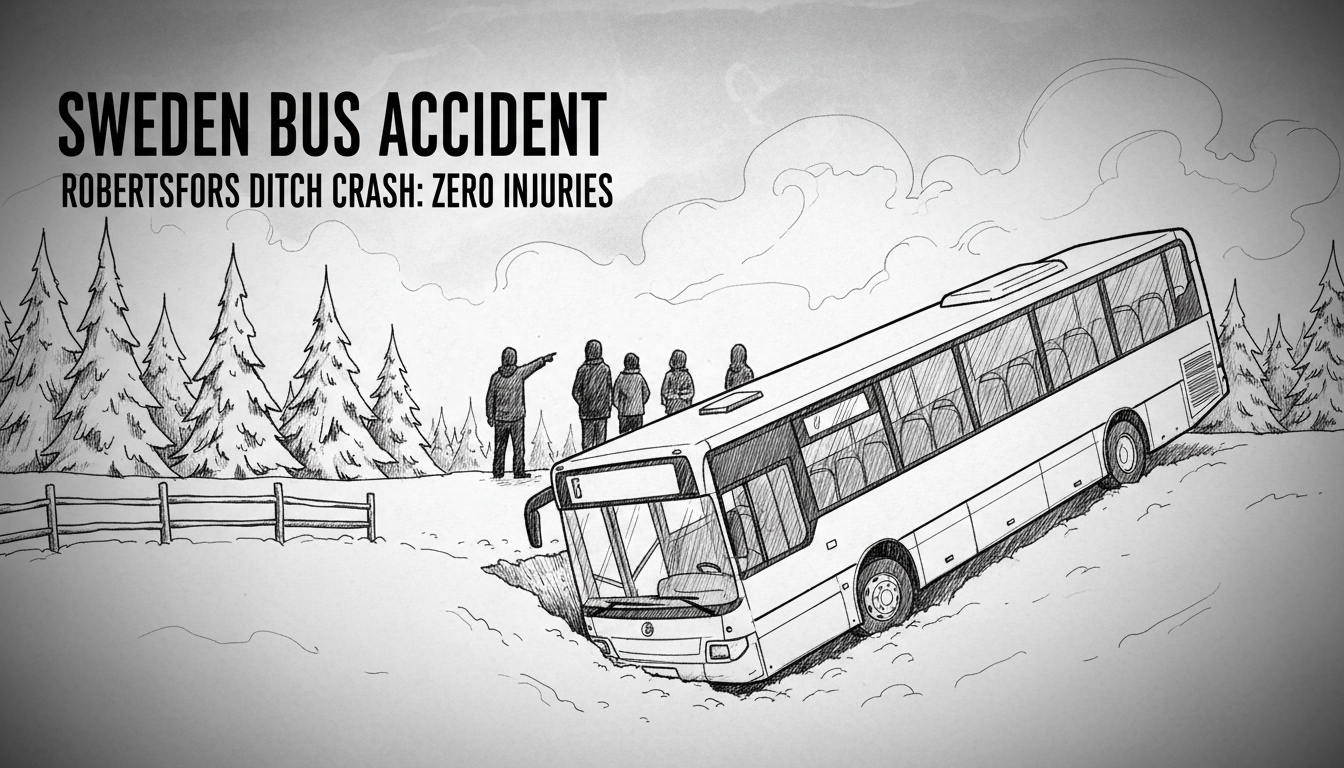
Swedish emergency services report a bus has reversed into a ditch outside Robertsfors with no passengers injured. The incident occurred on a rural road in Västerbotten County, northern Sweden, blocking half the carriageway and disrupting traffic, particularly for heavier vehicles. Rescue services were on site managing the situation until a recovery vehicle could arrive.
A Calm Response in the Northern Forests
The call came in during a crisp morning in Västerbotten. A bus, part of the region's vital public transport network, had ended up in a ditch. For the roughly 6,400 residents of Robertsfors municipality, buses are a lifeline, connecting remote homes to schools, workplaces, and shops in larger towns like Umeå. The immediate and most critical update from Räddningssamverkan Nord was reassuring. “No one is reported to have been injured,” an operator confirmed, highlighting the priority of passenger safety above all.
The scene, though disruptive, was one of orderly management. The Rescue Service's primary role was traffic control, a testament to Sweden's systematic approach to even minor emergencies. With the bus obstructing half the road, the flow of commerce and daily life was impacted. The Swedish Transport Administration confirmed heavy traffic could not pass, a significant issue in an area where timber trucks and agricultural vehicles are common.
The Lifeline of Rural Transit
This incident underscores a deeper story about Swedish society. Outside major cities, the bus isn't just transport; it's a mobile community center. It carries students, elderly residents, and workers across vast, forested landscapes. A disruption here is felt more keenly than in Stockholm or Gothenburg. “For many without a car, the bus is their only connection,” says Karla Lindström, a sociologist focusing on rural Nordic communities. “An accident like this isn't just a traffic report. It momentarily isolates people.”
Robertsfors, a community built around forestry and nestled by the Rickleån river, relies on these connections. The efficiency and safety of its public transport are not conveniences but necessities. Sweden's investment in a widespread bus network, even in low-density areas, reflects a core national value: accessibility for all, regardless of postcode.
Vision Zero: The Backdrop to Every Incident
While this event ended as a nuisance rather than a tragedy, it occurs against the backdrop of Sweden's world-leading 'Vision Zero' policy. Adopted in 1997, this ethical principle aims to eliminate all road fatalities and serious injuries. Every accident is analyzed not as an inevitable “accident,” but as a preventable failure of the system—in road design, vehicle safety, or speed management.
The latest statistics show progress is being made, though the goal is stubborn. In 2024, there were 225 road fatalities in Sweden, a number the country continues to work tirelessly to reduce. Each non-serious incident, like the one in Robertsfors, is still a data point. Was road signage clear? Was the shoulder adequate? Could the ditch be designed to be more forgiving? This systematic questioning is the Swedish way.
“The absence of injury is the first success,” notes traffic safety expert Erik Lundgren. “But the response—how quickly safety is restored and traffic normalized—is part of the same safety ecosystem. It's about minimizing secondary risks.” The prompt presence of rescue services to direct traffic aligns perfectly with this philosophy, protecting other road users from potential chain-reaction collisions.
Winter's Shadow and the Human Factor
Although specific causes are not yet released, anyone familiar with a Swedish winter knows the potential factors. Autumn in the north brings slippery wet leaves, early morning ice, and rapidly diminishing daylight. Road conditions can change in a kilometer. Driver error, mechanical fault, or an unexpected obstacle are all possibilities investigators will consider.
The human element remains central. For the driver, such an event is undoubtedly stressful. For the passengers, it’s an unwelcome disruption to their day, a story to share over afternoon fika. The community's reaction online was typically Swedish: concerned, but pragmatic. Comments focused on relief for the lack of injuries and patience for the traffic delay, rather than blame.
Beyond the Incident: A Connected Society
What does a single bus in a ditch tell us about Sweden? It reveals a society where safety is engineered into the response plan. It highlights the delicate infrastructure of rural life. And it demonstrates a public trust in systems and authorities to manage crises, big and small. The incident near Robertsfors will soon be resolved. The bus will be recovered, the road fully cleared, and the schedule will slowly return to normal.
But it serves as a small, real-world test of the networks that hold a dispersed society together. It passed the most important test: everyone walked away. As the Nordic night falls early over Västerbotten, the focus shifts from emergency response to the simple question that follows any minor crisis in Sweden: how do we stop this from happening again? The search for that answer is what continues to make Swedish roads some of the safest in the world.