
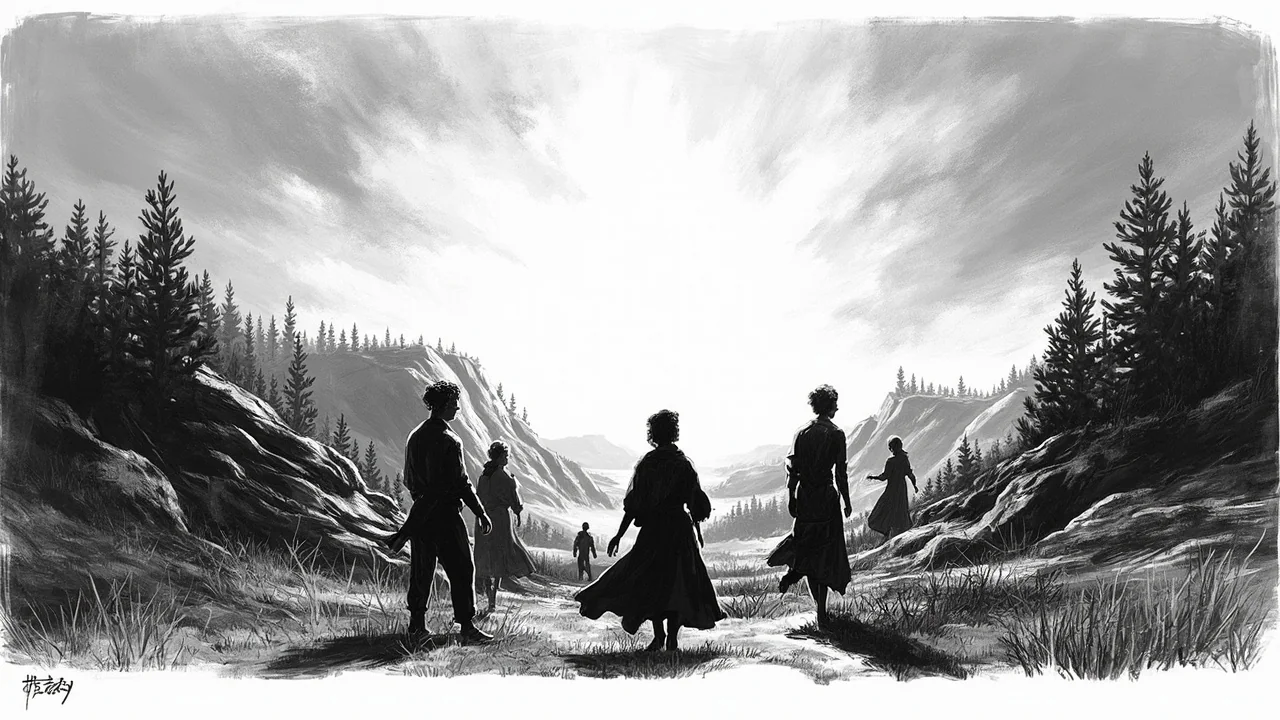
Finland's Vuoksi River once held a vibrant dance island called Myllysaari, a beloved community hub erased in the 1950s by a colossal dredger named Marion. The island, known locally as a 'humppasaari' for its lively dance pavilion, was consumed during an industrial expansion to boost hydroelectric power for the Imatra region. This act of mid-century progress permanently reshaped the local landscape and severed a tangible link to pre-war Finnish social life, leaving only photographs and fading memories where generations once danced by the rapids.
The Island That Danced
Myllysaari was not merely a geographical feature but a social institution. Positioned in the central stream of the Vuoksi River, south of what was then the ironworks and is now the steel plant, the island served as a focal point for community life from the 1930s through the post-war years. A short wooden bridge connected it to the tip of Vallinkoskenniemi peninsula, leading revelers directly to the dance pavilion. The roar of the Myllykoski rapids beneath the bridge provided a natural soundtrack. For residents of Imatra, it was the premier destination to showcase the dramatic Vuoksi landscapes to visitors, with many choosing the site for formal photographs. The island's identity was inextricably linked to recreation, music, and social gathering—a stark contrast to the heavy industry growing on its banks.
Marion: The Colossal Agent of Change
The transformation was executed by the dredger Marion, a machine described by contemporaries as being the size of a small apartment building. Its arrival in the 1950s represented the peak of post-war Finland's drive for industrial modernization and energy independence. Marion's task was brutal in its simplicity: to deepen and widen sections of the Vuoksi River, increasing water flow to the hydroelectric plants that powered the region's factories. To achieve this, the dredger didn't just clear sediment; it severed entire peninsulas and consumed islands whole. Vallinkoskenniemi peninsula was cut, and Myllysaari, sitting at its tip, was simply dug out of existence. The operation was conducted with what the source material describes as a 'rakkalla otteella'—a lively or vigorous grip. Säde Hollmerus-Niehaus, who attended the island's last party as a child, recalled the machine simply as 'pelottava'—frightening. This personal testimony underscores the awe and unease such massive technological power inspired in a community witnessing its landscape being physically rewritten.
The Trade-Off: Power for Place
The eradication of Myllysaari was a direct transaction in Finland's mid-century economic ledger. The increased hydroelectric capacity gained by modifying the Vuoksi's flow was deemed essential for national development. Finland, rebuilding after wars and solidifying its industrial base, prioritized energy security and manufacturing output. The social value of a dance island, while significant to local identity, carried little weight against these macroeconomic imperatives. This period saw many similar transformations across the Nordic region, where natural and cultural landmarks were sacrificed for infrastructure projects promising growth and stability. The decision was likely uncontroversial at a governmental and corporate level, framed as a necessary step for progress. The local community, while perhaps nostalgic, lacked the political or environmental frameworks to challenge such projects in the 1950s. The loss was accepted as the price of modernity.
A Finnish Paradox: Nostalgia Amidst Progress
The story of Myllysaari encapsulates a recurring Finnish paradox: a deep, almost romantic connection to nature and specific places coexisting with a pragmatic drive for technological and industrial advancement. Finland's national identity is built upon both its forests and lakes and its expertise in engineering and design. The Vuoksi River itself symbolizes this duality. It is a beloved natural landmark, a source of aesthetic inspiration, and a recreational artery, yet it has also been harnessed, channeled, and industrialized for over a century to produce power for mills, factories, and homes. Myllysaari was a casualty of this harnessing. Its destruction wasn't an act of malice but a byproduct of a society channeling its environment to build its future. The nostalgia for the island today is not a rejection of that progress but a poignant acknowledgment of what was quietly exchanged for it.
The Unrecorded Legacy
What makes the loss of Myllysaari particularly resonant is its ordinariness. It was not a protected historical site or a nationally famous landmark. It was a local hangout, a dance hall by the water—a type of venue that existed in countless variations along Finnish lakes and rivers. These were the stages for everyday life, for courtship, for community bonding, and for the simple, universal joy of dance. Their destruction is rarely documented in official histories focused on grand events and figures. Their memory survives in personal albums, family stories, and the occasional newspaper clipping. When such a place vanishes, it erases a layer of social history, making it harder to reconstruct the texture of daily life for past generations. The physical landscape loses a marker of human joy, replaced by a uniform flow of water optimized for megawatts.
Analysis: When Infrastructure Erases Memory
From a contemporary perspective, the fate of Myllysaari raises enduring questions about how societies balance development with cultural heritage. The 1950s lacked the environmental impact assessments and cultural heritage protections that might complicate such a project today. The value was measured almost exclusively in economic and functional terms. Modern Finland has much stronger legal and societal tools for preserving its cultural environments, but tensions persist. The debate continues whenever a new mine, wind farm, or data center is proposed in a region of natural beauty or historical significance. The story serves as a benchmark, showing how far attitudes have shifted from an era when a community's favorite picnic island could be unceremoniously dug up for a fractional gain in turbine efficiency. It reminds us that progress is not a single path but a series of choices about what we keep and what we discard.
The Vuoksi Today: A Modified Majesty
The Vuoksi River remains a powerful and beautiful force, but it is a meticulously managed one. Its flows are regulated, its banks reinforced, and its energy fully utilized. Where Myllysaari once stood, the water now runs unimpeded, fulfilling its industrial purpose. For older residents of Imatra, the memory might surface when passing a certain point on the shore or looking at an old photograph. For newer generations, it is a historical footnote, if it is known at all. The river's story is now one of sustainable energy production and environmental management, a success narrative of Finnish engineering. Yet, nestled within that narrative are the ghosts of places like Myllysaari—the humppasaaret that provided the rhythm for community life long before the steady hum of turbines became the region's dominant sound. Their absence is a silent testament to the fact that a landscape is more than its physical coordinates; it is also a repository of collective memory, and some excavations can never be backfilled.