
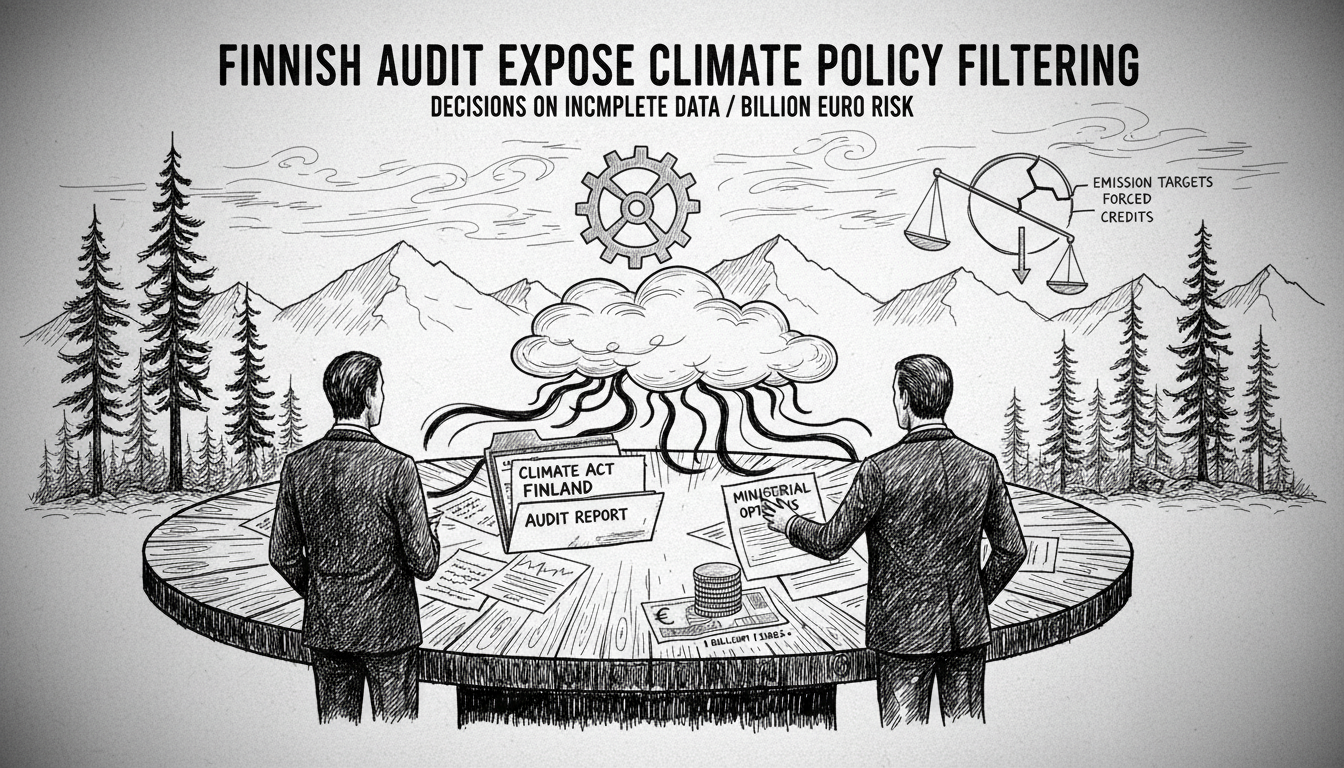
A major audit report from the Finnish National Audit Office reveals serious deficiencies in the preparation of the country's climate policy, alleging that civil servants filtered out key measures based on political acceptability before ministers could review them. The 62-page report criticizes the government of Prime Minister Petteri Orpo for making its most significant climate decisions in the spring based on incomplete information, lacking crucial data on emission impacts and cost-effectiveness. This failure directly contravenes Finland's Climate Act, which mandates that policymakers must consider the cost-efficiency of all climate actions, selecting those that reduce emissions as much as possible relative to their price. The audit found that civil servants supplemented data on impacts and costs during the process, but did so too late, after the government had already made its most critical choices.
The core finding is that a range of potential climate actions were screened out before politicians could even assess them. Civil servants and ministries pre-evaluated which measures were not politically acceptable and omitted them from lists presented to ministerial working groups. This prevented decision-makers from gaining a comprehensive overview of all possible options. The audit specifically noted the absence of proposals for emission-based food taxation and the reallocation of national agricultural subsidies from the list of considered measures. This pre-emptive filtering blurs the crucial line between political decision-making and objective civil service preparation, a foundational principle of Nordic governance.
Finland is legally bound by ambitious national and European Union climate targets, aiming for carbon neutrality by 2035. The EU's binding emissions reduction framework means member states must meet strict sectoral goals. If Finland falls short, the government faces two costly alternatives: implementing additional, potentially more expensive domestic measures or purchasing emission units from other EU nations. The Finnish Climate Change Panel estimates this latter option could cost the state over one billion euros. The audit office's proposal is to create a public, comprehensive mapping of emission reduction actions as standard civil service work before any government term begins. This open database would detail each measure's emission and cost impacts, clearly separating technical preparation from political choice and potentially speeding up the entire policy planning process.
In an interview, Ville Seppälä, the audit office's fiscal policy auditor, explained the practical consequences. He stated that the ministerial working group lacked key data, particularly the 'euro per tonne' cost-efficiency metric for different actions. This gap increases the risk that Finland will select unnecessarily expensive domestic measures. If the country then fails to meet its targets, it may be forced to buy emission units abroad, a scenario where understanding domestic cost-efficiency is vital. Finland should implement all domestic measures that are cheaper than buying foreign units, but without proper data, this comparison is impossible. Seppälä confirmed that political leadership within some ministries influenced which actions made it onto the final list, making it difficult to distinguish where political decision-making began and civil service preparation ended.
This report arrives at a critical juncture for Finnish and European climate policy. The findings suggest that the process, intended to be evidence-based, was compromised by political considerations at the preparatory stage. For international observers and EU institutions, it raises questions about the robustness of national climate planning within the bloc. The implications are financial and environmental. Choosing suboptimal measures increases the total cost of Finland's green transition and risks missing legally binding targets, triggering financial penalties and reputational damage. The audit serves as a stark reminder that transparent, data-driven processes are not just bureaucratic ideals but essential tools for effective and fiscally responsible climate governance in Helsinki and across the EU.