
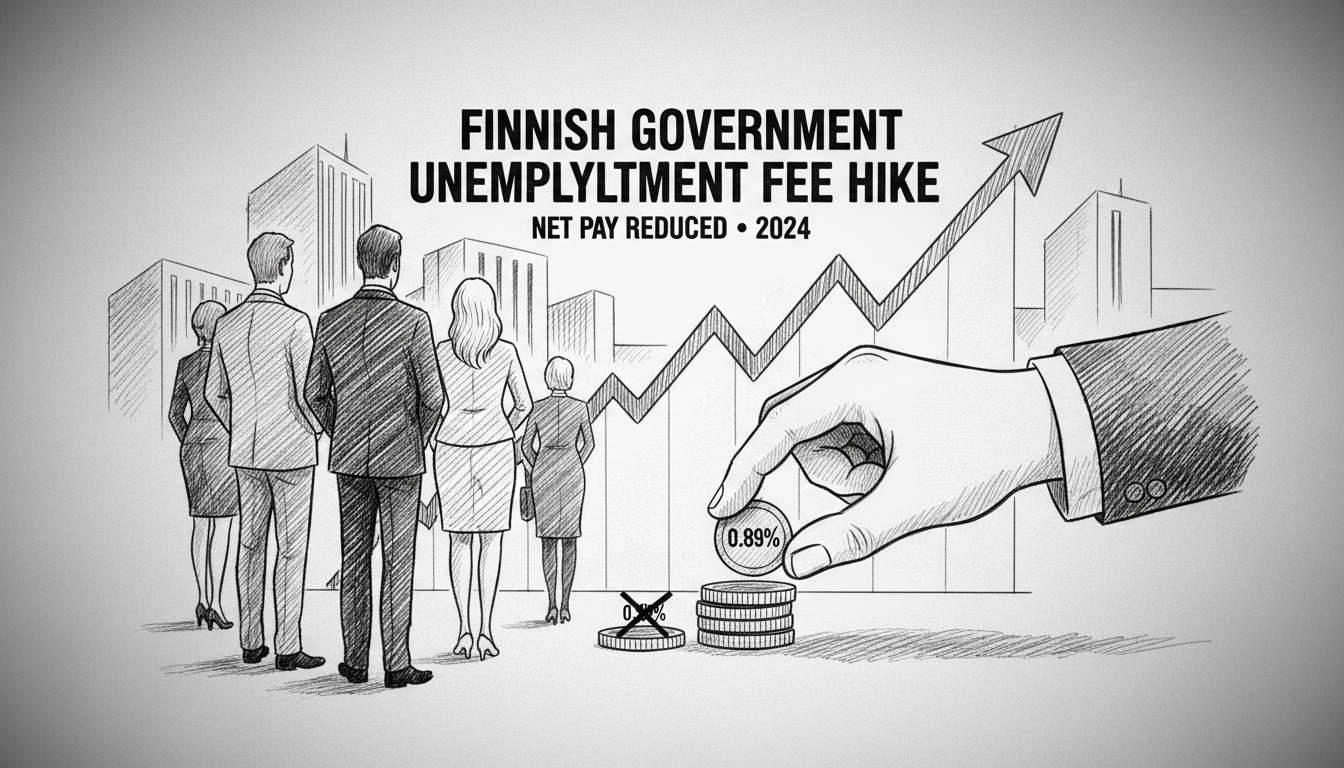
The Finnish government has formally approved a significant increase in the mandatory unemployment insurance contribution for employees. The decision, confirmed by the Ministry of Social Affairs and Health, raises the employee's contribution rate from 0.59 percent to 0.89 percent of gross salary. The law is scheduled to take effect at the start of the new year, following final approval by the President of the Republic. This policy shift, emerging from the government district in Helsinki, has ignited substantial political debate and will directly impact take-home pay across the nation.
Prime Minister Petteri Orpo of the National Coalition Party had publicly advocated for a very moderate approach to raising these fees. His concern stems from a clear economic tension. The increase threatens to erode the positive effects of tax relief measures for wage earners that were implemented during the government's mid-spring review. Reports indicate the Prime Minister contacted leaders of some labour market organizations regarding the fees. He also urged the Employment Fund to adopt a very restrained stance on the proposed hike, highlighting internal government deliberations on the measure's economic impact.
The financial effect on individual workers is now quantifiable. For a person earning a gross monthly salary of 3,000 euros, the increase translates to an additional 9 euros per month, or 108 euros annually. The scale of impact varies with income. An employee earning 2,000 euros monthly will pay 6 euros more, while someone with a 5,000 euro salary faces a 15 euro monthly increase. At the highest end, a 10,000 euro monthly salary will incur an extra 30 euros per month, or 360 euros per year. Regardless of the bracket, every employee will see a reduction in their net pay.
Employers will also face higher contributions. The employer's unemployment insurance payment will rise from 0.20 percent to 0.31 percent of wages, applicable to payrolls not exceeding 2,509,500 euros. For payroll amounts above that threshold, the contribution rate jumps to 1.23 percent. The ministry's release detailed further specific rates for company part-owners, state-owned enterprises, and universities, each with their own calculation brackets and ceilings. These adjustments to the Finnish social security model represent one of the more substantial changes to labour taxation in recent parliamentary sessions.
The policy's passage through the Eduskunta, Finland's parliament, reflects the governing coalition's priorities amid complex fiscal pressures. The move is ostensibly designed to bolster the financial sustainability of the unemployment security system. Critics, however, argue it contradicts the government's stated goal of increasing work incentives and net earnings for low and middle-income workers. The timing is politically sensitive, as the increase will be felt in paychecks shortly after the promised tax cuts. This creates a tangible policy contradiction that opposition parties are certain to highlight. The decision underscores the ongoing challenge of balancing social security funding with disposable income, a core debate in Helsinki's political circles and across EU member states grappling with similar welfare state financing questions.
Looking forward, the annual calibration of unemployment insurance contributions will continue. The government has also adjusted the payroll sum limits for the employer's co-payment, ensuring full liability for firms with a payroll of at least 40,152,000 euros. Smaller companies with payrolls under 2,509,500 euros remain exempt. These technical adjustments aim to align the system with wage development indices. The broader implication is a shift in the cost structure of Finnish labour, affecting both employee net income and employer overheads at a time of economic uncertainty. This development will be closely monitored by EU institutions as a case study in Nordic welfare state adaptation.