
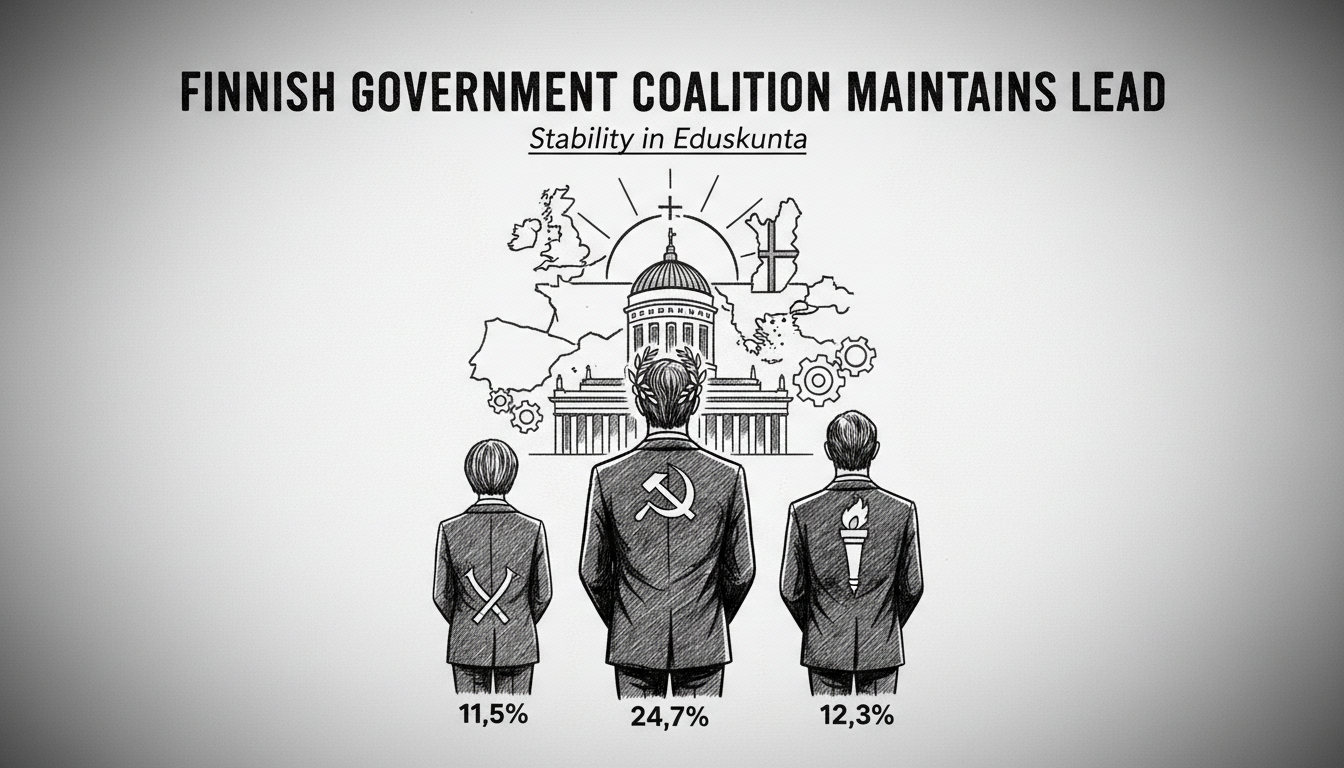
The Finnish Social Democratic Party (SDP) continues to hold the top position in national party support, according to the latest quarterly survey. The poll shows the SDP with 24.7 percent support, a slight decrease of 0.7 percentage points from the previous measurement. The governing coalition's lead party maintains a notable six-point advantage over its main rivals in the Eduskunta, the Finnish Parliament. The National Coalition Party (Kokoomus) follows with 18.7 percent, while the Finns Party (Perussuomalaiset) holds 14.2 percent. The Centre Party (Keskusta) trails closely behind the Finns Party with 13.9 percent support, creating a tight race for third place in Helsinki's political landscape.
These minor shifts in support all fall within the survey's two-percentage-point margin of error. The polling firm Taloustutkimus conducted the survey in the third quarter, interviewing approximately 2,400 individuals across mainland Finland. About 1,850 respondents disclosed their party preference. The results indicate relative stability among Finland's largest political blocs, with no major upheavals in voter sentiment. This stability is crucial for Prime Minister Petteri Orpo's government, which relies on a multi-party coalition to pass legislation. The government's agenda includes major reforms in social security and labor policy, which require consistent parliamentary backing.
The poll's findings carry implications for Finland's direction within the European Union. The SDP's continued strength suggests public support for its traditional Nordic welfare model and pro-EU stance. This contrasts with more EU-skeptic voices represented by other parties in the spectrum. As Finland navigates complex EU debates on defense cooperation, migration policy, and the green transition, domestic political stability provides a stronger negotiating position in Brussels. Historical context shows that Finnish governments often enjoy more stable support mid-term, unlike the volatility seen in some other European capitals. The current government formed after lengthy negotiations, reflecting Finland's consensus-driven political culture where compromise is essential.
For international observers, these numbers reveal a political system in a holding pattern. The core government parties retain enough combined support to govern effectively, but their individual margins are slim. This dynamic forces constant negotiation within the coalition, particularly on contentious issues like climate targets or budget allocations. The next major test will be the municipal elections, which serve as a key mid-term barometer. Voter turnout in these local elections often predicts broader national trends. The slight dip across all major parties could reflect typical mid-term dissatisfaction or specific concerns about economic pressures. Finland faces the same inflationary challenges as its EU neighbors, putting household budgets at the forefront of political debate.
Political analysts note that the Centre Party's position just behind the Finns Party sets the stage for intense competition. Both parties vie for similar rural and regional voters, though with different policy emphases on agriculture, EU relations, and cultural issues. This rivalry fragments the opposition, which works to the advantage of the governing coalition. The stability shown in this poll allows the government to focus on its legislative program without immediate threat of a political crisis. However, the small margins mean that any future scandal or policy misstep could quickly alter the balance of power in the Eduskunta. The government must carefully manage its coalition discipline to maintain its working majority through the full parliamentary term.