
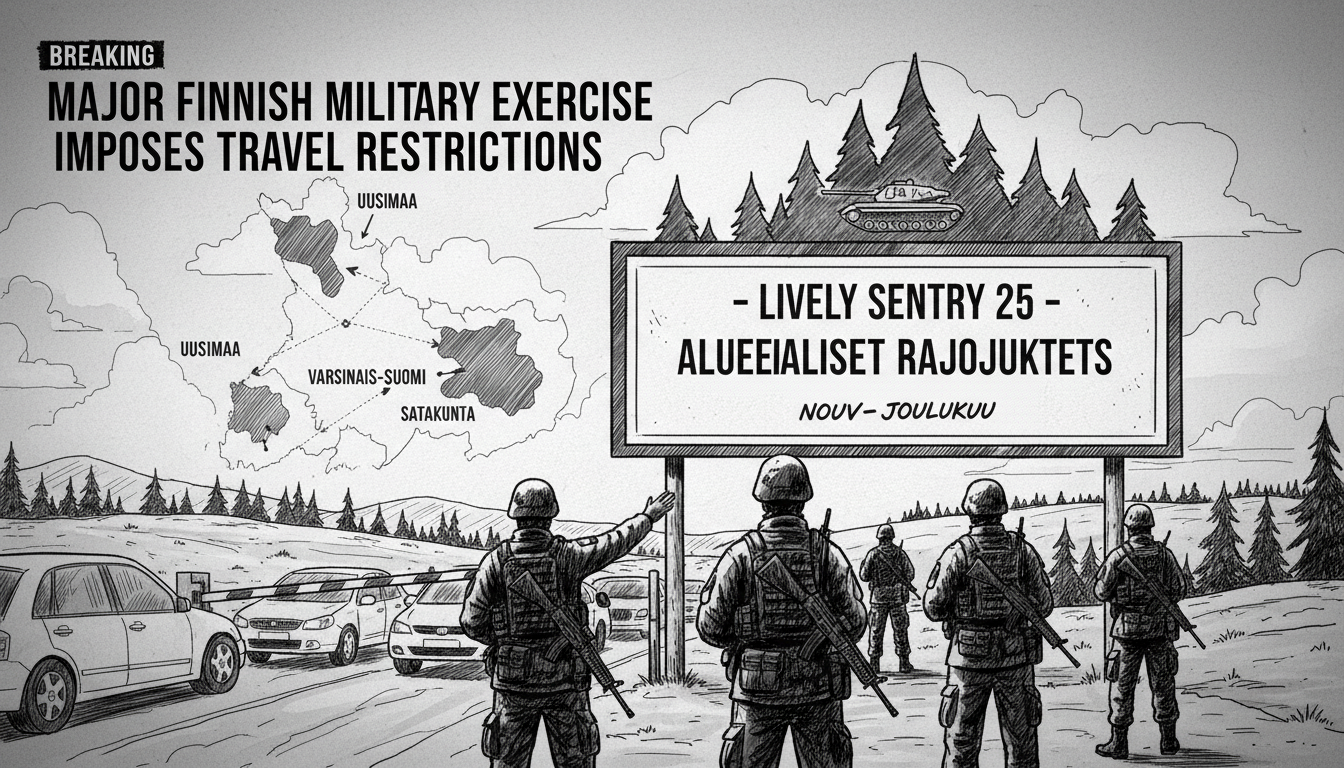
Finland's Defense Forces launch Lively Sentry 25, a substantial military exercise involving approximately 6,550 personnel across Eastern Uusimaa, Kymenlaakso, and Päijät-Häme regions. The operation commences in late November and concludes in early December, focusing heavily on the Orimattila-Artjärvi area where significant traffic disruptions will occur. Military authorities confirm road closures and movement restrictions throughout the training period, requiring local residents to coordinate with defense officials for basic mobility.
The exercise represents Finland's ongoing commitment to maintaining military readiness amid regional security concerns. Local residents must prepare for substantial inconveniences, including potential 30-minute waits at security checkpoints and restricted access to their own properties. The Guard Jaeger Regiment emphasized that emergency vehicles will receive priority passage, while school transportation and care services will experience minimal delays despite the security measures.
Approximately 4,000 conscripts, 1,700 reservists, and 850 professional military staff participate in this comprehensive defense operation. The training involves multiple military branches including the Guard Jaeger Regiment, Armoured Brigade, Pori Brigade, Karelia Brigade, Army Academy, Karelia Air Command, and Border Guard forces. This coordinated effort demonstrates Finland's integrated defense approach combining regular forces with reserve components.
Military vehicles dominate the exercise landscape with over 900 vehicles deployed, including 190 armored vehicles and battle tanks. Aviation support comes from Army MD500 helicopters and unmanned aerial systems, creating substantial noise pollution that officials have attempted to contain between 8 AM and 9 PM daily. The training incorporates live-fire exercises with practice ammunition, though commanders stress safety protocols remain paramount throughout operations.
Colonel Jussi Annala, the exercise deputy commander, explained that Lively Sentry 25 aims to enhance collaborative capabilities between different military branches and command levels. The challenging weather conditions and approaching winter create additional demands for all participants. This exercise particularly focuses on mechanized forest warfare tactics, where armored units operate in dense woodland terrain unfamiliar to conventional military operations.
For international observers, this exercise underscores Finland's serious approach to territorial defense following its NATO accession. The scale and complexity reflect Helsinki's determination to maintain operational readiness despite peacetime conditions. The involvement of December's discharging conscripts adds practical significance, as these soldiers complete their mandatory service with realistic large-scale training before transitioning to reserve status.
The Finnish military maintains transparency about exercise impacts, providing detailed guidance to affected communities. Residents within secured areas cannot move freely without military escort vehicles, though access to immediate home properties remains possible. The Defense Forces established escort services for essential travel, requiring advance coordination and patience from local inhabitants.
This training forms part of the Army's larger autumn exercise series involving approximately 15,000 conscripts and reservists nationwide. The substantial resource allocation demonstrates Finland's commitment to maintaining defense capabilities despite economic pressures affecting other public sectors. Military planners balance training necessities with civilian inconvenience, recognizing that operational readiness requires occasional disruption to normal daily life.