
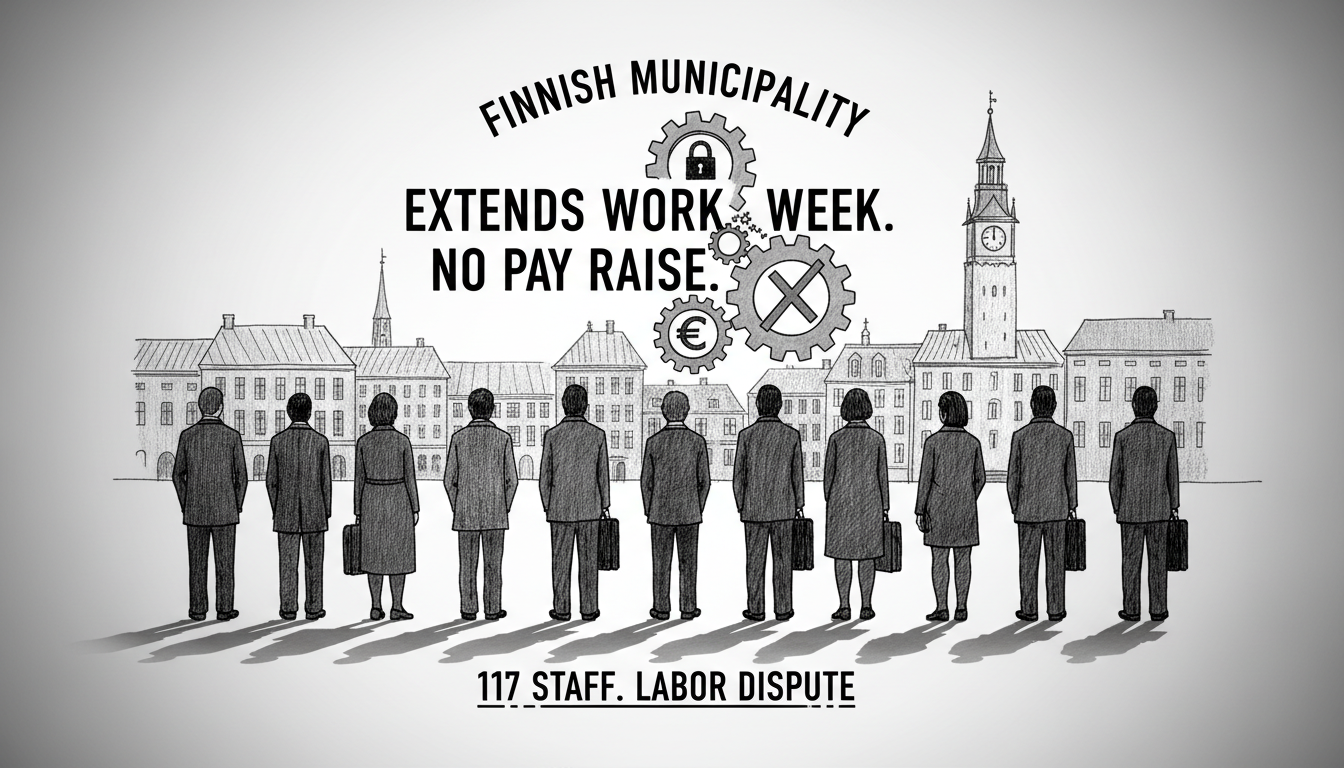
The City of Lappeenranta has increased the weekly working hours for 117 public sector employees by two hours without a corresponding salary increase. This contentious move follows the national transfer of employment services from the state to municipalities earlier this year. The change shifts staff from office work hours to general work hours, a reclassification that has sparked formal local negotiations and union opposition.
At the heart of the dispute is a reinterpretation of job duties. When employment services were a state responsibility under the Ministry of Economic Affairs and Employment, staff followed an office work schedule. This schedule accounted for significant administrative tasks. The municipal employer, following guidelines from the Local Government and Welfare Services Employers (KT), now classifies the roles as primarily involving customer service, which falls under general working hours in the municipal collective agreement (KVTES).
Päivi Savilampi-Oikkonen, the city's Human Resources Director, stated the employer acted on KT's assessment that the tasks constitute customer service work. The practical effect is a 38.5-hour work week instead of 36.5 hours for the affected employees, with no extra pay. Union representatives argue this is a unilateral imposition. Jouni Lahikainen, chief shop steward for the Jyty union in the Saimaa region, called the change unfair, noting state-level negotiations had assured staff that nothing would change upon transfer.
The transfer itself is part of a major structural reform in Finnish public administration. Over 120 state employees were transferred to Lappeenranta, which now manages the South Karelia employment services district. This shift moves oversight from a national ministry to local municipal councils, which unions say brings closer, more results-oriented monitoring.
Formal local negotiations were held this week but ended in disagreement. The union side, including Jyty, JHL, and JUKO, demanded a return to office working hours. The matter may now proceed to labor court. Lahikainen points to preliminary task monitoring initiated by the union, which showed work includes both office and general hour duties, challenging the clean reclassification.
This case highlights a broader national inconsistency. Not all municipalities have implemented similar changes, leading to varying practices across Finland's employment service areas. Savilampi-Oikkonen welcomed the negotiation request, hoping it brings clarity to a confusing situation. She acknowledged the stress on staff, who also face a surge in demand due to recent large-scale layoffs in the South Karelia region.
The city says it supports employees through occupational health services and coaching. It has also begun mapping staff competency development needs. If the working hour directive is later found incorrect, the city would provide financial compensation or equivalent time off.
This dispute is a direct consequence of Finland's ongoing social and healthcare reform (SOTE). It tests the practical implementation of transferring state functions to municipalities under uniform collective agreements. The outcome will set a precedent for labor relations in other regions and for future state-to-municipality transfers. It reveals the tension between centralized collective bargaining and the need for local flexibility in defining modern public service roles, where administrative and customer-facing tasks are increasingly blended.