
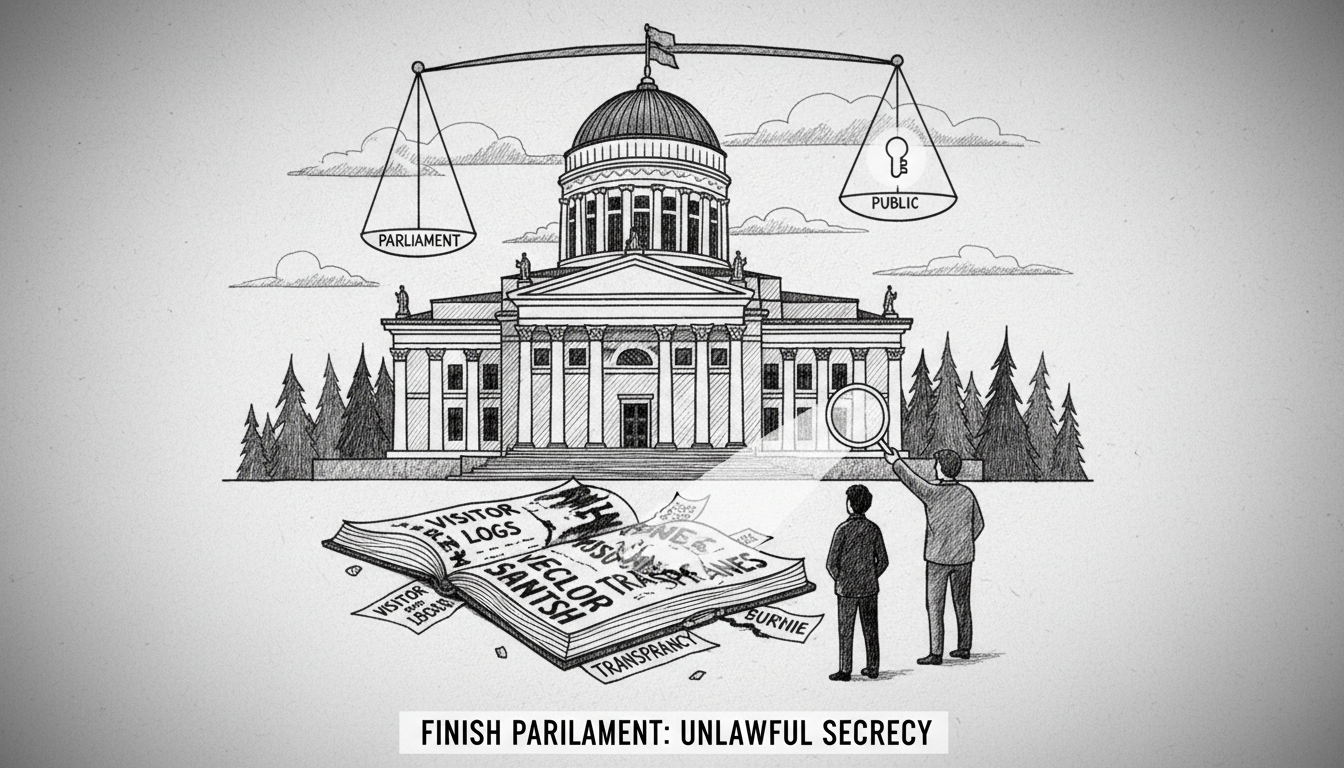
The Helsinki Administrative Court has delivered a sharp rebuke to the Finnish Parliament, the Eduskunta, ruling it acted contrary to law by destroying visitor logs after a journalist requested them. The case centers on a request made on August 18, the same day a Member of Parliament, Eemeli Peltonen of the Social Democratic Party, died by suicide within the Parliament building. The court found the legislature's actions violated Finland's Act on the Openness of Government Activities, a cornerstone of the nation's transparency framework.
Journalist Susanna Reinboth submitted her request for visitor data at 13:38 that day. The court stated the Parliament could not have refused to provide the requested information, at least for any logs not yet destroyed at the time of the request. Crucially, the ruling expresses a "well-founded suspicion" that the Eduskunta destroyed relevant data even after receiving the information request, a procedure the court deemed unlawful. Despite this finding, the court dismissed the journalist's appeal because the contested records no longer existed as a direct result of the Parliament's illegal actions.
The Eduskunta's administrative director argued in a statement to the court that visitor information is confidential before and during visits, and is deleted afterward. The court did not accept this as a valid justification for non-disclosure under the law. It ordered the Parliament to pay the journalist 500 euros in legal costs, stating she would have been entitled to receive the information if not for the unlawful procedure. This legal tussle over parliamentary visitor lists is not new. For years, Finnish media and transparency advocates have pushed for public access, with the Supreme Administrative Court previously ruling that such lists are official documents and fundamentally public in nature.
The Parliamentary Ombudsman has also criticized the Eduskunta's handling of similar requests, explicitly stating that data cannot be destroyed once a formal information request has been lodged. This latest court decision underscores a persistent tension within the Helsinki government district between operational security and public accountability. It raises direct questions about the consistency of applying transparency laws to the very body that creates them. The ruling carries implications for Finland's reputation regarding good governance and press freedom, metrics closely watched by European Union institutions.
For international observers, the case is a stark example of how transparency laws are tested in practice. Finland frequently ranks high in global transparency indices, but this incident reveals procedural gaps. The core issue is whether the principle of openness applies equally to all branches of government, including the legislature's inner workings. The decision may prompt a review of record-keeping and disclosure protocols within the Eduskunta to prevent future violations. It also serves as a reminder that legal frameworks like the EU's broader transparency directives depend on consistent national implementation to be effective.