
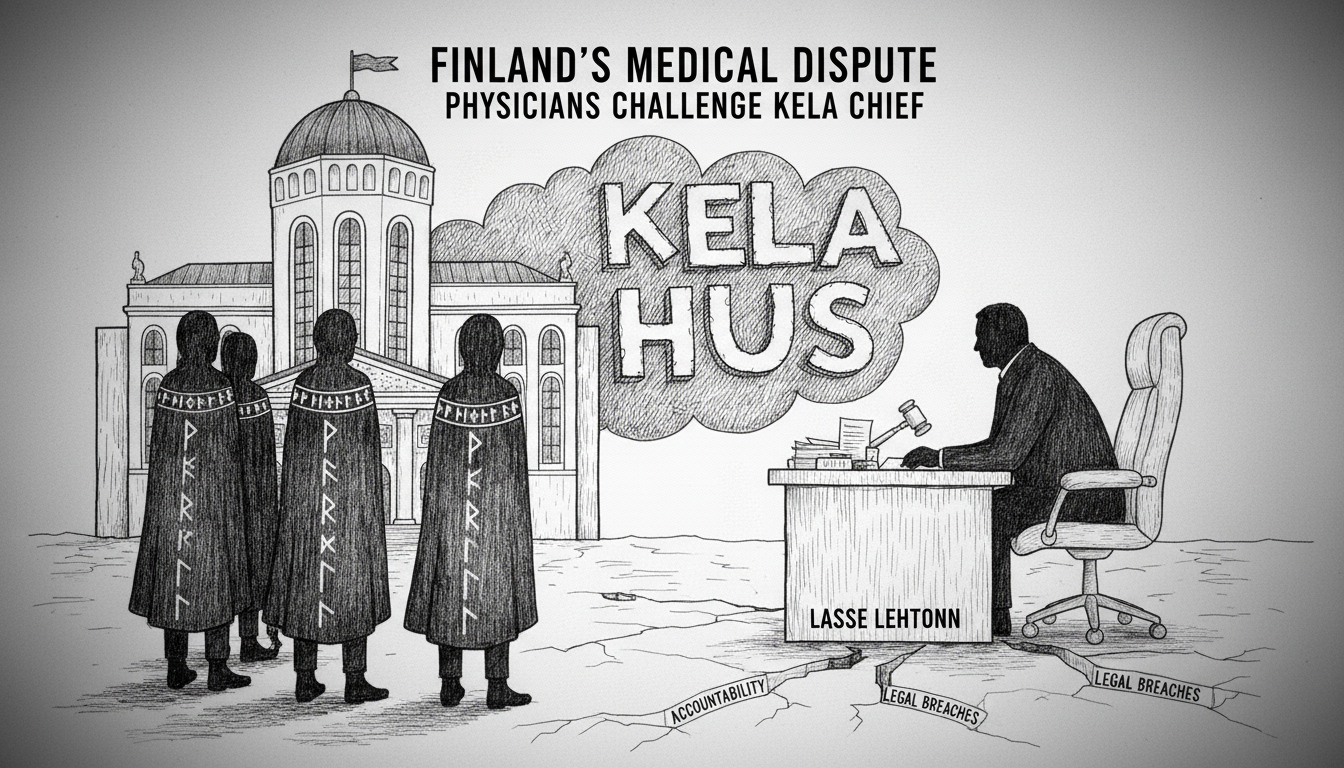
Finland's Parliamentary Ombudsman has received a formal complaint against Lasse Lehtonen, the current Director General of the Social Insurance Institution (Kela). The complaint originates from four senior physicians at the Helsinki University Hospital (HUS) Diagnostic Center. It alleges serious managerial misconduct during Lehtonen's previous tenure as the head of that unit. The case raises questions about public sector governance and the accountability of high-ranking officials who move between major state institutions.
The complaint was filed by Chief Physician Antti Markkola, Specialist Dentist Marianne Nixdorf, Department Chief Dentist Anni Suomalainen, and Specialist Physician Riikka Linden. All work at HUS's Meilahti Tower Hospital. Their grievance focuses on organizational changes within craniofacial and dental radiology units. It also cites a failure by the employer to fulfill cooperation obligations and points to inappropriate treatment by management.
In their submission, the physicians state the events demonstrate the employer's procedures did not fully meet a public employer's duty to obey the law and follow good administrative practice. The complaint's goal is for the Ombudsman to investigate the legality of the procedures. If deficiencies are found, the complainants want guarantees that HUS will implement proper corrective measures. The complaint strongly highlights the role of Lehtonen, describing his leadership style as 'management by fear'.
Several individuals experienced his behavior as inappropriate, the complainants say. The complaint also implicates HUS's top leadership. It claims CEO Matti Bergendahl and HR Director Johanna Karppi did not effectively intervene in Lehtonen's actions. This was despite an internal investigation recommending he receive at least a formal warning. Lehtonen declined to comment on the ongoing process when contacted.
The core dispute has a longer history. In December 2022, permanent dental radiologists Suomalainen and Nixdorf demanded HUS correct what they called incorrectly paid overtime bonuses. The complainants say that in the summer of 2022, dental radiologists were denied the opportunity for overtime work. In that context, then-director Lehtonen stated he would 'review the dental radiology organization in the autumn if there were difficulties adapting to the Diagnostic Center's operating models and processes.' The radiologists perceived the overtime ban as a discriminatory measure and the mention of reorganization as a threat.
Subsequent meetings in November 2023 are detailed in the complaint. Notes from a meeting show Lehtonen's actions included arbitrariness, such as suddenly tripling training quotas for dental radiologists or alternatively nearly completely ceasing their functions. The notes also reveal Lehtonen set unreasonable demands with unrealistic deadlines. When Suomalainen requested more information to respond properly, Lehtonen refused to provide it, reprimanded her for an inappropriate approach, and questioned her competence as a supervisor. The complainants say this procedure exemplifies Lehtonen's disrespectful, dismissive, and pressuring management style.
In a later phone call, Lehtonen asked Markkola if he was interested in an administrative chief physician role. When Markkola said he was satisfied with his current duties, Lehtonen replied he had asked because 'Markkola would have nothing left to manage in the future.' Lehtonen announced his intention to reorganize craniofacial radiology. Markkola expressed confusion about why Lehtonen wanted to dismantle a well-functioning unit that had recently received excellent feedback. Lehtonen provided no justification for his decision during the call, nor did he clarify what the planned reorganization would entail. The complainants state this phone conversation also characterizes Lehtonen's leadership approach and his attitude toward subordinates.
Because the employer repeatedly failed to present any substantive grounds for reorganizing dental radiology functions, the staff concluded this was one of Lehtonen's methods of harassing the dental radiologists. A later memorandum to CEO Bergendahl and leading chief physician Mäkijärvi stated Lehtonen's conduct and management by fear had become a significant risk to staff well-being and endurance. The organizational culture had become harmful. Consequently, HUS Occupational Health initiated a targeted assessment of psychosocial stress factors for the craniofacial radiology unit.
Lehtonen left HUS in June of last year. After his departure, staff again contacted HUS's top leadership. Their concern was the continuing erosion of expertise and function in craniofacial radiology. The unit had been placed under a neuroradiology chief physician unfamiliar with the field. In August, Markkola received an email from HR Director Karppi that appeared to try to retroactively find or construct different justifications for Lehtonen's decision. Based on the email, no written document or basis for removing Markkola's headship could be found.
The complaint includes non-public responses Markkola gave to Karppi. An unknown person defends Markkola's views in these responses and confirms the described course of events. This person also recounts Lehtonen's inappropriate behavior in meetings. They ponder whether the bypassing of cooperation procedures originated from a Diagnostic Center cooperation meeting on May 12, 2022. At that meeting, Lehtonen reportedly announced he was resigning from cooperation, behaved inappropriately and loudly, and particularly directed shouting and aggressive conduct at employee union representatives. Several staff representatives present confirm these events, though they were not minuted. Lehtonen is said to have verbally attacked the union representatives and stated at the end that 'if you look for a fight, you'll get a fight.'
This case is significant for Finland's public administration. It tests the mechanisms of accountability when a senior official is accused of serious managerial failures in one major institution while leading another. The Parliamentary Ombudsman's investigation will be closely watched. It will signal how Finland handles internal governance complaints within its critical welfare state pillars like HUS and Kela. The outcome may influence future appointments and the scrutiny of leadership cultures in public sector entities that directly impact citizen services and specialist professions.