
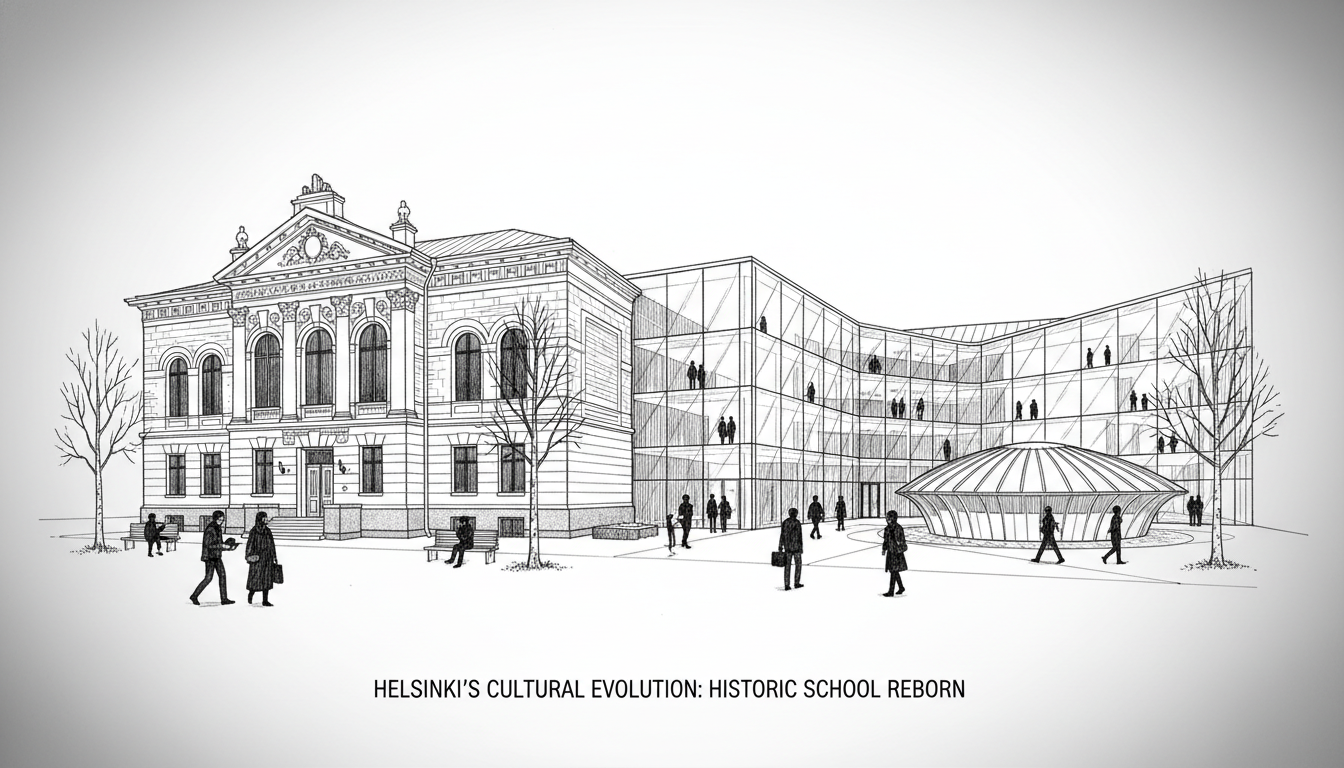
A landmark stone building in central Helsinki undergoes major renovation to become a modern cultural and office center. The former Helsinki Finnish Girls School on Bulevardi street will soon house learning spaces, offices, and event venues. This transformation represents Helsinki's ongoing effort to preserve historic architecture while adapting it for contemporary use.
The building at the corner of Yrjönkatu and Bulevardi dates back to 1880. Architect Sebastian Gripenberg designed the original neo-Renaissance structure. For decades, it served as an educational institution before hosting various cultural activities. The property has belonged to Svenska Folkskolans Vänner since 2003.
City officials will review the zoning change application next Tuesday. The proposal seeks permission for broader use of the property than currently allowed. The owner plans to create an open learning and cultural center with high-quality office spaces.
Existing classrooms, halls, and auditoriums will transform into spaces for meetings, work, hobbies, and exhibitions. A sculptural extension building will rise from the inner courtyard. This new addition will contain an auditorium for events and gatherings. Architects describe the design as adding a contemporary layer to the historic building.
Several authorities oversee the development process. The Museum Board has guided the architectural planning. The Uusimaa Centre for Economic Development, zoning officials, and the city museum all participate in the project.
The building's history reflects Helsinki's cultural evolution. From 1980 to 1990, it housed the Academy of Fine Arts. Later, spaces served as public event venues, exhibition galleries, and restaurants. Galleria G18 and Restaurant G-18 operated within the building. City Folk High School used studio spaces in recent years.
Beyond standard classrooms, the building contains impressive original features. A generous 160-square-meter celebration hall offers space for larger events. A vaulted cellar provides atmospheric underground space. The building underwent extensive restoration in 2005.
This project demonstrates Helsinki's approach to urban development. The city balances preservation with modernization, finding new purposes for historic structures. The transformation will bring renewed activity to one of Helsinki's most valuable stone buildings while maintaining its architectural integrity.
The timing coincides with increased demand for flexible cultural and workspace in central Helsinki. The location near Old Church Park makes it ideal for public access. The project shows how historic educational buildings can find new relevance in modern cities.
Local residents and cultural organizations will gain new gathering spaces. The open learning center concept addresses growing interest in lifelong education. High-quality offices will attract businesses seeking distinctive central locations.
The renovation continues Helsinki's tradition of repurposing historic buildings. Similar transformations have occurred throughout the city center. This approach preserves architectural heritage while meeting contemporary urban needs.