
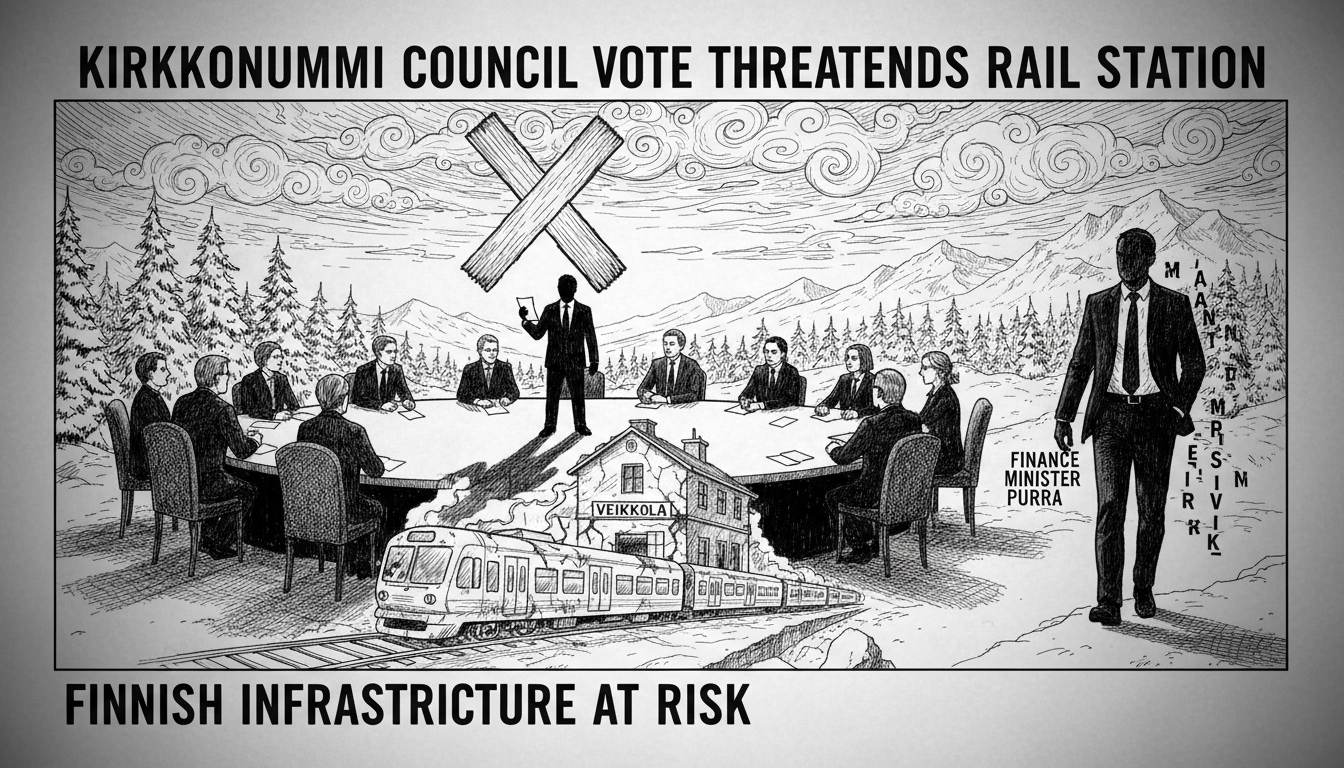
The Kirkkonummi municipal council faces a decisive vote on Monday regarding its participation in the major Western Rail Line project, a vote that could jeopardize the planned station in the Veikkola district. The council is deeply divided, with nearly all political groups split between supporters and opponents of the agreement. Finance Minister Riikka Purra of the Finns Party will not participate in the crucial local vote, citing other commitments, despite her party's national stance against the rail project.
The municipal executive board has already recommended rejecting the shareholder agreement by a vote of eight to five. This sets the stage for a tense council meeting where the outcome remains uncertain. The council's decision carries direct consequences for local infrastructure. If Kirkkonummi rejects the deal, the proposed Veikkola station may not be built, or its construction could become significantly more expensive for the municipality to fund independently at a later date.
Political fragmentation is evident across the council. The largest group, the National Coalition Party with 14 seats, contains both advocates and critics. Group chair Urho Blom supports joining the agreement, acknowledging inherent cost risks in large infrastructure projects but citing a key interpretation from the Ministry of Transport and Communications. The ministry's reading suggests a shareholder's financing commitment cannot be substantially exceeded without their consent, a point Blom emphasizes.
The Swedish People's Party group, holding 11 seats, leans heavily toward rejection. Group chair Kim Liljequist argues the benefits for Kirkkonummi are smaller than for other municipalities along the line, while the financial risk is substantial. He likened the shareholder agreement to an open cheque, expressing concern over uncontrolled costs.
The Green League and Social Democratic Party groups, the next largest, also report internal divisions. Green chair Lauri Lavanti notes a slight majority of supporters in his group currently, but his personal concern centers on the risk of the rail line being built without the Veikkola station. SDP councilor Tuovi Ronkainen estimates more opponents than supporters in her party's group, questioning the justification of the agreements and fearing the municipality will bear a heavier financial burden than stated.
The Finns Party group opposes the Western Rail Line nationally. Its local chair, Piia Aallonharja, indicated the group will likely support the executive board's recommendation to reject. She confirmed Finance Minister Purra's absence from the local vote.
This local decision unfolds within a larger national framework. The Western Rail Line is a major transport initiative where both the state and shareholder municipalities fund an initial 400 million euros. The project company also holds borrowing rights for an additional 500 million euros, and the project hopes to secure EU funding. Kirkkonummi's proposed share of municipal funding is the smallest among participating towns, so Monday's vote, while critical locally, is not expected to derail the entire rail project on its own.
The situation highlights a recurring tension in Finnish regional development between local autonomy and national infrastructure goals. Municipalities weigh direct costs against long-term connectivity benefits, often leading to protracted negotiations. The Finance Minister's absence from a vote concerning a project her party opposes nationally is a notable detail, reflecting the complex interplay between local representation and national political lines. The outcome will test whether local councils prioritize risk mitigation or future growth potential when committing to decades-long national projects.