
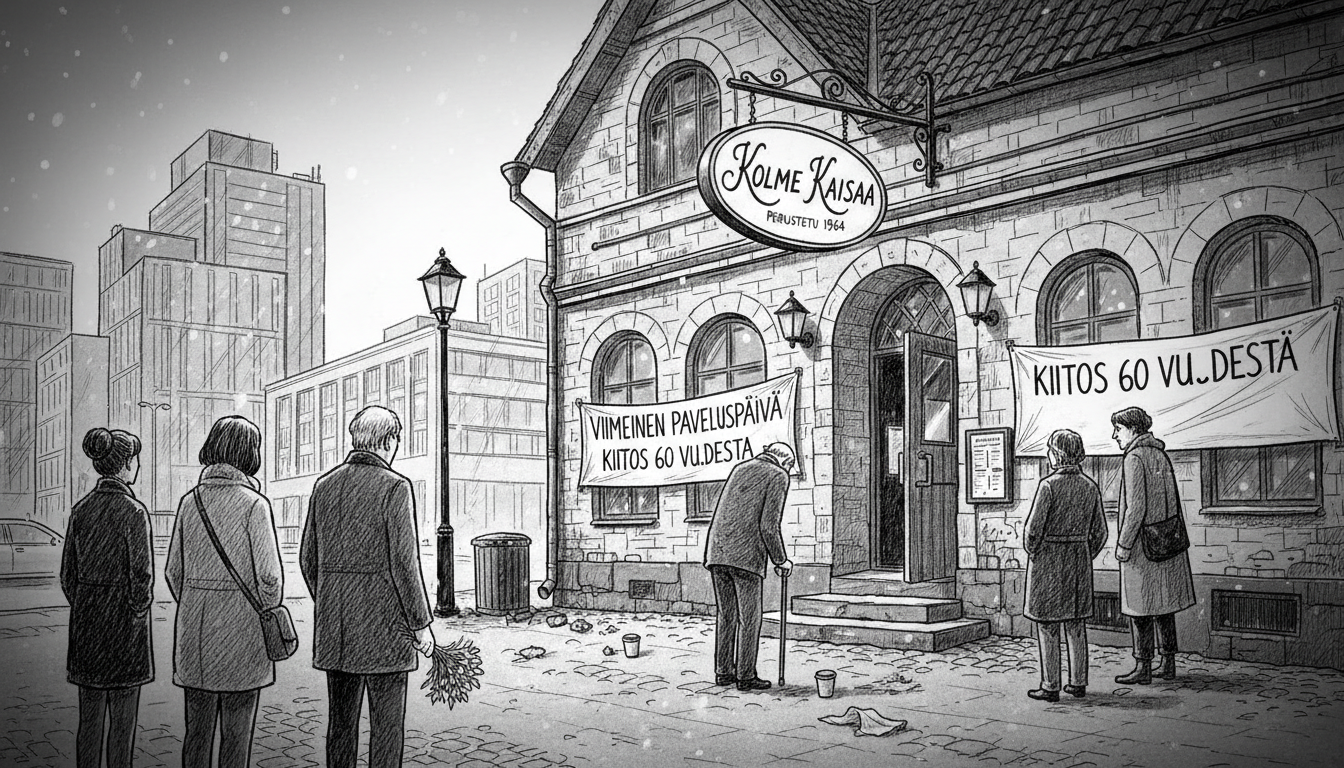
A legendary Helsinki restaurant and bar, Kolme Kaisaa, is closing its doors permanently in the Kurvi district. The establishment will cease operations just before Christmas after failing to reach an agreement on a lease extension with its landlord. Restaurant manager Tiina Hintikka confirmed the closure, stating that a fixed-term lease had ended and negotiations for a continuation had broken down. The final closure date is expected to be a few days before the holiday, marking the end of an era for a venue that first opened as a café in 1964 before evolving into a popular licensed restaurant.
The announcement has shocked a loyal customer base that has frequented the spot for decades. Hintikka described patrons as upset and somewhat disbelieving that such a fixture could disappear. She expressed immense gratitude to the customers whose support sustained the business through difficult periods, including the pandemic. The closure represents a tangible loss for Helsinki's urban fabric, removing a social anchor point with deep generational connections. This is not merely a business closing but the dissolution of a community space with intangible cultural value.
Hintikka indicated a strong desire to potentially continue the Kolme Kaisaa concept at a new location. She acknowledged the cold reality that finding an equivalent iconic premises would be extremely challenging. Any relocation would inevitably alter the character and concept of the establishment. The situation highlights broader pressures on traditional, independent hospitality venues in central Helsinki. Rising commercial rents and property development priorities often displace long-standing local businesses, changing the social geography of neighbourhoods.
This closure fits a recognizable pattern in Nordic capitals where economic efficiency frequently trumps cultural continuity. The story of Kolme Kaisaa is a microcosm of a city's evolution, where market forces reshape familiar landscapes. For international observers, it illustrates a tension common in prosperous European cities: balancing modern development with the preservation of social history. The restaurant's fate will be watched by those concerned with urban identity and the survival of non-chain venues that provide cities with unique character.
The next steps for the Kolme Kaisaa team remain uncertain. The coming weeks will involve the logistical process of closing the current operation while exploring future possibilities. The response from the public may yet influence the search for a new home, but the specific atmosphere of the Kurvi location is irreplaceable. This event serves as a reminder for residents and visitors to value local institutions before they become memories. The closure before Christmas adds a poignant note to the end of a Helsinki institution that served generations.