
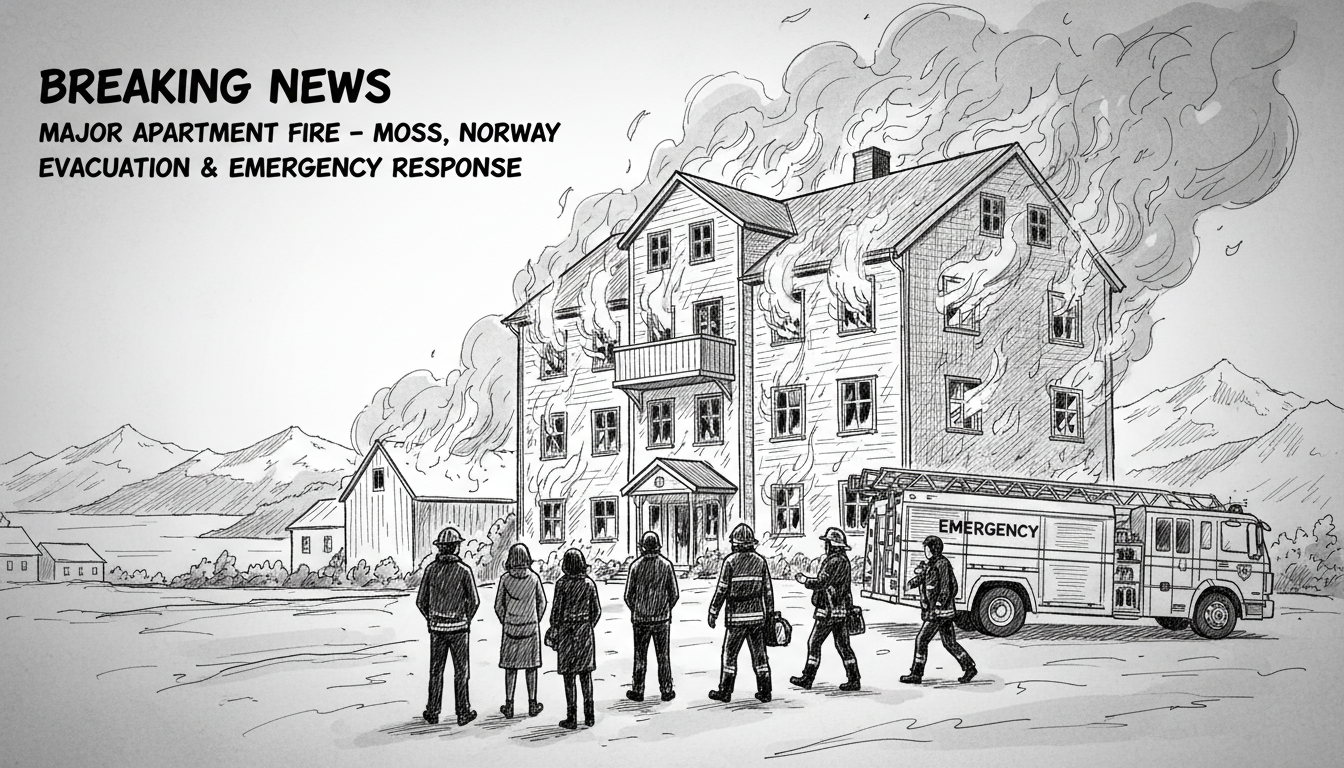
Emergency services responded to a serious apartment fire in Moss, Norway, late Tuesday evening. The blaze affected four separate apartments in a residential building. Officials confirmed eight people were evacuated from the scene. Five came from the burning building and three from a neighboring structure.
Operations leader Arild Bråten stated all residents from both buildings were safely accounted for. He confirmed no individuals were missing. Open flames were extinguished, but significant smoke continued to emanate from the structure. Bråten noted some individuals may have inhaled smoke. He reported no serious injuries at this time.
This incident in Moss highlights critical aspects of Norwegian urban safety and emergency preparedness. Norway maintains strict building codes, especially for multi-unit dwellings. The rapid evacuation and lack of serious injuries suggest protocols functioned as intended. Fire safety in residential blocks remains a persistent concern for municipalities across the country.
The response involved coordinated efforts from police and fire services. Such operations are standard but resource-intensive for local emergency teams. Events like this test municipal response plans and inter-agency communication. The outcome here appears positive from a life-safety perspective.
Looking deeper, this fire raises questions about building material standards and inspection regimes. Norwegian cities have a mix of older wooden structures and modern concrete buildings. Each presents different fire risks and challenges for firefighters. The cause of this blaze will be investigated thoroughly by local authorities.
For international readers, it is important to understand Norway's decentralized emergency response system. Each municipality has primary responsibility for fire and rescue services. They often cooperate with regional and national resources for major incidents. This structure generally produces high response times and effective outcomes.
The event in Moss is a localized incident. It does not indicate a broader systemic failure. It does, however, serve as a reminder of the constant work required to maintain public safety in dense housing areas. Norwegian authorities typically review such events to identify potential improvements in codes or response tactics.
Residents displaced by the fire will receive support from local social services. Temporary housing and assistance are standard provisions in these situations. The building will remain closed until engineers assess structural integrity and smoke damage. The investigation into the fire's origin is the next critical step for officials.