
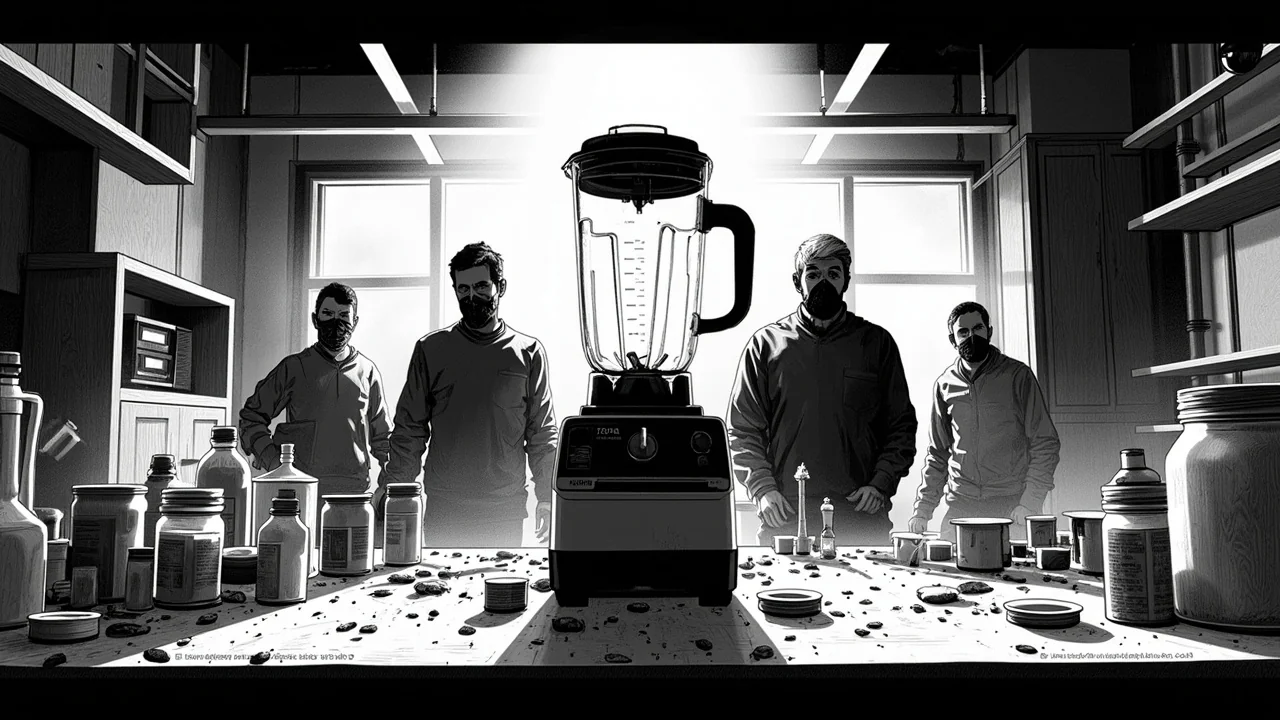
Norwegian police uncovered a large-scale methamphetamine production facility on a remote farm in Modum, seizing equipment that included a common kitchen blender. The discovery came during an investigation into an unrelated tip in June 2022. Police believe at least 74 kilograms of amphetamine were produced there, with 66 kilograms already sold on the market.
"We uncovered what we believe is a laboratory, or a production site, for amphetamine," said State Prosecutor Vibeke Gjøslien. "We found some amphetamine residue on the farm, but also equipment and raw materials or packaging for it, which we believe have been used."
In addition to the drug production evidence, police found stolen cars and illegal weapons on the property. Three men from the Buskerud region now face charges in Buskerud District Court. Two are charged with producing and selling the amphetamine, aggravated money laundering, illegal weapons possession, and car theft. A third man is charged with transferring 286,000 Norwegian kroner from criminal activity to another person.
The Farmhouse Laboratory
The production setup was rudimentary but effective. Images from the scene show ten mortar buckets with white powder residue, a packaging machine, a fan, a kitchen scale, and plastic cans. The most striking piece of equipment was an ordinary kitchen blender, repurposed for mixing drug components. Police also seized approximately eight kilograms of finished amphetamine from a car one of the accused was stopped in.
Forensic analysis of 555 grams of amphetamine base and packaging materials found on-site allowed police to calculate the total production volume. "This is relatively a lot. It is, in any case, a serious offense, with a 15-year penalty frame," Gjøslien stated. The prosecution has filed a confiscation claim for 2.5 million Norwegian kroner linked to the proceeds.
The Accused and Their Defenses
The legal proceedings reveal contrasting defenses. One of the men charged with production partially admits guilt. The other denies all charges. His defense lawyer, Espen Wangberg, argues police fell into a confirmation bias trap. "We perceive that the police have a desire, that they have gone into a so-called confirmation trap here. So they want to try to link him to it," Wangberg said. He stated his client claims he did not live or stay at the farm in question during the relevant period, though he lived there later. The third man, charged with money transfer, also denies criminal guilt.
This case highlights a common challenge in prosecuting organized crime: linking individuals directly to criminal activity in remote locations. The defenses suggest a strategy of distancing the accused from the physical site during the exact production timeline.
Scale and Significance of the Bust
The seizure of 74 kilograms of amphetamine represents a significant interception. For context, the European Monitoring Centre for Drugs and Drug Addiction (EMCDDA) reports that wholesale prices for amphetamine in Europe can vary widely, but such a quantity represents a major supply chain disruption. The operation's location on a remote farm follows an international trend of drug producers using rural properties to avoid detection, leveraging isolation to mask chemical odors and unusual activity.
The use of everyday equipment like a kitchen blender points to the adaptive methods of producers. It shows how drug manufacturing can be set up without highly specialized industrial tools, making it harder for authorities to track purchases of specific equipment. The presence of stolen vehicles and weapons also fits a pattern of poly-criminality, where groups involved in drug production engage in other crimes to support their operations or finance their activities.
Expert Perspective on Drug Production Trends
While not commenting directly on this case, independent drug market analysts note a shift in European production patterns. "There is an increasing trend of domestic production within Scandinavia, moving away from pure importation," says a researcher familiar with Nordic drug markets, who spoke on condition of anonymity due to the sensitivity of their work. "These decentralized labs reduce transport risks for criminal groups. They source precursor chemicals through complex networks and use simple chemistry. A farm building is ideal—it's isolated, has space, and draws little attention."
The analyst explained that amphetamine synthesis can be performed with relatively basic knowledge. The real value for criminal networks lies in distribution. Selling 66 kilograms indicates an established and efficient sales network. The confiscation claim of 2.5 million NOK likely represents only a fraction of the total generated revenue, underscoring the profitable nature of the trade.
The Broader Fight Against Organized Crime
This bust is part of a wider Norwegian police strategy targeting high-level production and distribution. Major drug seizures often result from connecting smaller tips, as happened here. The investigation that began with an unrelated tip in 2022 demonstrates the importance of following all leads, as they can unravel larger operations.
Money laundering charges are increasingly crucial in these prosecutions. Disrupting the financial incentive is key to tackling organized crime. By pursuing the 2.5 million NOK confiscation, authorities aim to hit the criminal enterprise where it matters most: its profits. The inclusion of weapons charges also reflects the violent nature of these networks, where arms are used for protection, intimidation, and enforcing deals.
What Happens Next?
The trial in Buskerud District Court will examine forensic evidence, telecommunications data, and witness testimony to establish the roles of each accused. The prosecution must prove beyond reasonable doubt that the men were responsible for the production and sales operation on the farm. The defense will likely challenge the forensic links and the interpretation of evidence, particularly regarding who was present and when.
The outcome could set a precedent for how similar cases are prosecuted, especially regarding evidence from remote, temporary production sites. A conviction would represent a significant victory for police in disrupting a substantial supply line. However, the market's nature means other groups may attempt to fill the void, highlighting the continuous challenge for law enforcement.
This case serves as a stark reminder of the hidden criminal economies operating in rural Scandinavia. It shows how ordinary landscapes can conceal significant illegal activity. The kitchen blender, a symbol of domestic life, transformed into a tool for crime, illustrates the unsettling blend of the mundane and the illicit in modern drug production. The court's decision will be closely watched by both law enforcement and criminal networks, each assessing its impact on the risks and rewards of the drug trade in Norway.