
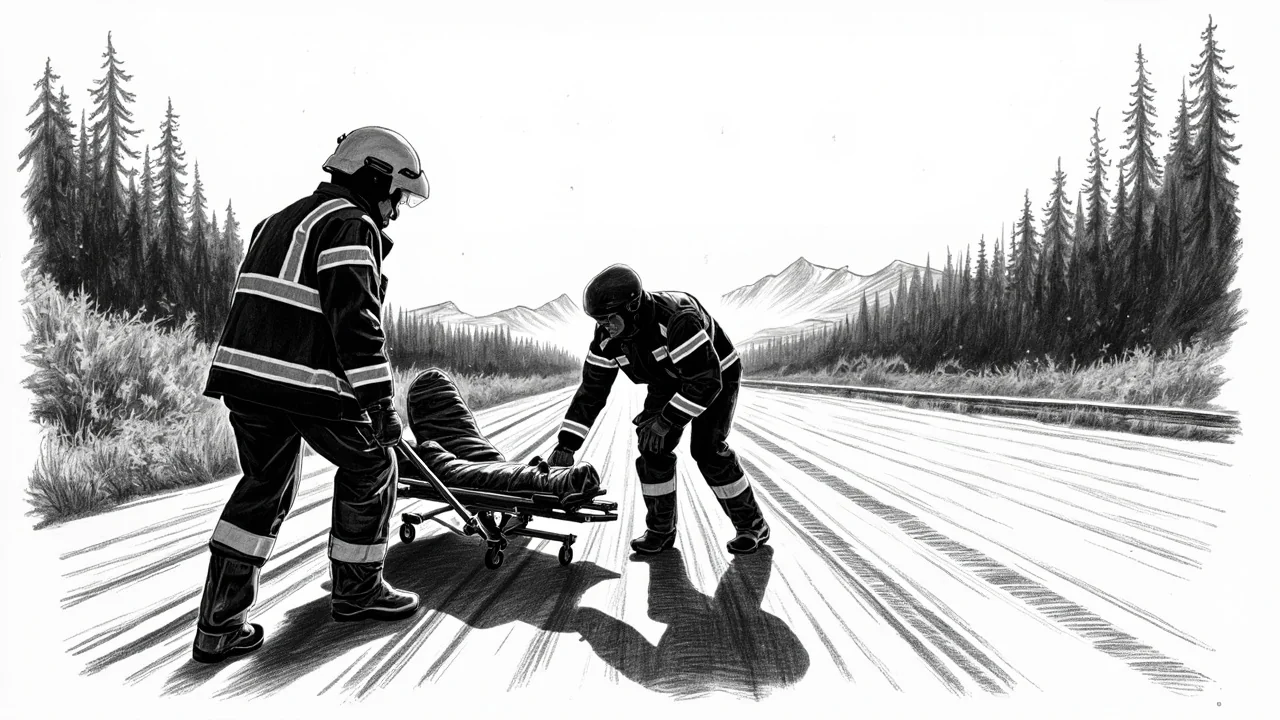
Norwegian emergency crews report over 1000 dangerous incidents annually as drivers fail to slow down at accident scenes, putting responders' lives at risk during critical rescue operations. Firefighters and rescue personnel describe cars passing within one meter while they work, turning every roadside emergency into a potential second tragedy.
A Reckless and Growing Trend
Andreas Røsche, an operations leader with Grenland Fire and Rescue, uses stark language to describe the behavior. “Some fall under the category of ‘driving like pigs.’ Sometimes we are out there with our lives at stake,” he said. He was the incident commander at a traffic accident on the E18 in Bamble in early January. Despite marked emergency vehicles, blue lights, accident signs, and a reduced speed limit of 50 km/h, many motorists maintained excessive speed. “When cars pass us with as little as one or two meters of distance, we feel it in our bodies,” Røsche stated, highlighting the visceral danger. “The margins are so small. One small misjudgment from a driver there, and we could have accident number two.”
A National Problem Confirmed
This is not an isolated experience. Colleagues of Røsche in Trøndelag, Bergen, Kristiansand, and Vestfold report the same alarming behavior. They all experience motorists driving too fast past crews working along the road. While official statistics from the Norwegian Public Roads Administration show reports of over 1000 unwanted incidents on national and European roads each year, the agency acknowledges the figure represents significant underreporting. Rune Wiggo Johnsen, an operations leader in Trøndelag Fire Department, confirms a negative trend is underway. “Motorists are more inattentive, have less patience, and more are driving under the influence of drugs,” Johnsen said, pointing to a broader degradation of road safety culture. “Drivers are unfocused, we are often in their blind spot, and we are often pressed for time when we are at traffic accidents.”
The Human Cost for Responders
The physical and psychological toll on emergency workers is constant. Jan Helge Kaiser, a fire chief in Vestfold, described a recent Friday morning in January where his department, covering four municipalities, was called to four separate traffic accidents on the E18. In the aftermath of these missions, crew safety was a primary topic of discussion. “I urge road users to show consideration when passing an accident site, so they do not expose our crews and others to risk,” Kaiser said. The close calls are not abstract statistics for these teams, they are moments of genuine fear that compound the stress of an already high-pressure job. The phrase “with our lives at stake,” used by Røsche, transitions from metaphor to a literal description of their working conditions.
A Culture of Impatience on the Road
Experts analyzing road behavior suggest this trend correlates with wider societal shifts. The increase in distracted driving, often linked to smartphone use, is frequently cited. A pervasive sense of urgency and eroded patience among drivers means safety protocols, especially those protecting vulnerable workers on the roadside, are being ignored. The emergency crews’ flashing lights and signs are meant to create a protected zone, but that zone is increasingly violated. This creates a paradoxical situation where the people arriving to save lives must constantly fear for their own. The problem escalates with every near-miss, as each unreported incident reinforces a driver’s belief that high-speed passage is acceptable.
Seeking Solutions and Accountability
Addressing this crisis requires a multi-faceted approach. Emergency services continue public awareness campaigns, directly pleading with drivers through media channels, as these firefighters have done. Enforcement is another critical pillar. Police presence and the use of automated speed control in areas where emergency crews are working could act as a stronger deterrent. Some have suggested stricter penalties for those who violate speed limits in marked emergency zones, similar to laws in other countries. Technological solutions, such as advanced warning systems in vehicles that detect emergency lights and alert drivers, may play a future role. However, all responders emphasize that the immediate solution lies with individual drivers making a conscious choice to slow down and move over.
The Unseen Second Accident
The core of the issue, as framed by the responders themselves, is the prevention of “the second accident.” The first accident is the crash they are called to manage—a contained tragedy with known victims. The second accident is the one that happens when a speeding car plows into the rescue scene. This second accident would be catastrophic, potentially killing or injuring firefighters, medical personnel, police, and already-vulnerable crash victims. It would completely halt rescue efforts. Every time a driver speeds past with a two-meter gap, they are gambling with the possibility of triggering that second disaster. The emergency crews are forced to accept this risk as part of their duty, but they are now speaking out to make the public understand that this risk is preventable, unnecessary, and driven by sheer recklessness. Will drivers start to see the human beings in the reflective suits, or will the dangerous rush past blue lights continue?