
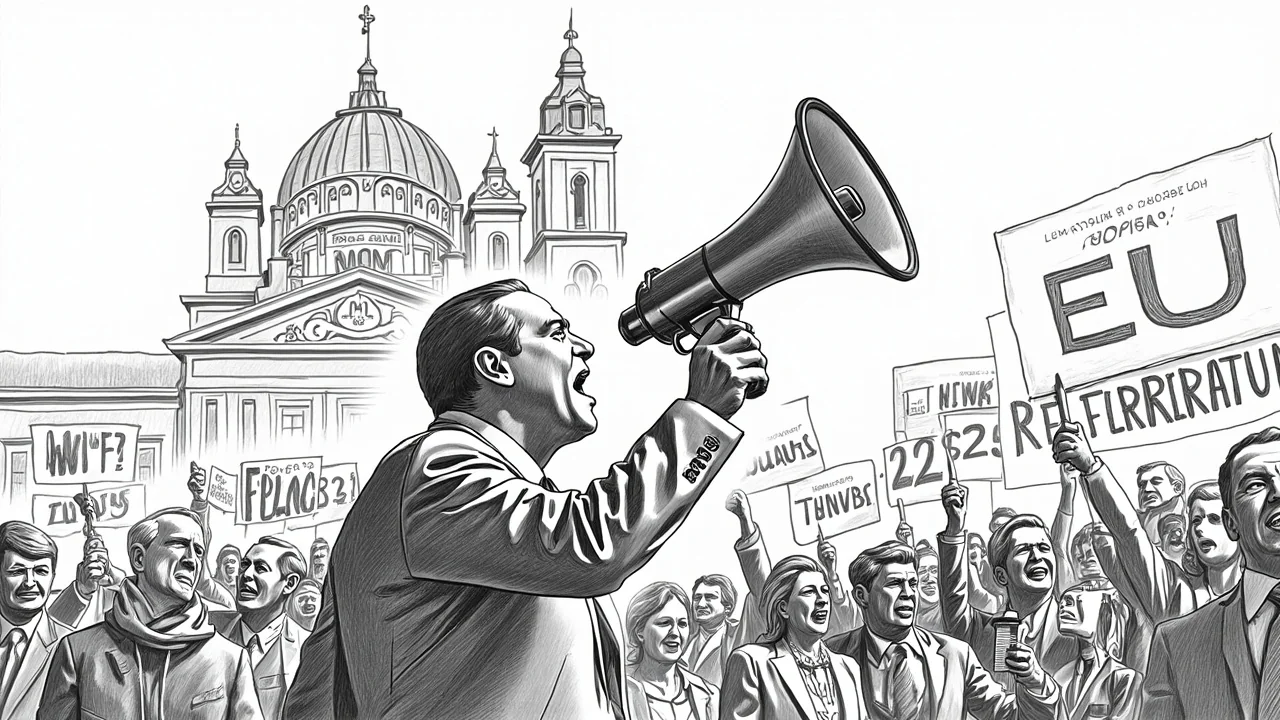
Will Norway finally join the European Union, thirty years after its last vote? Oslo Høyre, the capital's chapter of the Conservative Party, has voted to set a date for a new national referendum on Norwegian EU membership. The resolution, passed Friday night, aims to force the issue onto the national agenda ahead of the party's national conference in February.
Merete Agerbak-Jensen, the Conservative group leader in Oslo's city council, led the resolution effort. She argues that Norway's current relationship with Europe, governed by the EEA agreement, is becoming untenable. Her primary evidence is the political shift in neighboring Iceland, where the government aims to hold a vote on applying for EU membership by 2027.
“Norway should connect itself to the Icelanders' process as soon as possible, and set a date for an EU referendum before this parliamentary period is over,” Agerbak-Jensen said. This sets a clear deadline: a vote must be called before the current Storting term ends in September 2025.
The Core Argument for Change
Oslo Høyre's resolution outlines three main arguments for pursuing full membership: security and preparedness, influence where decisions are made, and equal conditions for Norwegian workplaces. The party contends that in a more uncertain geopolitical climate, exemplified by the war in Ukraine, Norway's security is directly tied to deeper European integration. They argue that the EEA agreement leaves Norway as a passive rule-taker from Brussels, without a seat at the table to shape the regulations its businesses must follow.
The economic argument focuses on a level playing field. Norwegian companies operating in the EU's single market face administrative hurdles and competitive disadvantages that firms within member states do not. Full membership, the resolution suggests, would eliminate these barriers and provide more stability for major industries.
A Historical Shadow and a New Catalyst
This push revives one of Norway's most divisive political debates. The country rejected membership in a 1972 referendum and again in 1994, when 52.2 percent voted against joining. For decades, the issue has been considered settled, with successive governments relying on the EEA agreement to ensure market access while officially remaining outside the political union.
The potential game-changer, as cited by Oslo Høyre, is Iceland. If Iceland, a fellow EFTA and EEA member, decides to pursue EU membership, it could fundamentally alter the structure of Norway's key European agreements. The EEA is built around a balance between the EU and the EFTA states. The departure of a key EFTA partner could force a renegotiation, potentially putting Norway in a weaker position. This external catalyst provides a new, practical rationale for reopening the membership question, moving beyond the ideological debates of the past.
The Rocky Road to a National Vote
While significant, the Oslo chapter's resolution is just the first step in a long and uncertain political process. The proposal must now be adopted by the Conservative Party's national conference in February to become official party policy. Even if successful, the Conservatives are in opposition. The current government is a minority coalition led by Labour Party (Ap) Prime Minister Jonas Gahr Støre, who has consistently opposed reviving the EU membership question.
Securing a parliamentary majority for a referendum would be a formidable challenge. It would require support not only from the Conservatives but likely from other center-right parties, while overcoming resistance from the Labour Party's left wing and steadfast opposition from the Centre Party (Sp) and the Socialist Left Party (SV), who are key government supporters. The populist Progress Party (FrP), a traditional conservative ally, is also historically skeptical of the EU, making a unified bloc difficult to assemble.
A Test for National Identity
Beyond the political and economic calculations lies a question of national identity. The 1994 referendum revealed a deep divide between urban and rural Norway, between the internationalist coast and the inward-looking inland. A new campaign would likely reopen these old wounds, testing whether three decades of globalization, European integration via the EEA, and generational change have shifted the underlying sentiment.
Younger voters, who have never known a Norway outside the European single market, may view the practical benefits differently than those who campaigned in the 70s and 90s. Yet, the emotional pull of national sovereignty remains powerful. The outcome would hinge on whether the new arguments around security, influence, and Iceland's move can overcome a deeply ingrained tradition of independence.
The move by Oslo Høyre is a bold attempt to break a national taboo. It sets the stage for a fierce internal debate within the Conservative Party and, potentially, the country. As Merete Agerbak-Jensen stated, the clock is now ticking on the current Storting period. Whether this spark ignites a national fire will be determined in the conference halls of the Conservative Party and, ultimately, in the hearts and minds of Norway's five million citizens. The shadow of 1994 looms large, but the map of Europe has changed.