
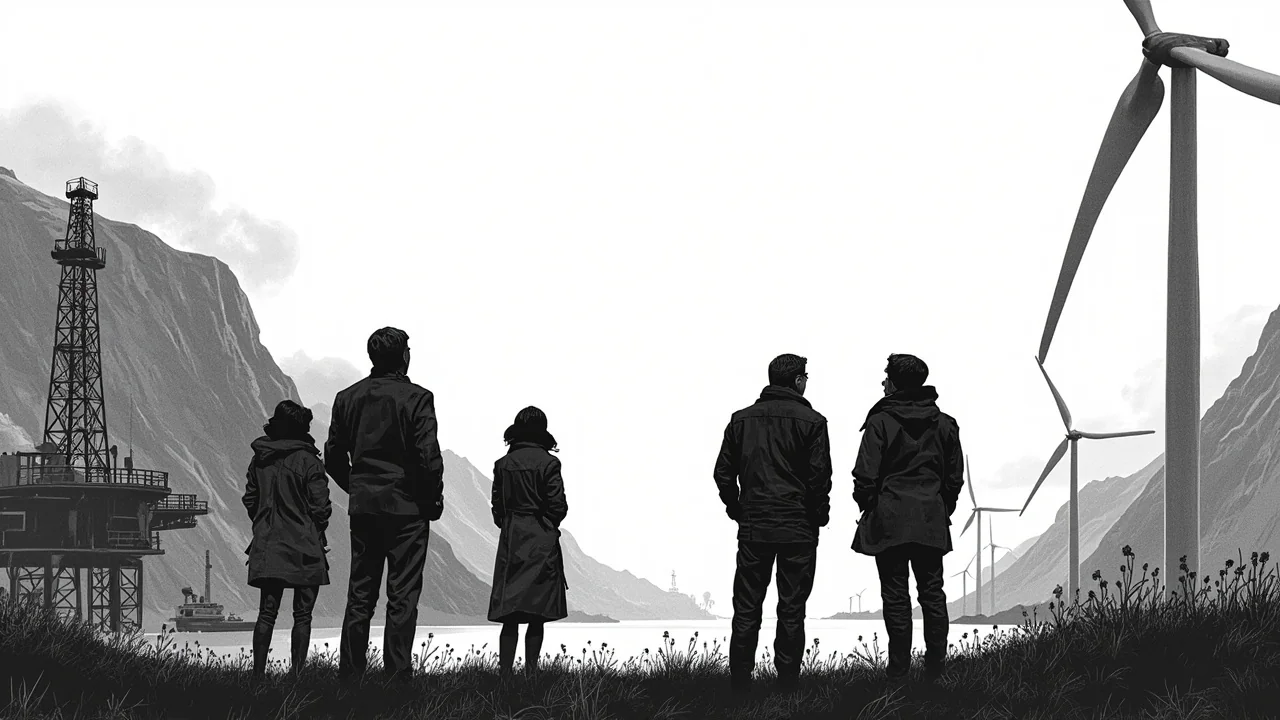
Norway's oil giants Equinor and Aker BP are preparing for a new chapter on the continental shelf, moving away from massive standalone projects toward smaller, faster developments. They plan to tackle the coming downturn not with new crisis packages but through a major push for increased efficiency and productivity.
“I believe we are facing a new chapter,” Equinor CEO Anders Opedal said. The era of huge, independent field developments is ending. With the start-up of the Johan Castberg and Yggdrasil areas, only the demanding Wisting project remains from that generation of megaprojects.
“Therefore, we are transitioning to being an industrial continental shelf, where we really have to work,” Opedal stated.
A Strategic Pivot for the Shelf
Both company leaders are clear that the industry itself must take responsibility for the next phase. The goal is to work smarter, not just to ask for government aid. “I think the continental shelf is about to change a little,” said Aker BP CEO Karl Johnny Hersvik. He confirmed that Wisting is likely the last major field development of the kind seen in recent years.
Going forward, the focus will be on numerous smaller subsea projects tied to existing fields and infrastructure. Hersvik estimates there are 4–5 billion barrels of oil equivalent to recover from tight reservoirs and high-pressure, high-temperature fields. “It is more challenging to make the economics work there than what we have had before,” he admitted.
The Drive for Productivity and Speed
This economic challenge is driving a profound operational shift. “Therefore, we have taken fairly clear action now to drive up productivity and accelerate project development and reduce the consumption of input factors as much as possible,” Hersvik explained. The strategy is about doing more with less, optimizing every part of the value chain to maintain profitability as the easy oil is depleted.
Equinor’s Opedal echoed this need for a fundamental change in approach. “We know that there are reserves, but it is about our ability to become more efficient and carry out faster developments,” he said. “This is about powerfully becoming more efficient.” He emphasized that the most important contribution from the government would be to announce new awards in pre-defined areas (TFO), which provide companies with access to new exploration acreage without a formal licensing round.
The Resource Reality and Industry Context
The backdrop to this shift is a changing resource base. Originally, there were about 69 billion barrels of oil equivalent in the fields developed on the Norwegian shelf. Now, roughly 14 billion barrels remain. The Norwegian Petroleum Directorate estimates that nearly 100 billion barrels could ultimately be recovered in total, with about 45 billion barrels still left, according to its 2024 resource report.
This transition follows a period of high activity supported by the oil crisis package of 2020, which led to a stream of major contracts. The Petroleum Directorate now anticipates a gradual slowdown. The industry's task is to manage this deceleration without a collapse in investment or employment.
The Path Forward for Norwegian Oil
The message from the top of Norway’s oil industry is one of controlled transition. The call for efficiency over emergency aid is a strategic declaration of independence and adaptation. As the shelf moves into this industrial phase, the measure of success will no longer be the size of the next giant field, but the ability to consistently and profitably unlock the next billion barrels from increasingly complex reservoirs. The coming years will test whether this new, leaner operational philosophy can successfully redefine maturity for one of the world’s most important offshore sectors.