
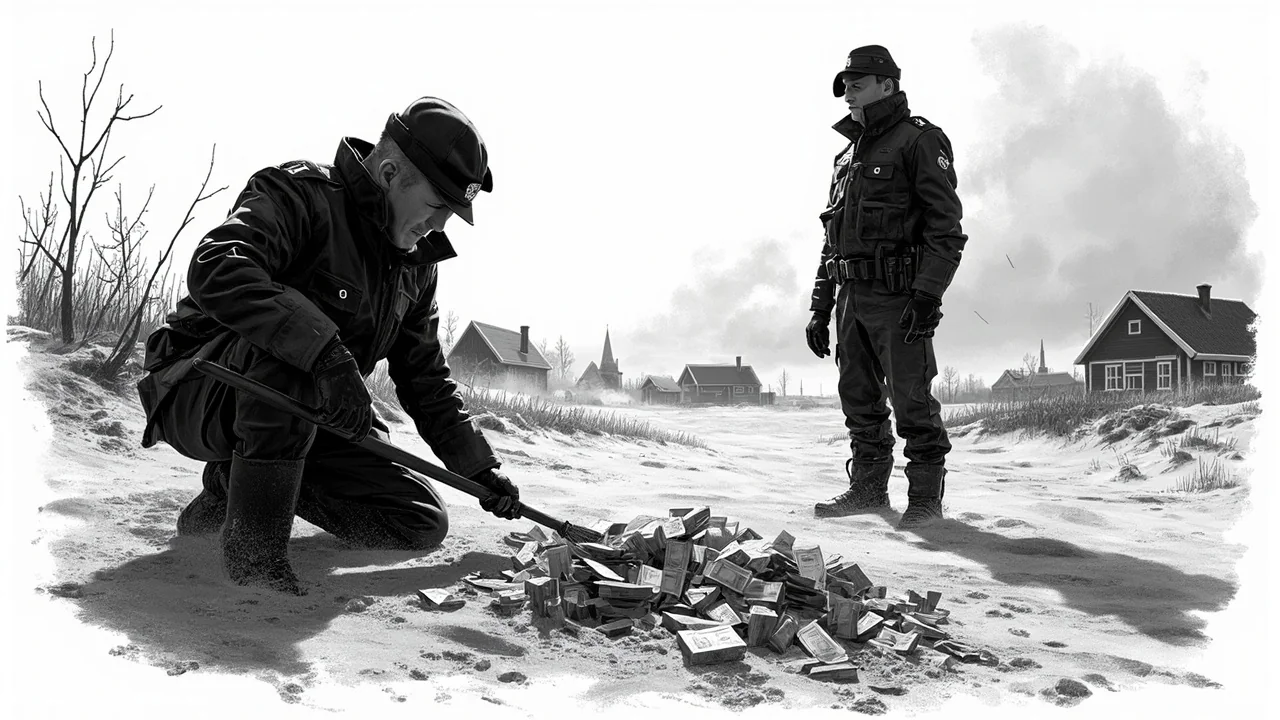
Norway police have concluded a major cash discovery in Sandnes does not originate from the infamous Nokas robbery. Investigators confirmed the 2 million kroner (approximately $185,000) found buried last week came from more recent criminal activity, closing one chapter in a long-running local mystery while opening another.
Police attorney Isa Linn Ravndal of the Southwest Police District announced the findings Tuesday. "The forensic examinations are now completed. The money has been counted, and the total sum is a little over 2 million kroner. Parts of the banknotes are of a more recent date, which means this is not money from the Nokas robbery," Ravndal said in a statement. The discovery was made around 2 PM last Tuesday during road expansion work on Oalsgata street.
A Street with a Criminal History
The location of the find, Oalsgata 74, has a documented history of concealed cash. In 2004 and 2013, police found a total of around 1 million kroner during searches of a house on the same property. That money was discovered in the possession of a man living in a first-floor apartment he did not own. The man, who died in 2017, had previous convictions. In both 2006 and 2015, courts found him guilty of storing significant sums of money proven to originate from criminal acts.
Police have not explicitly connected last week's larger find to these previous discoveries. However, the proximity and method of concealment—buried in the ground—strongly suggest a pattern. The property appears to have served as a long-term storage site for illicit funds, possibly managed by more than one individual over nearly two decades. This raises immediate questions about potential criminal networks operating in the Rogaland region and their methods of asset concealment.
The Enduring Shadow of Nokas
The initial speculation linking the money to the 2004 Nokas robbery was understandable. That audacious heist in Stavanger, just a short distance from Sandnes, remains one of Norway's most famous unsolved crimes in terms of its missing proceeds. Armed robbers attempted to steal cash from the Nokas cash depot, resulting in a police officer's death. While several perpetrators were caught and convicted, a substantial portion of the estimated 57 million kroner loot was never recovered.
The revelation that the Sandnes money features newer banknotes effectively rules out Nokas. This forensic detail is crucial. Norwegian banknote series have specific issue dates and security features. The presence of post-2004 series notes provides a clear timeline, indicating the buried cash is linked to criminal activity that occurred, or at least involved transactions, well after the famous robbery. This shifts the investigative focus squarely onto contemporary organized crime.
The Practicalities of a Cash Discovery
With the origin investigation ongoing, police now face administrative and legal procedures. A key question is the handling of the seized money. Ravndal confirmed authorities are working to clarify "whether a finder's reward shall be paid." Norwegian law has specific provisions for found property. If the rightful owner cannot be identified—which is likely given the criminal source—the finder may be entitled to a reward, typically a percentage of the value. The workers who discovered the money during municipal roadwork could potentially receive a significant sum.
The more complex issue is ultimate ownership. If police successfully prove the money is proceeds of crime through a legal forfeiture process, the state will claim it. These funds would then be directed into the state treasury. The process requires establishing a clear link to criminal activity, which may involve tracing serial numbers or linking the find to specific ongoing investigations. Ravndal noted it is still too early to say if DNA or fingerprints were found in connection with the money, evidence that could break the case open.
Analysis: Cash in the Digital Age
This discovery is a stark reminder that for all of Norway's advanced digital banking and traceable transaction systems, high-value physical cash remains the lifeblood of serious organized crime. Large bundles of banknotes are used to pay for illicit goods, launder profits, and create untraceable emergency funds. Burying cash is a primitive but effective method of storage, avoiding bank scrutiny and seizure from home raids. It represents a failure of the financial system to fully penetrate the shadow economy.
The repeated use of the same property in Sandnes suggests either remarkable criminal complacency or a belief in the security of the method. It indicates that certain locations are considered "safe" for such activities, possibly due to longstanding local networks or perceived lower police scrutiny. For law enforcement, the find is both a success and a challenge. Recovering 2 million kroner disrupts criminal operations, but the fact such a large sum was successfully hidden for an unknown period highlights the scale of the underground economy.
A Local Mystery with National Implications
While the Sandnes discovery is a local event, it reflects national trends in organized crime. The Norwegian National Criminal Investigation Service (Kripos) has repeatedly warned about the increasing sophistication and financial resources of criminal networks, particularly those involved in drug trafficking. The Rogaland region, with its major port in Stavanger and connections to international shipping, is a strategic location for importation and distribution.
The burial of cash also suggests a network with long-term planning. This is not money intended for immediate use; it is a stored asset, possibly a reserve fund or capital set aside for a major purchase. Its discovery may therefore trigger significant operational problems for the criminals involved, potentially leading to internal conflicts or desperate attempts to recoup losses.
What Happens Next?
The Southwest Police District's investigation now enters a meticulous phase. Forensic accountants will likely examine the banknote serial numbers, attempting to trace their circulation. Investigators will cross-reference the find with known suspects, previous seizures, and ongoing cases in the region. The history of the property and its former resident will be scrutinized for connections to active criminal figures.
The public announcement serves multiple purposes: it informs the community, manages speculation, and may prompt tips from the public. Someone may have knowledge of who used that property or who had access to the land. The police statement is deliberately measured, revealing just enough to be transparent while protecting the operational details of the ongoing probe.
For the residents of Oalsgata, the discovery is a unsettling revelation of criminal activity in their midst. For Norway, it is a tangible data point in the fight against financial crime. The 2 million kroner, now bagged and tagged as evidence, is more than just cash; it is a physical map leading back to the people who put it there. The challenge for police is to follow that map before the trail goes cold again. The buried treasure of Sandnes has been unearthed, but the real work of uncovering its story has only just begun.