
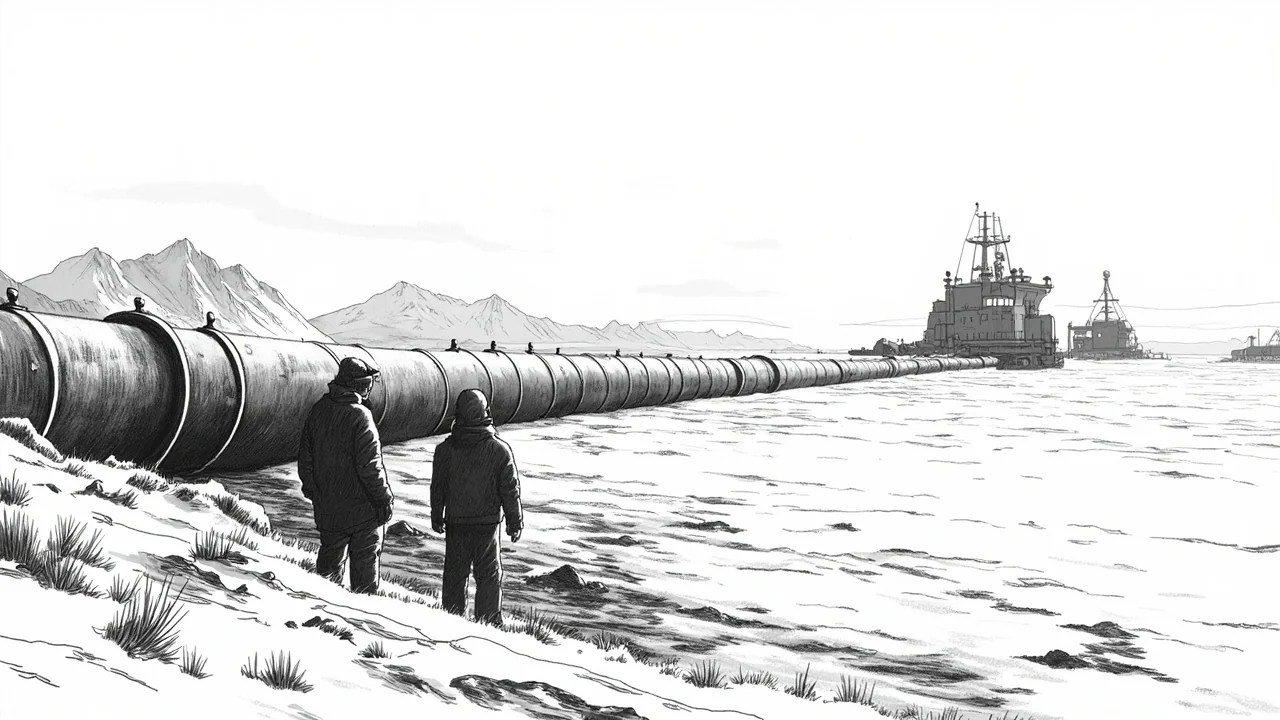
Norway's proposed 53 billion kroner gas pipeline from the Barents Sea lacks sufficient investor interest and has not passed the market test, Energy Minister Terje Aasland stated in a response to parliamentary questioning. The confirmation halts any near-term development of major new Arctic gas export infrastructure, reinforcing the market-driven approach of Norway's energy policy.
The Minister's Definitive Stance
Terje Aasland, representing the Labour Party (Ap), provided a written answer to SV party deputy leader Lars Haltbrekken, who sought updated cost figures and potential state subsidies. "There are not enough proven gas resources in the Barents Sea today for a pipeline southward to be found investable by the relevant license holders," Aasland wrote. He emphasized that such a solution has so far not passed the market test for new infrastructure development. The minister explicitly ruled out government financial support, stating, "The government has no plans to subsidize a potential gas pipeline, or other solutions to increase gas export capacity, from the Barents Sea." This positions the project firmly within the realm of commercial viability, dependent on private sector investment.
Cost Estimates and Commercial Hurdles
A 2023 study by Gassco, the state-owned pipeline operator, estimated the cost at 53 billion Norwegian kroner for a new gas processing plant (dew point plant) on Melkøya in Northern Norway and a pipeline to the Norwegian Sea. This infrastructure would allow gas from the Barents Sea to be transported to European markets. However, Aasland noted that no updated cost estimates exist. "Since there has not been sufficient interest among the companies with resources in the Barents Sea to proceed with concrete maturation of a project for increased gas export capacity, there are no updated cost estimates for a gas pipeline or other gas export solution," he explained. Analysts point to a fundamental resource gap. Industry sources state that an additional 400 to 500 million barrels of oil equivalent in gas reserves are needed to justify the economics of a pipeline southward from the Barents Sea.
Political Divides and European Context
The issue sits at the heart of a political divide in the Storting, Norway's parliament. A majority supports continued development of the Norwegian continental shelf, while smaller parties on both the left and right seek to halt new exploration or slow activity. Lars Haltbrekken expressed concern in his question that investments in new gas infrastructure could undermine Europe's push for clean energy. Minister Aasland countered this perspective directly. He pointed out that analysis environments expect Europe to need oil and gas for several more decades to ensure stable energy at acceptable prices. "The alternative to Norwegian deliveries would be higher imports to Europe of oil and gas from other parts of the world," Aasland wrote, framing Norwegian gas as a stable and preferable source for European energy security amidst geopolitical uncertainty.
The Resource Challenge in the Barents Sea
The central obstacle remains the volume of commercially recoverable gas. While the Barents Sea holds significant potential, discoveries to date, such as the Snøhvit field currently feeding the Melkøya LNG plant, have not reached the critical mass required for a standalone pipeline. Development in the remote Arctic region involves higher costs and technical challenges compared to fields in the North Sea. The market test Aasland references is a cold calculation by energy companies like Equinor and its partners, who must commit capital based on long-term price forecasts and reserve certainty. Without a substantial new discovery or cluster of discoveries, the pipeline project remains conceptual. This reality underscores the gradual pace of Arctic hydrocarbon development, where projects advance only when economics align.
Infrastructure and Future Pathways
The existing infrastructure at Melkøya processes gas from the Snøhvit field, exporting it as liquefied natural gas (LNG). A pipeline would represent a different export pathway, potentially offering higher capacity and direct ties to the European grid. The Gassco study outlined a route from the Barents Sea, tying into existing networks in the Norwegian Sea. However, the absence of "ongoing project activity" indicates that companies are not actively engineering or seeking approvals for such a link. The government's stance means any future movement would require the industry to first announce major new gas finds and then independently propose a development plan. This maintains Norway's tradition of state ownership and regulation of subsea infrastructure, but with development triggered by commercial demand.