
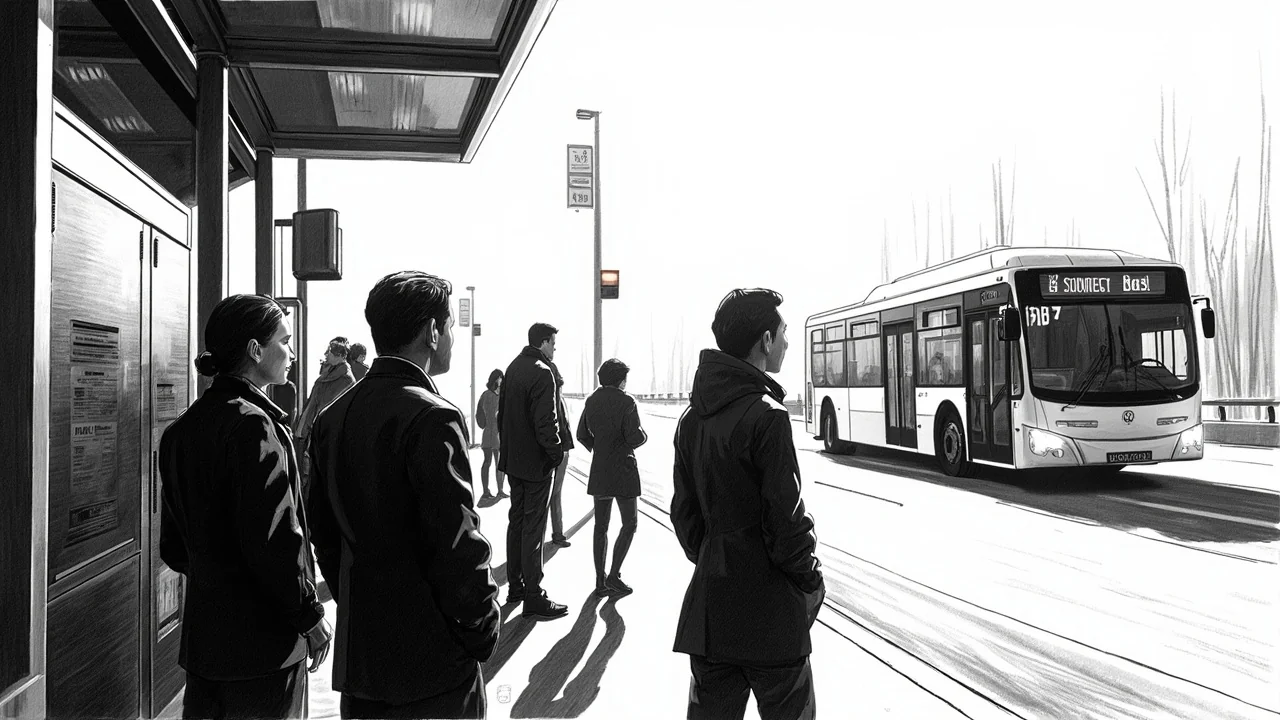
Norway's public transport authority Skyss insists bus drivers are 'not mind readers,' defending a policy urging clear hand signals that some passengers say excludes the disabled. The policy, intended to improve traffic flow, has led to incidents where drivers have driven past stops or publicly admonished passengers who failed to signal, creating what critics call a humiliating barrier to inclusion. This clash pits operational efficiency against the principles of universal design central to Norwegian transport policy.
The Core of the Contradiction
Skyss, which manages bus, boat, and tram services in Hordaland county, implements several inclusive measures. These include audio announcements of stops to help blind and visually impaired passengers navigate. However, standing in stark contrast to this inclusive design is the organization's clear instruction to passengers: raise your arm to signal the driver you wish to board. A Skyss press contact, Øyvind Strømmen, stated the rationale plainly. 'Bus drivers are among the everyday heroes of public transport, but they are not mind readers. If you don't clearly show that you want to get on board, either through a hand signal or in another way, you risk the bus driving past.'
Passenger Experiences and Practical Failures
In practice, this directive has created inconsistent and problematic outcomes. Passengers report that many drivers stop anyway when they see people at a stop, while others drive straight past—even on routes serviced by only a single bus line. The subsequent interaction can be fraught. It is not uncommon, according to passenger accounts, for drivers to scold passengers because they did not raise their arm in time. Such reprimands have reportedly been delivered over the bus's public address system, an act described as 'humiliating for those it affects.' Furthermore, drivers sometimes pull into a stop only to find the waiting individuals are not intending to board, a situation Skyss says creates minor delays and worse traffic flow.
Skyss's Official Stance and Justifications
The organization clarifies that a hand signal is not strictly 'required,' but describes it as a very common way to signal intent to board, a practice of many years both in Norway and internationally. 'It is therefore wise to signal clearly that you want to get on the bus,' Strømmen said. Skyss reinforces this message on its websites and through video clips on screens aboard vehicles. The agency stresses that it expects drivers operating on its contracts to be service-oriented. For passengers dissatisfied with their treatment, Skyss recommends contacting its customer service for follow-up. This positions the issue as one of clear communication rather than a flaw in policy, placing the onus on the passenger to make their intentions unmistakably known to the operator.
The Deeper Conflict with Universal Design
The heart of the criticism lies in Norway's strong commitment to universal design—the concept of creating environments and services accessible to all people, to the greatest extent possible, without the need for adaptation. The audio stop announcements are a prime example of this philosophy in action, aiding independent travel for the visually impaired. However, the expectation for a clear visual signal creates a direct obstacle for the same group. A person who is blind or has low vision cannot reliably know when a specific bus is approaching their stop to time a visual signal. They are dependent on the driver seeing them and interpreting their presence as a desire to board. The policy, as described, effectively makes their access contingent on the driver's individual decision to stop without a signal, which the policy simultaneously discourages. This inconsistency reveals a gap between the stated goal of inclusion and the practical implementation of efficiency-driven rules.
Navigating a Path Forward
The debate highlights a fundamental tension in modern public transport systems. On one side are the operational pressures for punctuality and smooth traffic flow, where clear passenger signals reduce unnecessary stops. On the other is the ethical and legal imperative for equal access. Skyss's current communications attempt to navigate this by promoting the hand signal as a strong recommendation rather than a strict rule, but passenger experiences suggest it is enforced as a de facto requirement by a significant number of drivers. The solution may not be a simple binary choice. It could involve enhanced training for drivers to better recognize and accommodate passengers who may not be able to give a clear visual signal, or the implementation of accessible, on-demand stopping buttons at bus shelters. For now, the situation remains unresolved, leaving some passengers in a frustrating limbo, uncertain if their presence at a stop will be enough or if they will be left behind, caught between the principle of inclusion and the practical reality that drivers, indeed, are not mind readers.
The Broader Implications for Norwegian Society
This is not merely a dispute about bus etiquette. It touches on larger questions about how Norway delivers on its celebrated promises of equality and accessibility. When a public service provider like Skyss establishes a guideline that inadvertently creates a barrier for disabled citizens, it forces a re-examination of priorities. Is the marginal gain in traffic flow worth the potential exclusion of vulnerable users? The conflict also tests the service orientation of the transport system. Drivers, as the frontline representatives, are placed in a difficult position, forced to interpret ambiguous situations quickly while managing schedules. The reported instances of public scolding, however, indicate a failure in service culture that no policy can justify. Ultimately, the Skyss signal debate serves as a microcosm of a universal challenge: building efficient systems that do not sacrifice dignity and access at the altar of convenience and speed. The answer will define what kind of public sphere Norway wishes to maintain.