
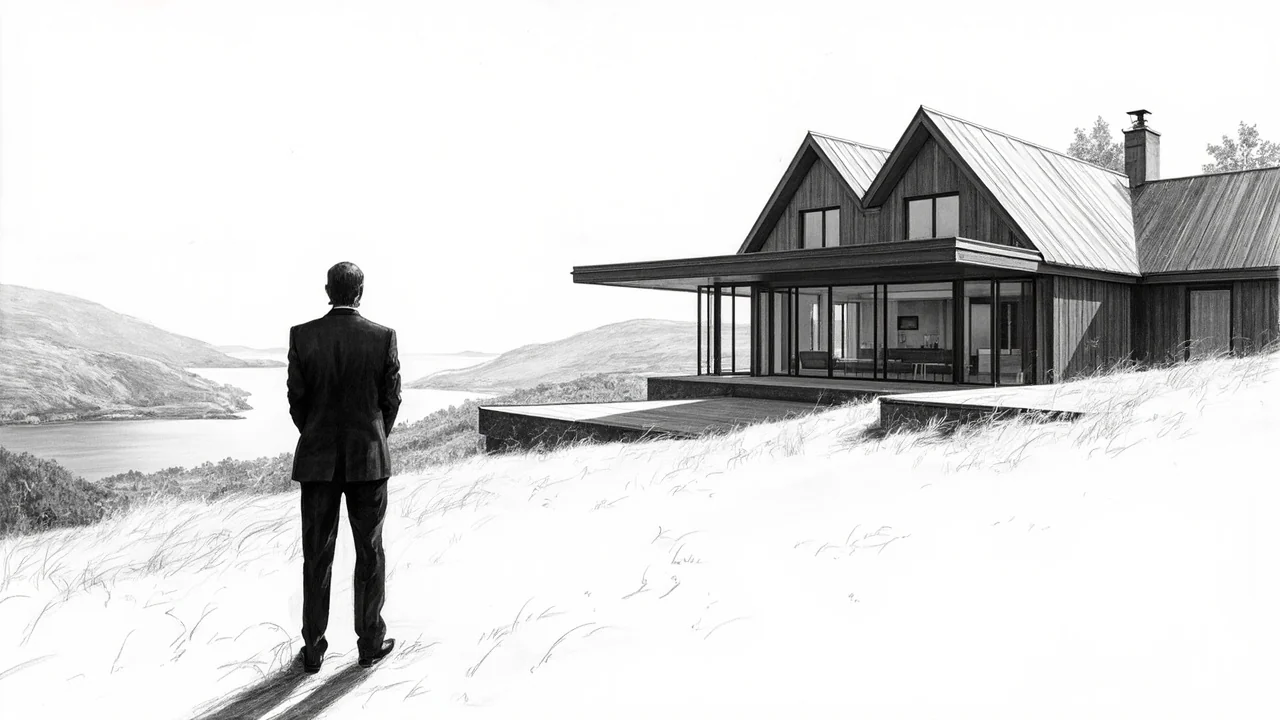
Norway's new property valuation model has sent tax bills soaring for owners of homes worth over 10 million kroner, but it still fails to capture the true value of the country's most exclusive estates. A stark analysis from Statistics Norway (SSB) confirms the system continues to significantly undervalue the very top tier of the housing market, raising questions about fairness in the wealth tax system.
Senior advisor Per Medby at SSB states the revised model provides clearly better estimates than the old one, even for expensive properties. Yet he confirms a critical flaw. "Analyses show the model still underestimates the very most expensive homes," Medby said. The core issue lies in the data. SSB identifies that the most expensive properties are under-represented on the housing portal Finn.no, which serves as a central data source for the model. These properties often sell off-market or through private channels, transactions that are not fully mapped in available data sources.
How the New Model Works
The updated model, implemented by the Tax Administration, aims for more accurate estimates of market value for primary residences. It represents a significant technical shift. Where the old model used municipality-level data, the new system divides Norway's 14,000 statistical tracts into roughly 1,200 calculation areas, separated by housing type. It relies on nationwide statistics on sales value and key characteristics of individual homes, such as type, size, and age. However, it cannot capture unique selling points of a specific property—its sunlight, renovation standard, or a panoramic fjord view—factors that command major premiums in the high-end market.
Furthermore, the model does not incorporate the declared sales price or consideration listed in the official Land Registry for transactions that do occur. This omission, confirmed by SSB, creates another gap in assessing the true sale value of luxury properties, where final prices can deviate wildly from listed asking prices.
The Skattebombe for Some, a Discount for Others
The model's launch has been dubbed the "skattebombe" or tax bomb for many affluent homeowners. With the wealth tax base calculated as a percentage of a home's assessed value, the updated figures have led to drastic tax increases for 2026. Many owners have seen their property's taxable value revised upward several-fold, leading to complaints about unattainable valuations. Yet the SSB analysis reveals an ironic paradox. While the model is creating a tax shock for homes in the multi-million kroner range, it is simultaneously giving what amounts to a systematic discount to the absolute pinnacle of the market—the secluded villas, historic mansions, and architecturally unique waterfront properties whose sales are rarely made public.
Medby notes the difficulty in quantifying the scale of this undervaluation. "It is difficult to quantify how large the effect is, as the extent of off-market sales and private trading is not completely charted in available data sources," he said. This lack of transparency is intrinsic to the luxury segment, where privacy and discretion are often part of the transaction.
The Road Ahead for Property Valuation
The Tax Administration's new model is a step toward more accurate and data-driven wealth assessment. However, the SSB's analysis serves as a crucial reminder of its limitations. As the debate over property taxes and wealth inequality continues in the Storting, the technical details of valuation models matter. They directly determine the distribution of the tax burden. For now, a segment of Norway's wealthiest homeowners continues to benefit from a systemic blind spot, while their neighbors in merely expensive homes face the full force of the updated calculations. The challenge for authorities is to close this gap without constructing a disproportionately intrusive apparatus. Can Norway's famed tax transparency be extended to its most secretive property sales?