
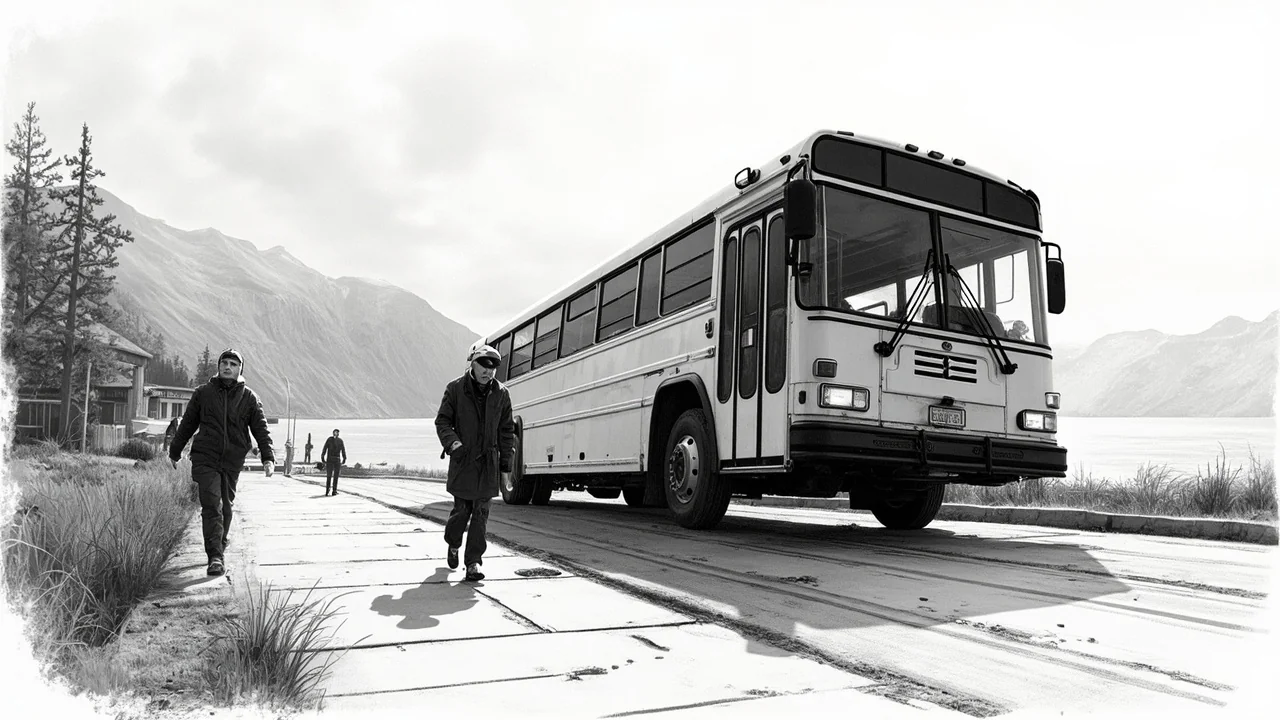
Norway's schoolchildren face a daily danger on a busy Sarpsborg route where public buses regularly drive on the sidewalk. Residents have filmed and reported the recurring issue to authorities for years, fearing a tragedy.
Heidi Elisabeth Vassgård filmed a recent incident. She watched a bus drive halfway onto the pavement along a road heavily used by children walking to Tindlund Barneskole. "It is not acceptable," Vassgård said. "If I had driven on the sidewalk, I would have lost my license. But the buses can drive there every day."
Her video sparked massive response on social media. Many claimed this happens frequently. Vassgård finds it strange that nothing has been done. She says it will be tragic if authorities only act after a child is hit.
"It does not help to be wise after the event if a child is run over on the way to school," she said. "It is simply tragic that no one is addressing this."
Parents and Neighbors Voice Alarm
Anne-Margrethe Gabrielsen lives on the street where the video was filmed. From her living room window, she sees buses using the sidewalk as a lane daily. "I think it is very scary," Gabrielsen said. "This is a school route for all of Greåker. There is a reason they built out the sidewalk, because many children walk there."
She notes the problem is worst during morning hours when many children are heading to school. Buses do not just briefly mount the curb to pass an obstacle. They continue driving along the pavement. Gabrielsen has alerted Sarpsborg municipality but feels her concerns have been ignored.
School Principal Sounds the Warning
The principal of Tindlund Barneskole, Dag Tjeldstad, confirms he has received a stream of worried messages from parents. He fully understands their frustration.
"I understand the parents' frustration who send small five-year-olds and six-year-olds to school," Tjeldstad said. "When you can risk that the bus comes onto the sidewalks. It goes without saying, that is not good."
The principal has taken action by contacting Østfold Kollektivtrafikk, the public transport company. He has expressed his deep concern directly to them.
Transport Company and Council Under Scrutiny
Østfold Kollektivtrafikk, the transport authority, responded to inquiries. As the client for bus services, they stated they expect and demand that driving is done in a safe and responsible manner. They did not comment further on the specific street.
Sarpsborg municipality has not commented on the repeated requests for a statement regarding this long-standing safety complaint. The lack of official response has fueled residents' anger and anxiety.
A Systemic Failure of Road Safety
The situation on this Sarpsborg street reveals a clear breakdown in road safety protocol. Sidewalks are sacred spaces for pedestrian protection, especially around schools. Norwegian traffic law is strict on this point, yet consistent violations are recorded and ignored.
Local residents have become de facto safety auditors, using phones to document hazards the municipality overlooks. Their videos provide undeniable evidence of routine risk-taking by professional drivers. The failure to act suggests a prioritization of traffic flow over child safety.
This is not a single blind spot but a documented pattern. The collective testimony from neighbors, the school, and visual evidence points to a normalized hazard. The standard procedure for a private driver committing the same violation would be a hefty fine and license points.
The disparity in enforcement is stark. It creates a perception that public transport operators operate under different rules. This erodes public trust in both the transport system and local government's duty of care.
The High Cost of Waiting for Tragedy
The core of the residents' argument is proactive versus reactive safety. They are pleading for intervention before a catastrophic accident, not after. History shows that road safety improvements often follow severe incidents, not the warnings that precede them.
This approach has an immense human cost. Parents should not have to fear a known, recurring danger on their child's walk to school. The stress and uncertainty imposed on families is a significant burden.
School zones demand the highest standard of caution. Traffic calming measures, clearer signage, or route adjustments for large vehicles are standard solutions employed elsewhere. Their absence here is conspicuous.
A Call for Accountable Leadership
The silence from Sarpsborg municipality is the loudest part of this story. Responsible governance requires acknowledging legitimate public safety concerns. Dismissing or ignoring the warnings of an entire community and its school leadership is a failure of accountability.
Østfold Kollektivtrafikk, as the contracting authority, also holds significant responsibility. They set the standards and expectations for driver behavior. They must investigate why their operators feel compelled or permitted to drive on sidewalks and rectify it.
Ultimately, this is a test of political and administrative will. Fixing this problem may require inconvenient or costly changes to road design or bus schedules. The alternative, as residents starkly warn, is potentially far more costly. Will officials act on the evidence before them, or will they wait for a tragedy to force their hand?