
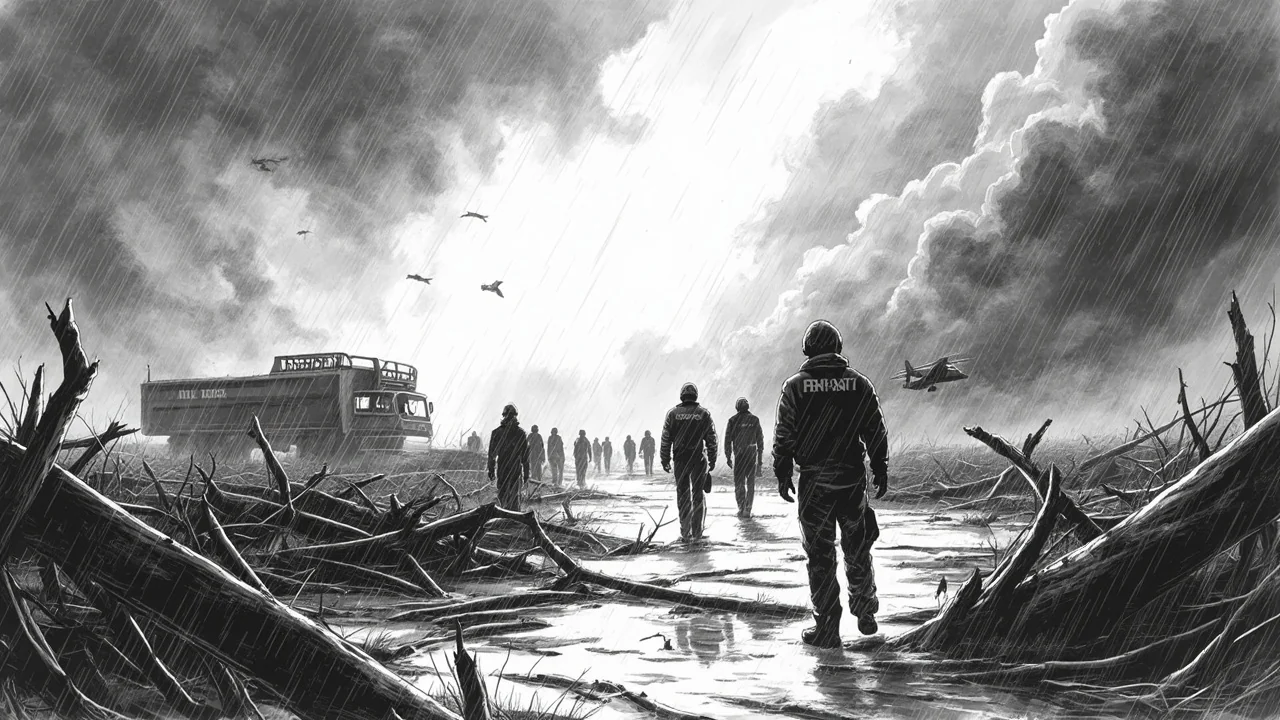
Norway's Vestlandet region faced a powerful wind storm Monday, with gusts reaching 55.9 meters per second at Folgefonna glacier. The severe weather caused flight cancellations, triggered emergency callouts, and led to a significant timber spill in a Bergen fjord. While no major incidents were reported, authorities warned of ongoing dangers as the storm slowly abated.
A Morning of Minor Emergencies
Bergen's fire service received its first significant call just after 8 AM. A construction site on Lars Hilles gate reported issues with scaffolding sheeting. "We have a vehicle out at Lars Hilles gate now, at a large scaffold on a bigger building," said acting watch manager Frode Eide. "The scaffolding is stable, but the sheeting on the front has come loose. It's flapping in the wind." Fire crews contacted the site workers, who were en route to secure the material. This call typified the morning's events—localized hazards amplified by the fierce winds.
Earlier, at 2:24 AM, firefighters were called to a car fire. A parked vehicle was fully engulfed in flames below some residential buildings. Crews extinguished the blaze within twenty minutes. "The car is completely burnt out," said police operations leader Morten Rebnord. Another car parked nearby sustained heat damage. The cause remains unknown, and police have opened an investigation.
Transport Disruption Across the Region
The storm's most immediate public impact was on air travel. Scandinavian Airlines (SAS) cancelled two Monday morning departures from Bergen to Stavanger. Several other flights experienced delays. Widerøe, the regional carrier, confirmed cancellations on the route between Bergen's Flesland airport and Florø. "That plane is unfortunately weather-bound at Hovden," explained Widerøe press officer Lina Lindegaard Carlsen, referring to the airport between Ørsta and Volda.
When asked about further cancellations, Carlsen highlighted the unpredictable conditions. "With this exact weather, we have learned we must make ongoing assessments. Suddenly a small pocket [of calm] can come that allows us to take off after all." The situation required continuous monitoring by airline operations teams.
Meteorological Force Behind the Chaos
Susanne Moen Olsen, the duty meteorologist at StormGeo, provided the forecast that grounded those planes. "The wind will continue for the next few hours and then subside," she explained Monday morning. "There is also sleet on the way, but it should let up by late morning." The data revealed a potent weather system. At 4 AM, a gust of 29.5 meters per second was recorded at Florida in Bergen.
That reading, however, was far from the storm's peak. "It's 38.6 meters per second average wind at Folgefonna, and 55.9 meters per second in a gust. That is the strongest wind in the country," Olsen stated. A sustained wind speed of 55.9 m/s qualifies as hurricane force. "It's blowing powerfully there, but we are talking about the top of Folgefonna then," she clarified, noting the extreme conditions were at high altitude on the glacier.
A Hidden Hazard in the Dark Fjord
Perhaps the most unusual incident occurred in Osterfjorden. Around 40 cubic meters of timber spilled into the water from the Eknes timber quay on the Alversiden of the fjord. Robert Sævereid, the duty harbor inspector for Bergen Port, explained a timber retaining structure had given way on Sunday. The darkness prevented any immediate recovery operation.
Sævereid issued a stark warning to boaters. "It's scary stuff. You don't see it in the dark." The floating timber poses a significant navigation hazard, especially for smaller vessels. Authorities must wait for daylight to begin the complex task of retrieving the logs from the fjord, a process that will likely take several days.
Analysis: Norway's Preparedness for Increasingly Common Events
While this storm passed without major injury or structural damage, it serves as a real-time test of Norwegian infrastructure and emergency protocols. Meteorologists note that such intense wind events, while not unprecedented, may become more frequent or intense due to changing climate patterns. The coordinated response—from meteorologists providing precise forecasts to harbor masters issuing warnings and transport operators making safety-first decisions—shows a system designed for resilience.
However, the incidents also highlight vulnerabilities. Construction sites must constantly review securing protocols for materials in high winds. The car fire, though of unknown origin, reminds residents of the increased risk of flying debris igniting or damaging property. The timber spill points to the need for regular integrity checks on industrial waterfront infrastructure, especially as weather patterns evolve.
The economic ripple is immediate for airlines and passengers but also extends to port operations and logistics. Every cancelled flight and delayed shipment has a cost. The response demonstrates a societal priority on safety over convenience, a calculation deeply embedded in Norwegian public policy.
Looking Ahead: Cleanup and Calmer Skies
The immediate forecast offers relief. Winds across Vestlandet were expected to decrease throughout Monday afternoon. Cleanup operations, particularly for the timber in Osterfjorden, will begin in earnest. Flight schedules should normalize as the low-pressure system moves on.
Yet the event leaves a question in its wake. As weather modeling improves, can response systems become even more proactive? Could AI-driven risk assessment of construction sites or port facilities before a storm hit prevent such callouts and spills? Norwegian tech startups in Oslo and Bergen are already developing sensor networks and predictive analytics for infrastructure monitoring. This storm provides a clear use case for their innovations.
For now, the focus remains on securing loose sheeting, retrieving logs, and getting travelers to their destinations. The wind will drop, but the lessons from a blustery Monday in March will linger much longer.