
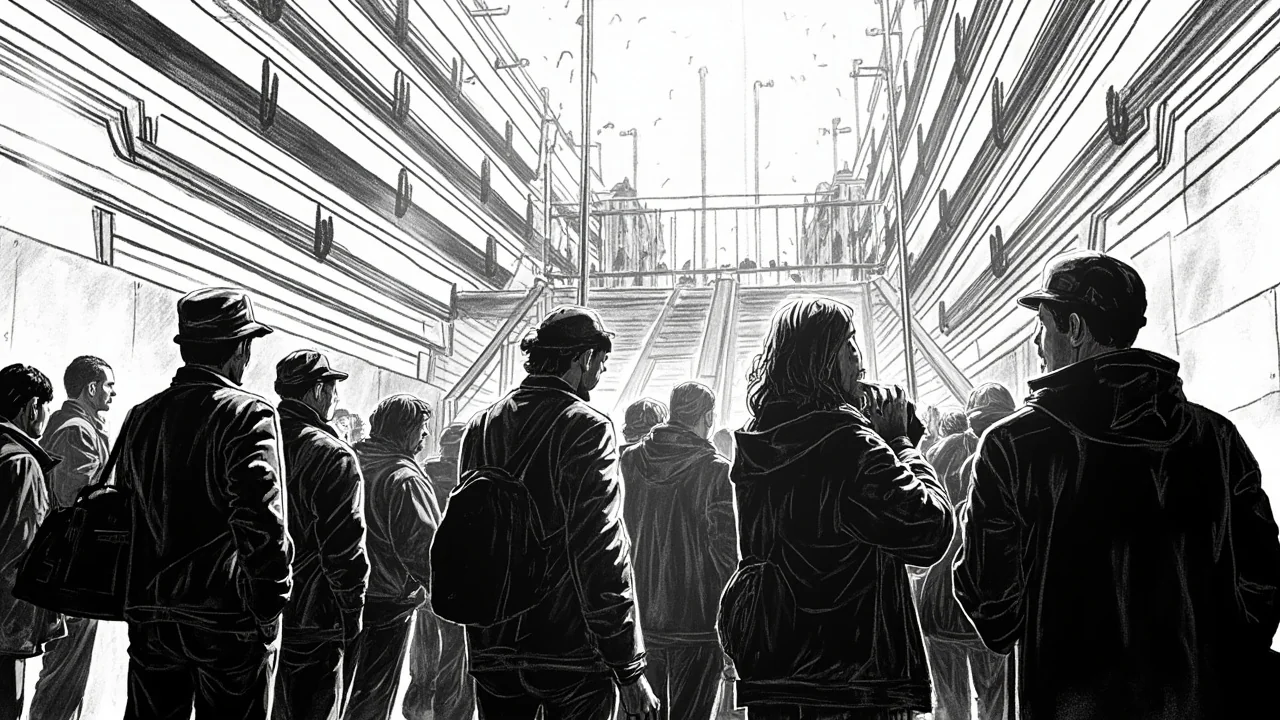
Norway's capital city faced a major transport crisis Tuesday morning when a single technical fault at Tøyen station brought the entire Oslo Metro system to a crawl. The disruption, which lasted through the peak morning rush hour, forced thousands of commuters to seek alternative transport or face significant delays across all five lines. By 8:30 AM, operator Ruter confirmed the fault was fixed, but warned that ripple effects would linger throughout the day.
For a city that prides itself on efficient public transport and punctuality, the system-wide failure was a stark reminder of infrastructure vulnerability. The incident highlights the interconnected nature of modern metro networks, where a single point of failure can have cascading consequences. Oslo's T-bane, which typically carries over 300,000 passengers daily, is the backbone of the city's mobility.
A Single Point of Failure
The problem originated at Tøyen station, a critical junction in eastern Oslo where multiple lines converge. Trains were forced to pass through the area at severely reduced speeds due to what Ruter's press officer, Øystein Dahl Johansen, described as a technical fault. He confirmed the issue was resolved by mid-morning. "The fault is fixed, and things are moving again," Johansen said. "There will likely be considerable delays that persist throughout the day."
This domino effect is characteristic of tightly integrated rail networks. When one section slows or stops, trains back up across the system, creating gridlock far from the original problem site. Commuters on the Lørenskog-bound Line 4, the Vestli-bound Line 5, and the Ellingsrudåsen-bound Line 2 all reported delays of 20 to 40 minutes during the critical 7:00 AM to 9:00 AM period.
The Commuter Experience
The human impact of the failure was immediate and widespread. Social media platforms filled with images of crowded platforms at major stations like Jernbanetorget, Nationaltheatret, and Majorstuen. Many passengers reported being packed into carriages, while others chose to abandon the T-bane entirely. This sudden surge in demand spilled over to Oslo's bus network, tram lines, and city bike stations, putting additional strain on alternative transport modes.
For a city government actively promoting public transport to reduce car traffic and meet climate goals, such disruptions are politically sensitive. They undermine confidence in the system and can push people back toward private vehicles. "When the metro fails, the entire city feels it," said Lars H. Andersen, a transport analyst based in Oslo. "This isn't just an inconvenience; it's a test of the public's trust in our collective transport strategy."
Systemic Vulnerabilities and Redundancy
The incident raises questions about network resilience and redundancy. Oslo's T-bane, while modern, operates with a high degree of interdependence. The focus at Tøyen suggests a signaling or track circuit fault, which are particularly disruptive at major interchanges. Unlike road networks where drivers can find detours, metro trains are confined to fixed tracks with limited options for rerouting.
Experts note that while building complete redundancy into every segment of a metro system is prohibitively expensive, critical nodes like Tøyen warrant special attention. "Investment in maintenance and modernization of key junctions is not glamorous, but it's essential," Andersen explained. "Today's event shows that preventing a single-point failure can be more cost-effective than managing the city-wide consequences."
Political and Operational Repercussions
The disruption arrives at a time when Oslo's city government, led by Mayor Anne Lindboe of the Conservative Party, is championing a car-free city center and massive investment in public transport, including the new Fornebubanen metro line. Opponents are quick to seize on such failures as evidence that the city is moving too fast, or that the existing network cannot handle current demands, let alone future growth.
Ruter and Sporveien, the municipal companies responsible for operations and infrastructure, will face scrutiny over their response protocols and communication strategies. The speed of the technical fix—within a few hours—will be weighed against the scale of the disruption. Transparency about the fault's exact cause and steps taken to prevent recurrence will be expected by both the public and political overseers on the city council.
Looking Beyond the Morning Rush
As the day progressed, schedules gradually normalized, but the event left a mark. It serves as a case study in urban vulnerability. For Oslo, a city expanding rapidly and investing billions in transit-oriented development, reliable public transport is non-negotiable. The economic cost of such a shutdown, in lost productivity and disrupted logistics, is substantial, though rarely calculated in full.
The true test will be in the follow-up. Will this be treated as an isolated technical glitch, or as a catalyst for a broader review of network robustness? In the age of climate urgency and urban densification, the metro is more than a convenience; it is a critical utility. Today's failure proved that when that utility falters, Norway's efficient capital grinds to a halt. The question for city planners is not if another fault will occur, but how the system will be strengthened to withstand it.